
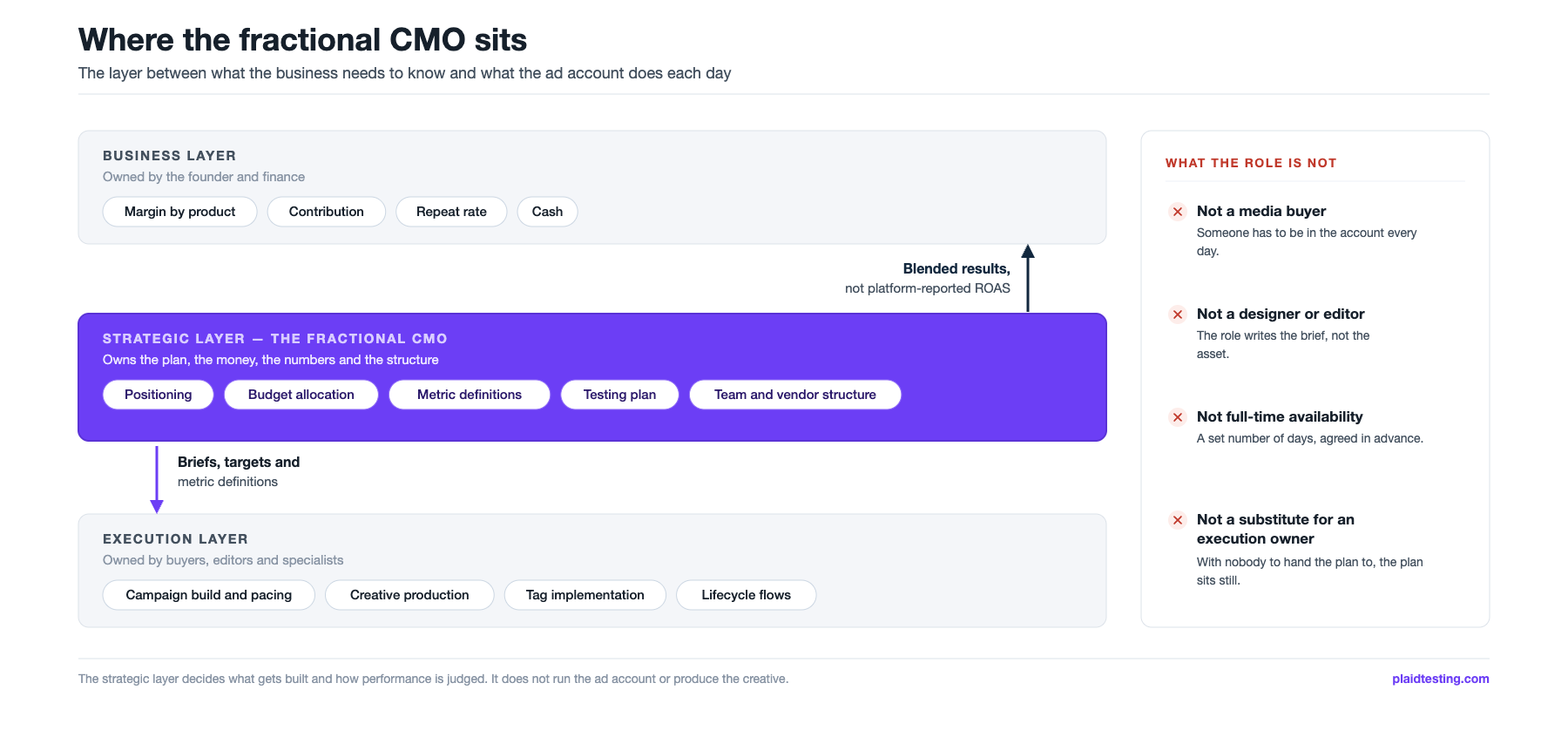
A fractional CMO owns marketing strategy, budget allocation, the measurement system and the hiring plan for a set number of days each month. The role decides what gets built and how performance is judged. It does not run the ad account, produce the creative, or replace the person who owns daily execution.
What does a fractional CMO actually own?
Four things, consistently: the plan, the money, the numbers and the structure.
The plan is positioning and the sequence of what gets built, in what order, for what reason. The money is allocation across channels, offers and retention, plus the decision to hold spend or move it. The numbers are the definitions the business steers by: what counts as a new customer, which ROAS is the one that matters, what margin assumption sits underneath the target. The structure is who does the work, in house or contract or partner, and what each of them is accountable for.
Some context on the seat itself. Spencer Stuart’s CMO Tenure 2026 study reports that 31% of S&P 500 companies have no chief marketing officer, across a study universe of 346 named CMOs of S&P 500 companies as of 30 June 2025. The same study puts the average tenure of S&P 500 CMOs at 4.1 years, against 5.0 years for all C-suite roles.
Those are large public companies, not ecommerce brands, and none of it proves anything about whether fractional work is growing. What it does show is that the senior marketing seat is genuinely being left empty at the largest companies in the country, and that the people who hold it do not hold it for long. The work does not disappear when the seat is empty. It gets distributed, usually to a founder and a media buyer who were not hired to do it.
Here is the scope in the form most founders actually need, with the boundary written down next to it.
| Area | What the fractional CMO owns | What stays with the brand or a specialist |
|---|---|---|
| Strategy and positioning | The offer, audience priority, category claim, the quarterly and annual plan | Product decisions, price approval, brand assets and trademarks |
| Budget | Allocation across channels and between acquisition and retention, monthly reforecast | Invoice payment, billing and card setup, finance sign off |
| Paid media | Spend targets, channel mix, spend ceilings, what a test has to prove before it scales | Campaign build, bidding, audience setup and daily pacing in Meta Ads Manager, Google Ads and TikTok Ads Manager |
| Creative | The brief, the concept map, the testing order, the kill criteria | Production, shooting, editing, design, asset delivery |
| Measurement | Metric definitions, the source of truth, the reporting cadence | Tag implementation in Google Tag Manager, platform configuration in GA4, Triple Whale or Northbeam |
| Lifecycle and retention | What email and SMS are for, the offer calendar, the segmentation logic | Flow build, list hygiene and sends in Klaviyo, Attentive, Postscript or Recharge |
| Team and vendors | Org design, the scope of each role, hiring and vendor selection | Employment, contracts, daily management of staff, support queues in Gorgias |
What is a fractional CMO not responsible for?
This is the part the top ranking pages leave out, and it is where most engagements fail.
A fractional CMO is not a media buyer. Someone has to be inside the account every day, checking pacing, pausing what is broken, building the next round of campaigns. That is a full time function at any meaningful spend level and the strategic layer above it does not replace it.
A fractional CMO is not a designer or an editor. The role writes the creative brief and decides what gets tested next. It does not produce the asset.
A fractional CMO is not a full time operator available at 11am on a Tuesday. The engagement is a set number of days, agreed in advance, with a defined escalation path for the things that genuinely cannot wait. Brands that expect standing availability end up disappointed by an arrangement that was never structured to provide it.
And a fractional CMO is not a substitute for someone who owns execution. If there is nobody to hand the plan to, the plan sits still.
The allocation question makes the boundary concrete. Gartner’s June 2026 marketing survey found that awareness and conversion account for 62.6% of total media spend, while loyalty and retention spending has fallen 29% since 2024, to under 15% of total media spend. Deciding whether that split is correct for your brand, your margin and your repeat rate is the fractional CMO’s call. Building the retention flows that follow from the decision is not.
A media buying agency is measured on the account, and a good one will beat an in house generalist on execution inside the platforms. That is a reasonable scope and it is not the same as being measured on the business, which is why the two can both be true at once: the account improved and the company did not.
What does a week with a fractional CMO look like?
A list of duties tells you very little. The shape of the week tells you what you are actually buying.
Most weeks have three or four fixed blocks. A numbers review early in the week, reading blended performance against the plan rather than platform reported results. An operating call with the owner and whoever runs execution, where decisions get made and written down. A creative review, working through what is in market, what is being briefed, and what gets killed. Then a monthly reforecast and a quarterly planning block that sit on top of the weekly rhythm.
Between those blocks the work is asynchronous. Written decisions in a shared document, so the reasoning survives a staff change. Answers to specific questions from the buyer or the lifecycle owner. Review of a landing page or an offer before it ships, not after.
Where do the hours go? Mostly to reading, deciding and writing, not to production. That surprises founders who expect a senior hire to be visibly busy in the tools.
The auction is the reason the weekly read matters. Meta’s Q4 and full year 2025 results, filed with the SEC on 28 January 2026, report that ad impressions delivered across the Family of Apps increased 18% year over year in Q4 2025 while the average price per ad increased 6% year over year in the same quarter. Costs move for reasons that have nothing to do with your account. Separating auction movement from account performance is a judgement call, and it is one of the few that cannot be delegated downward.
That read is only as good as the data feeding it, which is why tracking and attribution work almost always comes before any serious reallocation of budget. If you are not sure which of these blocks your brand is currently missing, a growth audit is a structured way to find out before you decide what the role should cover.
What should exist at the end of the first 90 days?
The first quarter is diagnosis, then definition, then the first deliberate reallocation. In that order. Anything that promises a transformed account in 30 days is describing a different job.
| Window | What exists at the end of it | What is deliberately not attempted yet |
|---|---|---|
| Days 1 to 30 | A written diagnosis: margin by product, contribution by channel, repeat rate, the current measurement setup and where it disagrees with itself. A single agreed source of truth. A list of what is broken, ranked. | No restructure of the ad account. No new agency or vendor. No hiring. Changing things before the baseline is agreed destroys the read. |
| Days 31 to 60 | Metric definitions everyone signs off on, a reforecast tied to margin rather than revenue alone, a creative testing plan with named concepts, and the first two or three reallocations with a stated hypothesis. | No channel expansion. No rebrand. No annual commitment to a new tool. |
| Days 61 to 90 | A quarterly plan with owners and dates, early results from the first reallocations, a gap analysis of the team, and a reporting pack the ownership team can read without translation. | No conclusions about creative strategy from a single quarter of data. No claim that the trajectory has changed. |
What should a brand not expect inside the first quarter? A step change in blended performance. Ninety days covers roughly one full creative testing cycle and one buying season at most, and part of that window is spent fixing the measurement that would let you see a change at all.
Budget reality shapes the plan. The Gartner 2026 CMO Spend Survey, a survey of 401 CMOs and marketing leaders fielded January to March 2026, found marketing budgets at 7.8% of company revenue in 2026, against 7.7% in 2025. The same survey found CMOs allocate 15.3% of marketing budgets to AI initiatives while only 30% report mature or fully developed AI readiness. Budgets are close to flat and a meaningful share of them is committed to capability that is not ready yet. A first quarter plan that depends on a bigger number is not a plan.
The 90 day sequence looks the same whether the work is done by a full time hire or through fractional CMO leadership brought in from outside the company. What changes is how many days of it you get each month.
How do you know whether the role is working?
By what the ownership team can see, and by whether the numbers agree with the bank account.
Platform reported ROAS is a channel level view. It answers whether the account is performing against its own attribution model. It does not answer whether the company made money, and those two questions come apart regularly. A CMO level view reports blended sales, contribution and margin, and it says out loud when growth in revenue has not turned into growth in profit.
With a womens fashion brand we work with, sales grew 99% while efficiency improved at the same time. ROAS was up 7.3%, new customer CPA down 21%, marketing efficiency ratio down 6.7% and new-customer ROAS up 58%. Net profit was up 136% and net margin improved 119%. Net margin is still around 3%. We report that openly, because it is the number that makes the rest of it credible, and it is exactly the kind of figure a CMO level view surfaces and a channel level view hides.
Cost of senior marketing capacity is worth understanding as market context. The US Bureau of Labor Statistics reports a median annual wage for marketing managers of $166,790 in May 2025. Gartner’s June 2026 survey puts labour at 24.5% of the total marketing budget in 2026, against 21.9% in 2025. Those figures describe the market for senior marketing labour generally. They are not a quote for any particular arrangement and they do not tell you which structure is right for your brand.
The honest test of the role is simpler than a dashboard. Six months in, does the owner know which products carry the margin, which channel is genuinely incremental, and what the next hire should be. If the answer is yes, the strategic layer is doing its job.
Common questions
Is a fractional CMO the same as a marketing consultant?
They overlap, and the difference is accountability. A consultant is usually engaged to produce a recommendation and hand it over. A fractional CMO holds the seat: the plan, the budget, the metric definitions and the team structure stay their responsibility while the engagement runs, and they are in the operating rhythm every week rather than presenting at the end of a project.
Does a fractional CMO replace our agency or our media buyer?
No. Execution still needs an owner, whether that is an in house buyer, a contractor or a media buying partner. The fractional CMO sets the targets, the channel mix and what a test has to prove, then reads the results at the business level. If anything, the role makes execution partners easier to manage, because the brief and the definition of success are written down.
How many days a month does the role take?
It depends on spend, channel count and how much is broken at the start. Diagnosis periods are heavier than steady state. What matters more than the number of days is that the days are committed and predictable, with fixed weekly blocks rather than ad hoc availability, and that there is a named escalation path for the small number of things that genuinely cannot wait a week.
What kind of brand does this actually suit?
Brands with real paid media investment behind them, typically $50,000 or more a month, where a bad allocation decision costs more than the role does. The model also assumes someone owns execution day to day. A brand with no buyer, no lifecycle owner and no creative resource usually needs those seats filled first, because strategy with nobody to receive it does not go anywhere.
When should we not hire one?
When the constraint is product, supply or cash rather than marketing. When there is no measurement at all and nobody willing to fix it. And when the owner is not ready to hand over decisions, since the role only works if the person holding it can actually redirect budget rather than recommend that someone else do it.
If you want a senior operator holding the strategic layer above your ad account, start with fractional CMO leadership and tell us what your current 90 day plan is missing.
Related reading
- How to Hire a Fractional CMO: Questions to Ask, Contract Terms and Red Flags — what to ask and what to put in the agreement
- What Is a Fractional CMO? An Ecommerce Founder’s Guide — the plain definition and where the model came from
- About Plaid Testing — who does this work and how
- All Insights