

Hiring a fractional CMO comes down to three documents: a scope that names deliverables, a contract that sets decision rights, access and exit, and a measurement definition agreed before work starts. Interview for operating experience over credentials. The agreement, not the interview, decides whether the engagement produces anything.
What are you actually buying when you hire a fractional CMO?
You are buying decisions, not hours. A fractional CMO sits above the ad account and owns the questions the account cannot answer on its own: what the brand is for, which customer is worth acquiring, what margin the business can defend, and where the next dollar goes. The work inside Meta Ads Manager and Google Ads is downstream of all of that.
The role exists because the full-time version is expensive, scarce and unstable. Spencer Stuart’s CMO Tenure 2026 study reports that the average tenure of S&P 500 CMOs is 4.1 years, against 5.0 years for all C-suite roles, and that 31% of S&P 500 companies have no chief marketing officer. That study covered 346 named CMOs of S&P 500 companies as of 30 June 2025. Budgets are not expanding to cover the gap either. The Gartner 2026 CMO Spend Survey, fielded January to March 2026 among 401 CMOs and marketing leaders, found marketing budgets at 7.8% of company revenue in 2026 against 7.7% in 2025.
Four provider categories sell the same job title, and they are not interchangeable. A solo independent operator gives you one senior brain and genuine continuity, and is capacity limited by definition. A boutique consultancy brings a bench and a documented method, and asks for more coordination from your side. A staffing marketplace matches you quickly and leaves the vetting with you. An agency with a strategy layer attached couples thinking to execution, which is efficient when the execution team is strong and awkward when the same party grades its own work. Decide which tradeoff you can live with before you start taking calls, because each category answers the questions below differently and all four answers can be legitimate.
What questions should you ask a fractional CMO before you sign?
Ask questions that force specifics. A senior operator will describe accounts, numbers and decisions they personally made. A weak candidate will describe categories of activity. The difference shows up inside two minutes if you ask for the room they were in rather than the outcome the company reported.
Ask them roughly in the order below. The first few establish whether the person has operated at your spend level and in your category. The middle group establishes how they work, what they will own and what they expect you to keep owning. The last group establishes what happens when something goes wrong, which is the part most hiring conversations skip and the part that decides how the engagement ends.
| Question | What a strong answer sounds like | What a weak answer sounds like |
| Which accounts have you personally run, and what did you own in the room? | Names platforms, spend level, and the specific calls they made. | Describes company outcomes without naming their own decisions. |
| What will you own in the first 60 days? | A short list of dated deliverables with named owners. | “Strategy” and “alignment”, with no artefact attached. |
| How do you measure performance above the platform? | Explains blended reporting, contribution margin and new customer cost per acquisition, and why platform-reported numbers differ. | Quotes platform ROAS as the single truth. |
| Which parts of the stack do you need, and by when? | Names Shopify, GA4, Google Tag Manager, Meta Ads Manager, Google Ads, Klaviyo and a blended reporting tool such as Triple Whale or Northbeam, with dates. | “Whatever you have is fine.” |
| What decisions do you expect to make without me? | Draws a clear line on budget shifts, creative approval and vendor changes. | Asks for full autonomy, or claims to need none. |
| How many other engagements do you carry, and how are my hours protected? | Gives a number and a fixed weekly cadence. | Avoids the capacity question. |
| Who executes the work you design? | Separates strategy from execution and says who does each part. | Blurs the two so neither can be checked. |
| What does your reporting look like, and who reads it? | Shows the actual structure and names the owner-level audience. | Offers a dashboard and no narrative. |
| What happens to the work if we stop in month four? | Describes documentation, handover and account ownership. | Has not considered it. |
| What have you got wrong recently, and what changed after? | A specific account, a specific lesson, a specific process change. | “Nothing comes to mind.” |
Two of those questions matter more than the rest. The access question tells you whether the person has run this before, because operators know exactly which permissions block week one. The month-four question tells you whether they are building something that survives them or something that only works while they are being paid.
A third signal is quieter. Listen to whether they ask you questions back. Someone who has run this before will want to know your margin structure, your repeat purchase rate and who currently owns execution, because those three answers change what the role can realistically achieve in a first quarter.
What belongs in a fractional CMO contract?
A fractional CMO contract fails in the same places every time: work that is described rather than named, authority that is assumed rather than granted, and an ending that nobody wrote down. The table below covers the clauses that decide whether the engagement functions. Treat the second column as the real specification, because vague language does not stay neutral, it resolves in favour of whoever wrote it.
| Clause | What it is | What goes wrong when it is vague |
| Named deliverables | The specific artefacts due, each with a date and an owner. | Work becomes availability, and you pay for meetings instead of output. |
| Hours or availability | Committed time per week or month, and how it is scheduled. | Your account gets the hours left over after louder clients. |
| Reporting cadence | Frequency, format and audience of the written report. | Reporting drifts to verbal updates that nobody can audit later. |
| Decision rights and spend authority | What they can approve alone, what needs sign-off, and the dollar ceiling. | Every change waits on a founder, or a budget moves that nobody approved. |
| Tool and account access with dates | Named platforms, permission levels, and the date each is granted. | Week one is spent chasing logins, and the ramp you paid for never happens. |
| IP and work for hire | Who owns creative, models, dashboards and documentation, in writing. | Ownership defaults away from you and the assets leave with the contractor. |
| Confidentiality | What is protected, for how long, and what happens to data on exit. | Customer and margin data sits in personal accounts indefinitely. |
| Notice period | How either side ends it and how much warning is required. | An exit becomes a negotiation at the worst possible moment. |
| Exit and handover | The documents, recordings and access transfers due in the final period. | Institutional knowledge leaves the building with one person. |
| How success is measured | The named metrics, their definitions, and the reporting source of truth. | Both sides claim they were right, using different numbers. |
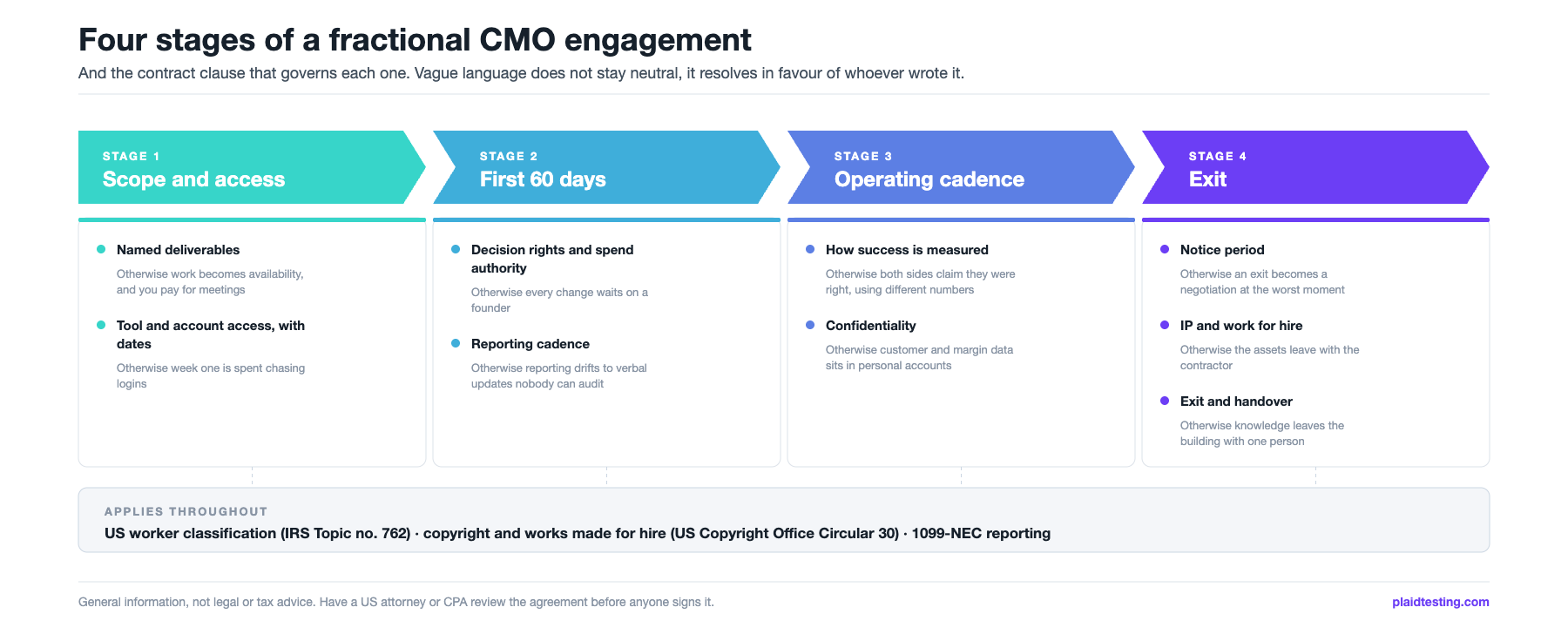
The last row is the one most engagements skip. Write the metric definitions down, including which tool is the source of truth, because blended and platform-reported figures will disagree and the disagreement always arrives during a bad month.
Here is what that looks like in practice. With a fashion apparel and accessories brand we work with, success was defined before spend moved: new customer cost per acquisition and new-customer ROAS were tracked throughout, while blended sales and margin were reported to the ownership team every cycle. Spend scaled 4x over the engagement. Sales rose 249% and net profit rose 205% year over year. The definitions written at the start are what made scaling spend that hard a defensible decision rather than an argument.
How the fee model changes behaviour
Three models dominate the market. A monthly retainer buys availability and continuity, and it hides how much time you actually receive. A day rate makes time explicit and pushes both sides toward billable work rather than the quiet thinking that produces the decisions you are paying for. A base plus a percentage of managed spend aligns the provider to growth, and it also rewards spending more, which is fine when margin is reported alongside spend and dangerous when it is not. For market context on senior marketing labour generally, the US Bureau of Labor Statistics puts the median annual wage for marketing managers at $166,790 in May 2025. That is a salary benchmark, not a fractional rate, and the two are not convertible. Plaid Testing does not publish rates. If you want a read on what your growth infrastructure needs before you price any engagement, a growth audit is a reasonable first step.
What do US classification, copyright and reporting rules change about the agreement?
Three pieces of US law shape how a fractional engagement behaves, and most hiring checklists skip all three. This is general information and not legal or tax advice, and a US attorney or CPA should review the actual agreement before anyone signs it.
The first is worker classification. Under IRS Topic no. 762, the IRS weighs three categories of evidence when deciding whether someone is an independent contractor or an employee: behavioral control, financial control, and the type of relationship between the parties. No single factor decides it. In practice that means a fractional agreement should describe outcomes and deliverables rather than dictating hours and methods, should be explicit that the provider carries their own tools and business expenses, and should have an end condition rather than running as an open-ended post.
The second is ownership. Under the US Copyright Office’s Circular 30 on works made for hire, a commissioned work by an independent contractor is a work made for hire only if it falls within one of nine statutory categories and there is a signed written agreement saying so. Absent that, the contractor owns the copyright by default. This is the clause that decides who owns the ad creative, the measurement model, the dashboards and the documentation when the engagement ends. If you are buying fractional CMO leadership and you expect to keep the assets, the ownership language has to be written in, not assumed.
The third is reporting. Under the One Big Beautiful Bill Act, the 1099-NEC reporting threshold for payments to non-employees rises from $600 to $2,000 for tax years beginning after 2025. That is a reporting-threshold change and nothing more. It does not change what anyone owes, and your finance team should confirm how your own filing process handles it.
Red flags
None of the following is proof of anything on its own. Each one is a signal worth a direct follow-up question before you sign, and two or three together usually mean the engagement will not hold.
- The proposal describes activities rather than deliverables. Activity is unfalsifiable, so you will have no basis to judge month three against month one.
- They will not name the accounts they have run or the decisions they owned. Senior operators remember the calls they made, because those are the parts that cost them something.
- Platform-reported ROAS is the only number in the deck. It ignores what the business actually banked, and it makes scaling decisions look like efficiency failures.
- There is no written notice period, or notice runs one way only. Asymmetric exit terms tell you who the agreement was drafted to protect.
- Access is requested as blanket admin with no list and no dates. Nobody who has run this before asks for everything at once, because they know which permissions gate which week.
- The contract is silent on who owns creative, models and documentation. Silence has a default outcome under US copyright rules, and it is not the one most buyers assume.
- They resist a handover clause or treat it as a sign of bad faith. An operator building durable infrastructure has nothing to lose from documenting it.
- Fees are tied to a percentage of managed spend with no margin reporting attached. The incentive points one direction and you will have no counterweight in the room.
- The answer to every scope question is yes. Someone who will not tell you what they do not do has not decided yet.
Common questions
Is a fractional CMO an employee or an independent contractor?
That depends on how the relationship actually runs, not on the title on the invoice. IRS Topic no. 762 weighs behavioral control, financial control and the type of relationship, and states that no single factor decides it. Write the agreement around outcomes, keep methods and schedule with the provider, and have a US attorney or CPA review it. This is general information and not legal or tax advice.
How long should a fractional CMO contract run?
Long enough to see a full measurement cycle and short enough to exit cleanly. Most ecommerce engagements need at least one quarter before the reporting changes are trustworthy, since tracking fixes, creative production and channel shifts all take time to show up in blended numbers. Set an initial term, a review point with named criteria, and a notice period that works in both directions.
Who owns the ad creative and dashboards when the engagement ends?
Whoever the contract says, and if the contract says nothing, the contractor owns it by default. The US Copyright Office’s Circular 30 explains that a commissioned work qualifies as a work made for hire only if it falls within one of nine statutory categories and there is a signed written agreement stating so. Name the assets explicitly: creative files, measurement models, dashboards, documentation and process recordings.
Should fees be tied to a percentage of ad spend?
It can work, and it needs a counterweight. A percentage of managed spend rewards growth, which is the point, and it also rewards spending more regardless of what the spend returns. If you use that model, require margin and blended sales reporting to the ownership team in the same document as the spend number, so both sides are looking at the same picture.
If you want a senior operator sitting above the ad account with the scope, decision rights and measurement written down before work starts, that is what fractional CMO leadership is built to do. Start there, and bring your current contract draft to the first conversation.
Related reading
- What Does a Fractional CMO Actually Do? Scope and 90 Days — what the role owns before you write it into a contract
- How Much Does a Fractional CMO Cost in 2026? — how the fee models compare in practice
- When to Hire a Fractional CMO: 7 Signals Your Ecommerce Brand Is Ready — whether now is the right moment
- All Insights