

A fractional marketing director is a part-time senior marketer who turns an agreed strategy into a working plan and manages the people who carry it out. Most engagements run $5,000 to $10,000 a month for roughly 10 to 20 hours a week (GoFractional, 2 September 2026). A fractional CMO sits one level up and sets the strategy itself.
What does a fractional marketing director do?
A fractional marketing director owns delivery of the marketing plan across channels. In an ecommerce brand that means turning the quarter’s goals into a calendar of launches and promotions, writing briefs for media, creative and email, running the weekly results review, and making the small calls that keep work moving: which launch slips, which test gets another week, which freelancer gets more scope. Between leadership meetings, the executors answer to the director.
SparkToro argued in a March 2023 essay that many companies are better served by a fractional marketing director than a fractional CMO, and described the director as “a tactical strategist, not someone you hire for the grand, chief-level vision” (SparkToro, 14 March 2023). That is fair: a good director thinks strategically, but inside a frame someone else has set, covering budget, channel mix, target customer and required margin.
What sits outside the director’s remit matters just as much. The budget split between channels, the measurement system, offer and pricing strategy, and the marketing hiring plan are chief-level calls, whoever makes them. A director is not the media buyer either. The daily work inside Meta or Google belongs to a specialist, and a director who lives in the ad account has stopped directing. The same seat is sometimes sold as a fractional VP of marketing, so judge any offer by scope and reporting line rather than the label.
Fractional marketing director vs fractional CMO: where is the line?
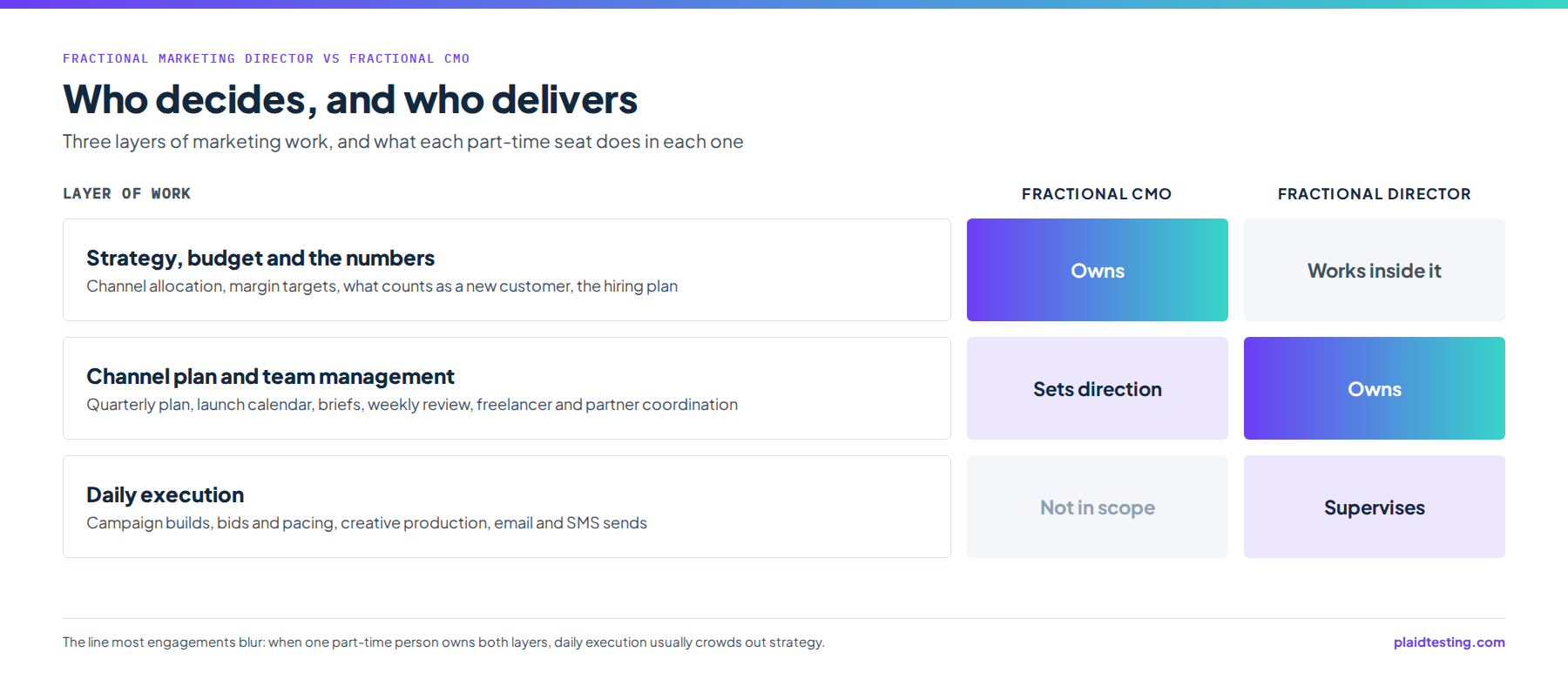
The quickest test is who decides and who delivers. A fractional CMO decides where the money goes, how performance is judged and which roles the marketing function needs next. A fractional marketing director delivers the plan that follows from those decisions and manages the people doing the work. When one part-time person does both, strategy usually loses, because execution problems are louder and arrive every day.
| Question | Fractional marketing director | Fractional CMO | Full-time marketing director |
|---|---|---|---|
| What does the seat own? | Delivery of the plan: calendar, briefs, weekly review, partner coordination | Strategy, budget allocation, the measurement system, the hiring plan | Delivery of the plan, plus daily management of an in-house team |
| Which decisions are theirs? | Priorities and trade-offs inside the agreed budget and channel mix | The budget split, targets, which numbers count, which roles to add | As the fractional director, with more say over hiring below them |
| Typical time | Roughly 10 to 20 hours a week, per GoFractional | A set number of days each month, agreed up front | Full time, on payroll |
| Who do they manage? | Media buyers, creative partners, email and content freelancers, sometimes a small staff | The director or lead executors, and the partner mix as a whole | An in-house team, plus outside partners |
| How is success judged? | Work shipped on the agreed dates, tests read and acted on, clear weekly priorities | Profit, contribution margin, new customer growth, numbers the business trusts | Plan delivery and team performance over a longer horizon |
| Who do they report to? | The founder, the CEO or a CMO | The founder, the CEO or the board | A CMO, the CEO or the founder |
The line shows up in three places. Budget: a director can move money between campaigns inside a channel, but shifting budget between Meta, Google, email and retail is an allocation decision with margin consequences. Measurement: a director reports the numbers, while a CMO decides which numbers the business steers by and what happens when a platform and the store disagree. People: a director manages the current executors, while a CMO decides whether the brand needs another in-house hire, a different partner or neither. Our fractional CMO service is built around those three calls.
The outcomes each seat answers for differ as well. At a heritage fashion brand we work with, net profit rose from $362,213 in Q1 2025 to $3,662,841 in Q1 2026 (January to March, year over year), per its Triple Whale account. Profit, after media and product costs, is the kind of result a CMO-level seat is accountable for, while a director’s scorecard sits closer to the work, such as launches shipped on time and tests read on schedule. The figure does not prove that marketing alone caused it: product, pricing and inventory decisions moved that number alongside media, and no holdout test isolated a single cause.
What does a fractional marketing director cost in 2026?
GoFractional reports observed director rates of roughly $80 to $250 an hour (GoFractional, 2 September 2026). Annualized, its $5,000 to $10,000 monthly range comes to $60,000 to $120,000 ($5,000 and $10,000 multiplied by 12), and if the low fee pairs with the low hours, both ends imply about the same hourly rate. Ten hours a week is about 43.3 hours a month (10 × 52 weeks ÷ 12), and $5,000 divided by 43.3 is about $115. Twenty hours a week is about 86.7 hours a month, and $10,000 divided by 86.7 is also about $115.
| Seat | Published figure | Annualized (inputs shown) | What the figure leaves out | Source |
|---|---|---|---|---|
| Fractional marketing director | $5,000 to $10,000 a month; roughly $80 to $250 an hour | $60,000 to $120,000 ($5,000 and $10,000 × 12) | The executors the director manages | GoFractional, 2 September 2026 |
| Fractional CMO | $150 to $500 an hour, or a $4,000 to $20,000 monthly retainer | $48,000 to $240,000 ($4,000 and $20,000 × 12) | Execution, unless the engagement includes a team | GoFractional, 12 August 2026 |
| Full-time marketing director | Median $194,832; 25th to 75th percentile $179,521 to $208,964 | Already annual | Benefits, payroll taxes, recruiting, equity | Salary.com, 1 September 2026 |
| Marketing managers (all industries) | Median $166,790 | Already annual | Benefits and payroll taxes; a broad federal category, not ecommerce specific | US Bureau of Labor Statistics, May 2025 wages |
| Advertising and promotions managers | Median $133,660 | Already annual | Benefits and payroll taxes; a broad federal category | US Bureau of Labor Statistics, May 2025 wages |
| Full-time CMO | Median $374,184 | Already annual | Benefits, payroll taxes, recruiting, equity | Salary.com, 1 September 2026 |
The in-house comparison is a full-time marketing director at a US median of $194,832 (Salary.com, 1 September 2026), or $166,790 for the broader marketing manager category (US Bureau of Labor Statistics, May 2025 wage data). Both exclude benefits, payroll taxes, recruiting fees and equity. GoFractional claims the fractional route costs roughly half of a full-time hire once benefits, payroll taxes and equity are counted; that is a vendor’s claim, so test it against your own offer letter.
At the chief level, GoFractional puts a fractional CMO at $150 to $500 an hour or a $4,000 to $20,000 monthly retainer (GoFractional, 12 August 2026), against a full-time median salary of $374,184 (Salary.com, 1 September 2026). The fractional ranges overlap, so the fee alone will not reveal which seat you are buying: one proposal buys hours of coordination, another at the same price buys allocation and measurement decisions. Read the scope, then see our breakdown of fractional CMO pricing models.
Pricing a director against a CMO-level seat is easier once you know which gap is costing more. Our free 30 minute growth audit reads your tracking and account structure before anyone talks about fees.
Which one does an ecommerce brand need at your stage?
Read stage from team shape and ad spend, not revenue. Two brands with equal revenue can need different seats: one has a clear plan and scattered freelancers, the other a capable team and an untested plan. The table uses $50,000 a month in paid media as the dividing line because that is where the brands we work with start.
| Your situation | Spend and team shape | The gap that hurts most | Usually the better first buy |
|---|---|---|---|
| Founder-led, early paid growth | Under $50,000 a month in ad spend, one main channel, founder plus freelancers | Execution hours and focus | A strong channel specialist; a senior seat is early |
| Plan works, delivery is scattered | $50,000 a month or more, a clear plan, several freelancers or partners and nobody coordinating | Calendar, briefs, follow-through | Fractional marketing director |
| Growth stalled or margin shrinking | $50,000 a month or more, capable executors, platform numbers that disagree with the store | Allocation, measurement, offer | Fractional CMO, working with the existing executors |
| Complex business, thin leadership | Several paid channels plus retail or marketplaces, a small in-house team, investor reporting | Leadership, hiring plan, budget defense | Fractional CMO now, with a director or in-house manager running delivery |
| Chief-level seat already filled | A full-time CMO, or a founder doing that job well | Delivery capacity | A director, fractional or full time, reporting to that person |
Four decision rules sit behind the table. First, if you cannot write one page on where next quarter’s budget goes and why, you need the chief-level decision before anyone executes. Second, if the plan exists but launches slip and partners work in separate lanes, a director is the cheaper and better fix. Third, if the platforms and the store disagree, fix measurement first, because a director can report the disagreement but lacks the mandate to settle it. Fourth, below $50,000 a month, the constraint is often execution hours, and one strong specialist may do more than either senior seat.
Plenty of large companies run without a chief marketing officer: Spencer Stuart found that 31% of S&P 500 companies have no CMO, and that those holding the title average 4.1 years in the role (Spencer Stuart, January 2026). The chief-level decisions still have to be made by someone there, whether a CEO or another commercial leader. A founder-led brand works the same way if the founder genuinely makes those calls. Whether the chief seat should later go full time is covered in our comparison of fractional and full-time CMOs.
How do you hire a fractional marketing director well?
Write the scope before you speak to anyone. One page is enough: what the director owns, which decisions they can make without asking, how much budget they can move inside a channel, who reports to them and who they report to. Without it, a brand hoping for a CMO pays for a coordinator, or a brand wanting a coordinator gets a strategist who rewrites the plan.
Interview for ecommerce specifics. How did they plan a promotion calendar around short inventory? What did they do when returns ate into a campaign’s margin? Ask what they cut from the last plan they ran, and why. Our guide to interview questions and contract terms for fractional hires was written for the chief-level seat, and most of it applies here with the scope narrowed.
Settle the reporting line early. A director reporting to a founder with no time for decisions ends up acting as a CMO without the mandate. If nobody above the director will own allocation and measurement, either the founder commits to that role or the brand adds a fractional CMO who owns strategy and budget above the director.
Finally, agree how the first month ends: a written read of the current plan and team, a calendar for the next quarter and a short list of work that should stop. Keep every ad account, analytics property and creative file in the brand’s name, and ask for a written weekly update so progress is visible without extra meetings.
When is a director the wrong hire?
A director is the wrong hire when the strategy is the problem. A capable director will deliver a flawed plan efficiently, which makes the flaw more expensive. Warning signs include spend rising while profit is flat, and every channel reporting a good return while the bank balance disagrees.
It is also the wrong hire when there is nobody to direct. With no media buyer, creative partner or email lead in place, a director becomes a senior executor paid director rates. Hire the specialist you are missing instead, or buy a team that brings the executors with it.
Measurement is the third case. If nobody trusts the numbers, a director will report them faithfully and the business will still be steering blind. Fixing that means choosing the source of truth, agreeing how platform figures are read against the store, and deciding what gets tested for incrementality. That is chief-level work, done alongside a tracking specialist.
Budget pressure pushes some brands toward the cheaper title, and it reaches the top: in Gartner’s 2026 CMO Spend Survey, 56% of CMOs said they lack the budget to deliver their 2026 strategy (Gartner, 11 May 2026), though its 401 respondents were mostly at companies above $1 billion in revenue. Buy the capability you are missing, not the title that fits the budget. The reverse holds too: when delivery is the only gap, a fractional CMO is an expensive way to buy coordination.
Not sure whether your gap is the plan or the people delivering it? Book a free growth audit with us. We check the tracking first, look at how your accounts are built, and hand back three fixes; no retainer is needed to start.
Common questions
Is a fractional marketing director the same as a fractional VP of marketing?
Often, but no standard definition exists. A VP title sometimes carries more budget authority and a seat in leadership meetings, which moves it toward a chief-level role. Ask who sets the budget split between channels, who decides which numbers count, and who manages the people doing the work. Those answers tell you which seat you are buying.
How many hours a week does a fractional marketing director work?
GoFractional reports roughly 10 to 20 hours a week for most engagements (GoFractional, 2 September 2026). The lower end suits a brand with one or two channels and settled executors. The upper end suits a heavy launch calendar or several outside partners. Well below that range, the role drifts into advice rather than direction, because there is too little time to run the weekly rhythm.
Can a fractional marketing director manage an outside agency or freelancers?
Yes, and coordinating outside partners is a core part of the role. The director sets priorities, approves briefs and holds partners to agreed dates, while each partner keeps running its own accounts. Put in writing that the director speaks for the brand on priorities. One caution: the director should not be employed by a partner they manage, since that makes an honest review difficult.
Can we start with a director and add a CMO later?
Yes, if the plan the director inherits is sound. The risk is order: under a flawed strategy you pay a director to execute it well, then pay again to change course. When the strategy is uncertain, set allocation and measurement first, then add a director for delivery. Our guide to what a fractional CMO does in the first months covers that first seat.
Related reading
- What Does a Fractional CMO Actually Do? Scope and 90 Days: the chief-level scope that sits above a director
- How Much Does a Fractional CMO Cost in 2026?: pricing models for the strategy seat
- Fractional CMO vs Full Time CMO: Which Does Your Ecommerce Brand Need?: when the chief seat should become a full-time hire
- How to Hire a Fractional CMO: Questions and Terms: interview and contract checks that also apply to directors