

A fractional marketing team is a group of senior specialists who each give your brand part of their week: a strategy lead, plus paid media, creative strategy, tracking and analytics, and retention. The brand gets several experienced people working to one plan under one owner, without recruiting and carrying five full-time salaries.
The model exists because ecommerce growth, once spend is meaningful, is a cross-functional job. More budget needs more creative, more creative needs a testing plan, and none of it can be judged without tracking the business trusts. A brand can hire those roles in house, buy them one at a time from separate providers, or bring them in as one team. Each route has a cost and a typical way of failing.
What is a fractional marketing team?
Fractional describes how the time is bought, not the seniority of the people. Each seat is held by someone who could do the job full time, working an agreed share of their week for your brand and the rest for other companies. What turns a group of part-time specialists into a team is structure: the seats answer to one strategy lead, work from one plan and read results from one agreed set of numbers. Without that structure you have a list of freelancers, each improving their own piece.
Buyers usually weigh the model against two alternatives. A single fractional CMO gives you the strategy seat: budget allocation, measurement and the hiring plan. That seat does not build campaigns, write creative briefs or rebuild a broken tracking setup. A channel provider sells one function, such as media buying or email, and works to improve results inside it. A fractional team covers the functions that have to move together as a brand grows, and gives one person the authority to decide between them. Some call it a fractional marketing department or an outsourced marketing team; the label matters less than whether one person owns the whole plan.
The pool of skilled people who work this way has grown fast. Upwork’s Future Workforce Index 2026 found that skilled freelancers make up 38% of US knowledge workers, up from 28% the prior year, and that 58% of full-time employees are considering freelancing, up from 36% (Upwork, 14 July 2026). The survey covered 2,400 US skilled workers across all knowledge work, not marketing alone, so read it as a sign of availability rather than a count of marketers.
We describe our own model in one line: “We don’t just bring a CMO. We bring the whole team.” The fractional CMO seat sets the plan, and specialists in paid media, creative testing and tracking run it with the same numbers in front of them.
Which seats does an ecommerce brand actually need?
Five seats cover the work that moves an ecommerce P&L. The table sets out what each one owns and what it should hand you every week; the notes after it cover the judgment calls.
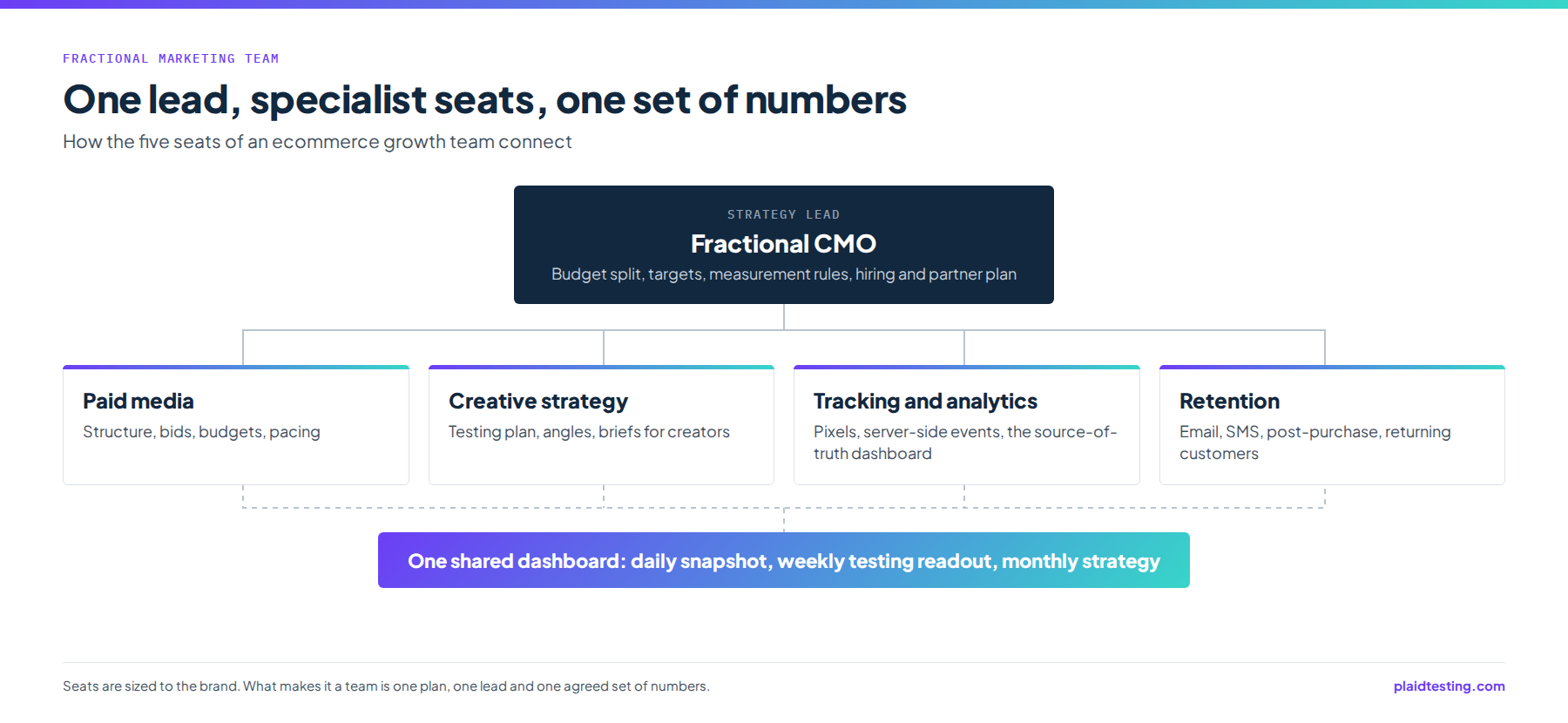
| Seat | What it owns | What it produces each week | When you need it |
|---|---|---|---|
| Strategy lead (fractional CMO) | Budget split across channels, targets, measurement rules, hiring and partner plan | The week’s priorities and a decision on anything that crosses two seats | From the start; without it each seat optimizes its own number |
| Paid media | Account structure, bids, budgets and pacing inside each ad platform | Pacing and budget changes, new campaigns launched, test setup | Once paid social or search drives a large share of new customers |
| Creative strategy | The ad testing plan: angles, formats, hooks, briefs for creators | Briefs for the next round and a readout of which concepts won and why | When thin creative volume or fatigue limits how far spend can scale |
| Tracking and analytics | Pixels, server-side events, the attribution tool, the source-of-truth dashboard | Data checks and a reconciled view of platform numbers against the store | Before any real increase in spend, and whenever platform and store disagree |
| Retention | Email, SMS, post-purchase flows, offers for returning customers | Campaign calendar, flow changes, a read of returning customer revenue | When repeat purchase is part of how the business makes money |
The strategy lead is the seat that makes the rest a team. Without it, each specialist improves its own metric: the media buyer lowers cost per purchase, the retention lead grows email revenue, and nobody decides whether the next dollar belongs in prospecting, retention or a slow product page. That lead is usually a fractional CMO, and it is the one seat we would not skip.
Paid media and creative strategy have to move in step. A paid media seat handles structure, budgets and pacing inside each platform, and the creative seat decides what to test next and why. In our practice performance creative is a testing system: the team sets angles, briefs and readouts, and production runs through the brand’s own creators. If you already have strong creators, you need the strategy layer, not another production vendor.
Tracking is the easiest seat to postpone and the most expensive one to postpone, because every other seat’s decisions depend on it. Retention is the seat many brands already cover in some form; fold it into the team when nobody is connecting repeat purchase to acquisition.
Why the seats must work together shows up as soon as one channel scales. For a womens fashion brand we work with, Facebook ad spend rose 56% to $829K between January and August 2026, compared with the same months of 2025, per its Triple Whale account. Scaling a channel that fast is not a media buying job alone: more budget needs more creative to spend against, and someone has to confirm the added spend is producing orders the store can see. The figure is spend, not a result, and on its own it says nothing about efficiency.
What does a fractional team cost compared with hiring in house?
The fairest comparison prices the same five seats as full-time hires. Public salary data does not map neatly onto ecommerce roles, so the table uses the closest published category for each seat and names it. On those figures, the five base salaries add up to $637,002 a year before benefits, payroll taxes, recruiting, equity or tools. Put a full-time CMO in the strategy seat, at the US median of $374,184 (Salary.com, 1 September 2026), instead of a marketing director and the sum rises to $816,354.
| Line | Role used for the figure | Annual figure | Source |
|---|---|---|---|
| Strategy lead | Marketing director (median salary) | $194,832 | Salary.com, 1 September 2026 |
| Paid media | Advertising and promotions manager (median wage) | $133,660 | BLS, May 2025 |
| Creative strategy | Graphic designer (median wage; a production role, the nearest category) | $62,960 | BLS, May 2025 |
| Tracking and analytics | Market research analyst (median wage) | $78,760 | BLS, May 2025 |
| Retention | Marketing manager (median wage) | $166,790 | BLS, May 2025 |
| Sum of five in-house seats | $194,832 + $133,660 + $62,960 + $78,760 + $166,790 | $637,002 | Computed from the rows above |
| Sum with a full-time CMO as strategy lead | $637,002 minus $194,832, plus a CMO median of $374,184 | $816,354 | Salary.com, 1 September 2026; computed |
| Third-party published range: one fractional CMO | $4,000 to $20,000 per month on retainer, × 12 | $48,000 to $240,000 | GoFractional, 12 August 2026 |
| Third-party published range: one fractional marketing director | $5,000 to $10,000 a month, × 12 | $60,000 to $120,000 | GoFractional, 2 September 2026 |
Read the proxies with care. The graphic designer median of $62,960 (US Bureau of Labor Statistics, wages for May 2025) describes a production role, and a creative strategist who runs a testing program does a different job, so treat that line as a rough marker. Market research analyst, at $78,760 in the same May 2025 release (US Bureau of Labor Statistics), is the nearest federal category to an ecommerce analyst, and the retention line borrows the broader marketing manager median.
The published fractional data covers single seats, not teams. GoFractional’s figures for one fractional marketing director are $5,000 to $10,000 per month at roughly 10 to 20 hours weekly (GoFractional, 2 September 2026), and its typical fractional CMO rate is $150 to $500 per hour, or a retainer of $4,000 to $20,000 per month (GoFractional, 12 August 2026). We know of no published benchmark for a whole fractional team, so ask any provider to price by seat and by hours, then line that up against the in-house stack.
Budget context helps too. Gartner’s 2026 CMO Spend Survey put marketing budgets at 7.8% of company revenue, against 7.7% in 2025, with 54% of CMOs reporting insufficient resources (Gartner, 11 May 2026). Most of its 401 respondents work at companies with more than $1 billion in revenue, so the percentage is not a target for a growing brand. What transfers is that people costs come out of the same budget as media, so every seat has to earn its share.
To see how we organize those seats around one brand, start with our page on the fractional CMO seat and the specialists behind it.
Fractional team, agency or in-house hires: how do you choose?
Each model solves a different problem, and many brands at scale run a mix. The table separates them on the questions that tend to decide it.
| Question | In-house hires | Channel agency | Fractional team |
|---|---|---|---|
| Who owns strategy across channels? | The senior hire, once recruited | Usually the brand; the agency owns its channel | The team’s strategy lead |
| What does starting look like? | Recruiting one role at a time | Contract, access and onboarding for one channel | Access, a tracking review, then one shared plan |
| What happens when someone leaves? | The seat stays empty until you rehire | The provider reassigns the account | The provider replaces the seat; handover notes matter |
| Where does knowledge live? | Inside the company | Mostly with the provider | Split, unless the team documents it |
| Best fit | Permanent, full-time functions you can manage well | A clear internal plan that needs one channel run well | Several functions needing senior judgment, none yet full time |
In-house hires make sense for work that is permanent, full time and close to the product. If a function needs someone inside it every day and the brand can recruit and manage a specialist well, owning that seat builds knowledge the company keeps. The costs are the salary lines above plus the time it takes to recruit each role, and a single departure can leave a gap nobody else covers.
A channel agency makes sense when the brand already owns a clear cross-channel plan and needs strong execution in one channel. A specialist provider brings process and people who have run that channel across many accounts. The limit is scope: a channel provider is hired to make its channel work, so decisions about moving budget out of that channel sit outside its brief, and someone on the brand side has to make them.
A fractional team makes sense when several functions need senior judgment at once and none yet justifies a full-time hire, or when the brand needs a strategy lead plus the specialists that plan depends on. The downsides are real. Your specialists have other clients, so their attention is shared. They will not absorb the company’s culture the way staff do, and knowledge sits partly outside the business unless the team writes it down. You still need one internal owner with authority over product, offers and inventory, because a fractional team can recommend those changes but should not make them alone.
How does a fractional team work from one set of numbers?
When several providers each report their own platform’s results, the totals rarely agree with the store. Each ad platform credits itself for sales it touched, so platform-reported revenue added together can exceed what the business took in. A team working from one set of numbers settles that before it argues about tactics.
In practice, one set of numbers means four agreements. The store is the anchor: orders, revenue, refunds and returns come from the ecommerce platform, not from ad dashboards. Profit is read after product cost, shipping, payment fees and returns, so a campaign selling low-margin items is judged on what it earned. New and returning customers are reported separately, because they answer different questions. Platform-reported figures guide decisions inside each channel and are read against store totals, never added together.
The tracking seat keeps those definitions in writing, and the strategy lead decides which number wins when two disagree. That is what our tracking and attribution work is for: every seat reads the same dashboard and knows where each figure comes from.
A fixed rhythm keeps the seats in step. We run a daily snapshot so problems surface the same day; a weekly testing readout where paid media and creative strategy report what ran, what won and what comes next; and a monthly strategy session where the strategy lead revisits the budget split, targets and any partner or hiring changes. Each seat’s weekly output feeds the same readout, which is how a budget change and a creative brief end up pointing at the same goal.
What should you check before you sign?
Problems with an outsourced marketing team tend to start with something nobody wrote down. Get clear answers on these points first.
- Named people. Who fills each seat, how much of their time you get, and who covers when they are away.
- Decision rights. Which calls the strategy lead makes alone, which need your approval, and what size of budget change triggers a conversation.
- Ownership. Ad accounts, pixels, analytics, the attribution tool and every creative file should sit in the brand’s name, with the team given access.
- Creative production. Who briefs, who films and who edits. If the team runs the testing system and your creators produce, confirm the creators have capacity.
- Reporting. The daily, weekly and monthly outputs, in writing, with metric definitions attached.
- Existing partners. How the team works with any agency or staff you keep, and who each one takes priorities from.
- Exit. Notice terms, handover documents and removal of access, agreed before work starts.
The contract questions overlap with hiring a single strategy seat, and our guide on how to hire a fractional CMO lists the terms we would put in writing. For budgeting, our guide to fractional CMO cost covers how the strategy seat alone is priced. If you only need one person to run delivery under a plan you already own, a single director may be enough; the trade-offs are in Fractional Marketing Director: Cost, Scope, vs CMO.
Want to know which of the five seats your brand is missing? Book a free 30 minute growth audit: we start with your tracking and account structure and leave you with three fixes, whichever model you choose.
Common questions
Is a fractional marketing team cheaper than an agency?
It depends on what each covers. A channel agency is typically priced as a flat fee, a percentage of ad spend or a hybrid of the two, and covers execution in its channel. A fractional team covers strategy, measurement and several functions under one plan. Compare total spend on people and partners against the work each option includes, and list what you would still need to hire or buy separately under each.
Who manages a fractional marketing team day to day?
The strategy lead, normally a fractional CMO, sets priorities and runs the weekly readout, and each specialist manages their own work inside that plan. On the brand side, one person owns approvals for offers, product and budget changes beyond agreed limits, usually the founder or the head of ecommerce. Without that internal owner, decisions stall and the team waits.
How long does setup take?
The sequence is predictable even when the length is not. Access to ad accounts, the store and analytics comes first, then a tracking review, then a baseline everyone agrees on, then the first tests. Tracking is the variable: a brand whose pixels, server-side events and attribution tool already agree with the store moves faster than one where the numbers need rebuilding. Ask any provider to show the order of the first month’s work.
Can a fractional team work alongside our existing agency or in-house staff?
Yes. A brand can keep a channel agency or in-house specialists and add fractional seats only for the gaps, such as strategy or tracking. What matters is clarity: each account has one owner, each partner knows who sets priorities, and everyone reports into the same weekly readout. Agree those lines in writing at the start, before the first budget decision tests them.
Related reading
- What Is a Fractional CMO? An Ecommerce Founder’s Guide: the strategy seat that leads the team
- Fractional Marketing Director: Cost, Scope, vs CMO: when one delivery lead is enough
- How to Hire a Fractional CMO: Questions and Terms: contract points to settle before signing
- How Much Does a Fractional CMO Cost in 2026?: published pricing for the strategy seat on its own