
An outsourced CMO is usually a firm that supplies marketing leadership as a service, often with a rotating executive and a bench behind them. A fractional CMO is a named senior operator who works with you part time on an ongoing basis. For an ecommerce brand spending $50K+ a month, the difference comes down to continuity and accountability.
What is an outsourced CMO?
An outsourced CMO is marketing leadership bought from an outside firm rather than hired onto payroll. The firm contracts to provide “a CMO” and the people who do the work underneath that title. In practice, the executive you meet on the sales call is not always the executive running your account a quarter later, because the firm staffs engagements from a bench and rotates people as its own capacity shifts. That is not a criticism. It is how a firm keeps a fixed monthly fee viable across many clients.
The model suits a brand that wants marketing handled end to end and does not have strong opinions about who handles it. You get process, templates, a reporting deck and a project manager.
The trade-off shows up in three places. First, institutional memory lives with the firm, not with one person. Second, strategy tends to be standardized so that any executive on the bench can pick it up. Third, if the firm also sells media management or creative, the leadership layer has an incentive to recommend its own services. None of these are deal breakers. They are simply the things to price into the decision.
What is a fractional CMO, and how is it different?
A fractional CMO is one named senior marketer who owns your growth function for a fixed fraction of their time, usually across a few clients at once. “Fractional” describes the time commitment, not the seniority. You get the same person in every meeting, accountable for the numbers, who remembers why a decision was made in March when it resurfaces in November.
Continuity is the practical advantage. Ecommerce growth is a sequence of compounding decisions: which channel to lean into, when to hold budget back ahead of a launch, whether to pull a hero product from paid because its margin cannot carry acquisition. A named operator carries that context forward. We covered the fundamentals in our explainer on what a fractional CMO is and does, so this post stays on the comparison.
The fractional model has its own limits. One person has finite hours, so execution capacity depends on what sits behind them. Some fractional CMOs work alone and direct your existing team or vendors; others bring an execution team. Plaid Testing is a named fractional operator who brings a team, so strategy and the hands-on paid media, creative testing and tracking work sit under one line of accountability. Ask any candidate which of the two they are before you compare fees.
Where does “CMO as a service” fit?
“CMO as a service” is the subscription framing of the same idea: marketing leadership sold as a recurring monthly product, often with tiered packages and a defined hours allotment. Some providers using this label are genuinely fractional operators who prefer subscription language. Others are outsourced firms describing a productized offer. The label alone does not tell you which.
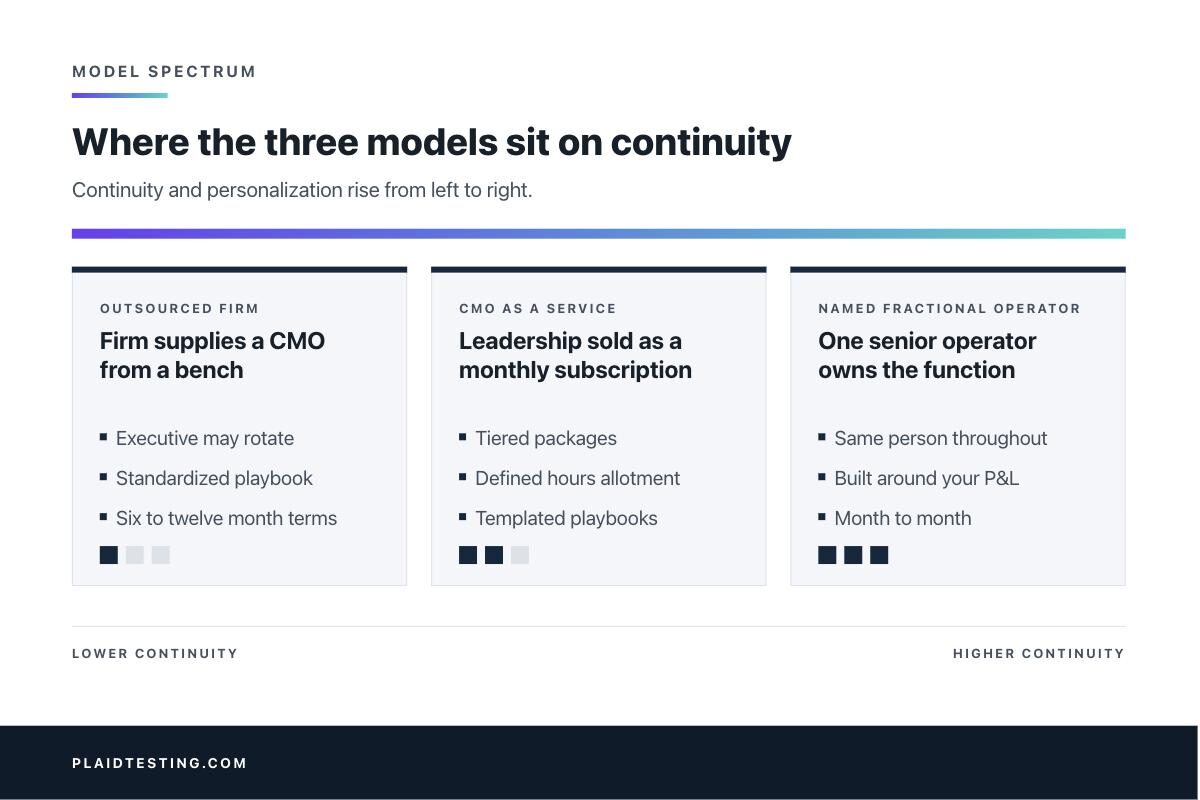
The subscription model appeals to a founder who has been burned before: the commitment is short, the scope is written down, and you can cancel. It also carries a structural weakness. Subscription pricing rewards the provider for keeping delivery hours low and client count high, which pushes toward templated playbooks. That is fine for an early-stage brand. It works less well at $50K+ a month in paid media, where the expensive mistakes are specific to your margin structure, inventory position and creative pipeline.
If you are evaluating a “CMO as a service” package, ask who exactly is assigned to you by name, what happens to the strategy if that person leaves, and whether the package includes budget for tools, testing and creative production or is leadership hours only. The part-time model itself is explained in our guide to what a fractional CMO is.
Outsourced CMO vs fractional CMO: side-by-side comparison
| Dimension | Outsourced CMO (firm) | Fractional CMO (named operator) |
|---|---|---|
| Who leads | A firm; the executive may rotate | One named senior marketer |
| Continuity | Depends on firm staffing | Same person throughout |
| Team behind it | Firm’s bench, shared across clients | Varies: solo, your team, or the operator’s own team |
| Reporting | Standardized deck, often monthly | Built around your P&L, typically weekly or biweekly |
| Strategy ownership | Firm process and playbook | Individual accountability |
| Exit terms | Contract term, often six to twelve months | Usually month to month or short notice |
| Best suited to | Full-service handling with low founder involvement | A senior partner in decisions, with the founder engaged |
The table compresses a lot, so two rows deserve a closer look. Reporting is where the models diverge most visibly by month two. A firm generally reports on the marketing activity it performed, because that is what its contract defines. A named operator tends to report on the business outcome, because that is what they will be judged on at renewal. Ask to see a sample report from each before you decide; the difference in what gets measured is usually obvious within a page.
Exit terms matter more than most founders expect. Longer contracts are not inherently bad, and a firm needs runway to recover onboarding costs. But a brand spending $50K+ a month on paid media cannot afford to sit in a poor fit for two quarters. A shorter notice period keeps both sides honest and signals that the provider expects to earn the renewal rather than enforce it. Finally, “team behind it” is the row where you should push hardest, because it determines whether the leadership can actually ship the work it recommends or will simply hand you a plan and a vendor list.
What does each model cost compared with a full-time CMO?
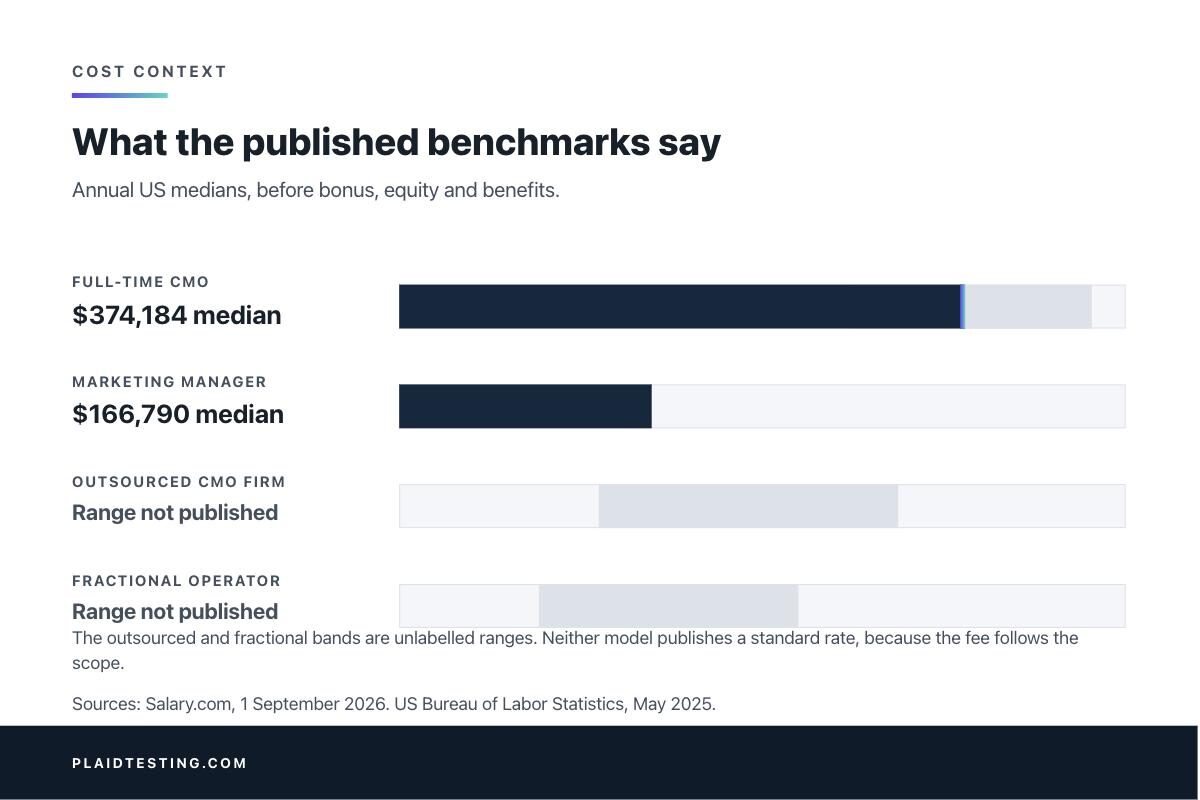
Start with the benchmark both models compete against. According to Salary.com, as of 1 September 2026, the median US Chief Marketing Officer salary is $374,184, with a typical range of $300,550 to $457,625, before bonus, equity and benefits. One rung down: the US Bureau of Labor Statistics reports a median annual wage of $166,790 for marketing managers (May 2025).
Outsourced CMO firms typically price as a flat monthly retainer tied to a scope tier, sometimes with a setup fee. Fractional CMOs price either on a fixed monthly fee for a defined time fraction or on a base plus a performance component. Neither publishes standard rates, because the right fee depends on how much execution sits inside the scope. We broke down fee structures in our post on fractional CMO cost.
Put any fee in the context of the total marketing budget. Gartner’s 2026 CMO Spend Survey, published 11 May 2026, found marketing budgets average 7.8% of company revenue, and 56% of CMOs say they lack the budget required.
Which model fits an ecommerce brand spending $50K+ a month?
It depends on what is broken. If your problem is execution capacity (nobody to build campaigns, brief creators or fix tracking) and you already have a clear strategy, an outsourced firm or a good specialist vendor can be the right call. If decisions are being made by the loudest dashboard or by nobody at all, you need a strategic owner, which argues for a named operator.
Here, a wrong strategic decision compounds quickly. Meta reported in its Second Quarter 2026 Results on 29 July 2026 that average price per ad rose 12% year over year while ad impressions rose 14%. A brand that is not actively managing channel mix pays more for the same reach each quarter, a leadership problem before it is a media buying problem.
On an account we run for a heritage fashion brand, Q1 2026 net margin was 48.31% against 32.79% in Q1 2025, up 15.52 points, while blended ad spend rose 419.3%. No incrementality test was run on that account, and those blended figures come from the brand’s own analytics stack rather than platform-reported dashboards. Scaling spend more than five times while margin improved required one person owning pricing, product mix and channel allocation together. If you would rather see your own account through this lens, request a growth audit and we will walk through it together.
How do you evaluate either option before signing?
The marketing leadership seat is unusually unstable even at large companies. Spencer Stuart’s CMO Tenure 2026 report, published January 2026, puts average S&P 500 CMO tenure at 4.1 years versus 5.0 years for all C-suite roles, and notes that 31% of S&P 500 companies have no CMO at all. If the largest companies struggle to keep the seat filled, expect turnover risk in any model.
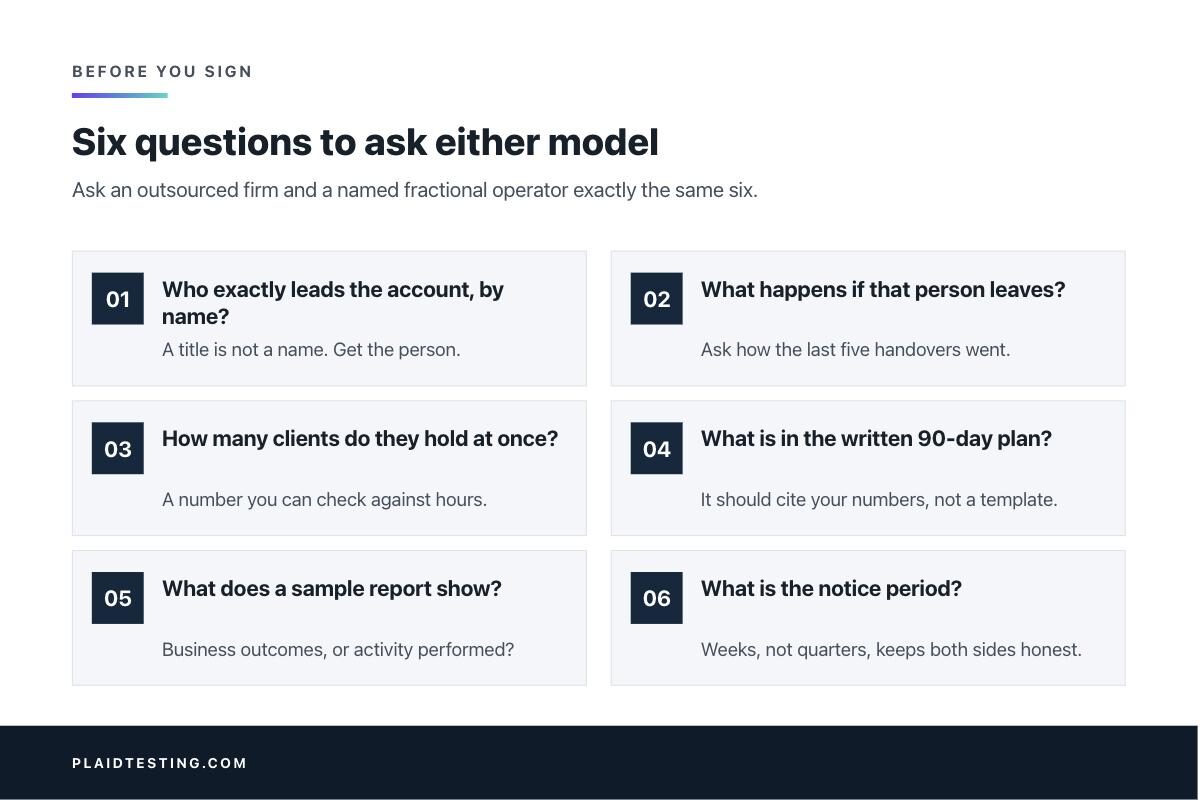
So evaluate for continuity and knowledge transfer, not just the pitch. Ask an outsourced firm how many executives have led its last five accounts and how handover works. Ask a fractional operator how many clients they hold at once and what happens if they are unavailable for a month. Ask both for a written 90-day plan and check whether it references your actual numbers or a generic “audit, strategy, execute” sequence.
Ask, too, who will be in the weekly meeting. A project manager plus an executive who joins monthly is an outsourced model whatever the proposal says. Our guide on how to hire a fractional CMO has a longer list, and the scope of the named-operator model we run is on our fractional CMO service page.
Common questions
Not quite. Both put senior marketing leadership outside your payroll, but an outsourced CMO is usually a firm’s service with a bench and an executive who may change, while a fractional CMO is a specific named person working part time on an ongoing basis.
Often, yes, and that can be convenient. The question is whether the leadership layer is independent from the media buying layer. If the same firm recommends the strategy and bills for executing it, make sure reporting is tied to business outcomes such as contribution margin, not just activity or platform-reported return.
Long enough to see a full planning cycle through, which for an ecommerce brand usually means one peak season. Most fractional arrangements run month to month after an initial period, while outsourced firms often ask for six- to twelve-month terms.
Both make the most sense once paid media spend is large enough that strategic mistakes cost more than leadership does, which for most apparel, fashion and wellness brands is around $50K a month and up. Below that, a strong media buyer plus a founder who owns strategy is often enough.
Get your free 30 minute growth audit
Deciding between an outsourced firm and a named operator is easier once you know what your account actually needs fixed. Request a free 30 minute growth audit and we will review your paid media, tracking and margin picture and send actionable takeaways. No retainer required to start.
Related reading
About the author
Jason Lu founded Plaid Testing, the fractional CMO and growth team that works with ecommerce brands spending $50K+ a month on paid media. He is a Meta Business Partner, presented on Triple Whale’s Meet Moby 2 webinar and has spoken on a panel at The Whalies.