
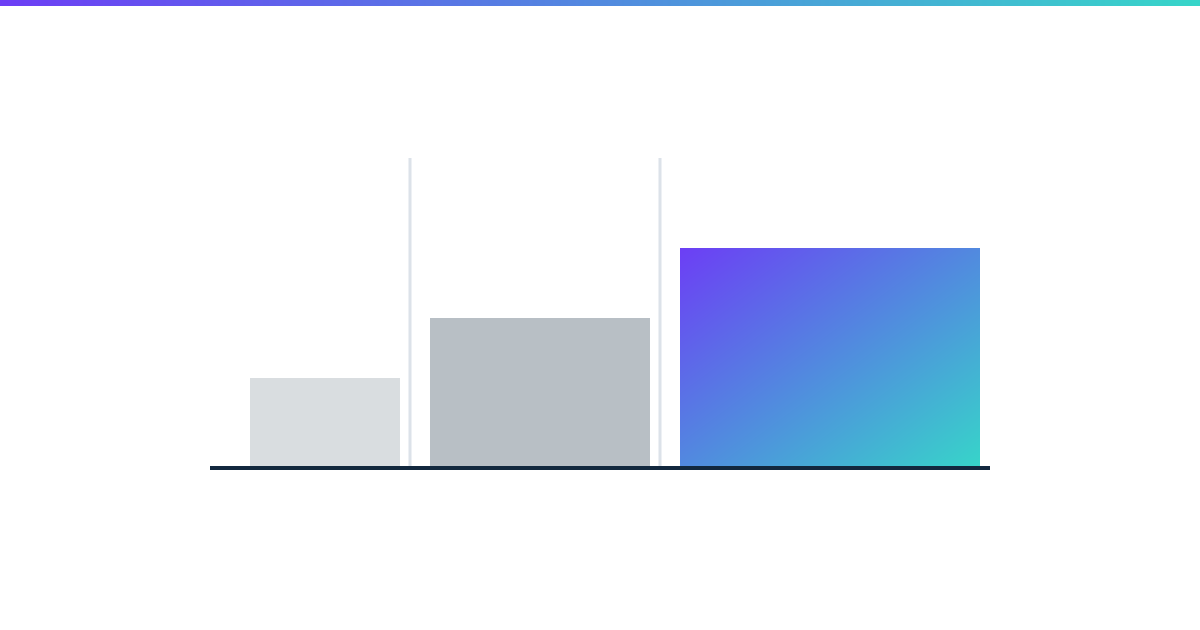
Most ecommerce brands spending under $50,000 a month on paid media need neither. Between $50,000 and $500,000 a month, a fractional CMO usually wins on cost and speed. Above $500,000, the workload and the equity conversation both point to a full time hire. Spend level, not ambition, decides it.
That is the whole framework. The rest of this article is the reasoning behind it, including the cases where the answer is a full time executive and a fractional operator would be the wrong call. The fractional CMO vs full time CMO question gets framed as a budget decision, which is why brands get it wrong so often. It is really a workload decision. A CMO seat is worth filling permanently when there is enough executive level work to fill it permanently, and not a quarter before.
One note on vocabulary. Fractional CMO and part time CMO describe the same arrangement: a senior marketing leader who owns strategy for a defined slice of the week rather than all of it. The labels are interchangeable in the market, and nothing in this comparison turns on which one a firm prefers.
The stage test, by monthly paid media spend
Paid media spend is an imperfect measure of company stage. In ecommerce it is still the best single proxy available, because it tracks the two variables that actually decide this question: how many channels, partners and numbers have to be coordinated, and how much money rides on a single allocation call.
| Monthly paid media spend | What usually constrains growth at this stage | The usual right answer | What to do instead of hiring |
|---|---|---|---|
| Under $50,000 | Offer, creative volume and unit economics. Coordination is not the bottleneck yet | Neither a fractional nor a full time CMO | Put the money into creative output, offer testing and clean measurement. The founder can still hold strategy |
| $50,000 to $500,000 | Coordination. Several channels, an agency or two, and reporting that does not reconcile | Fractional CMO | Buy senior judgment for part of the week and leave execution where it already sits |
| Above $500,000 | Organizational. Team size, cross functional decisions, planning cycles and hiring | Full time CMO becomes genuinely justifiable | Run a real search, budget the loaded cost rather than the base salary, and use equity to align the horizon |
Two caveats before the detail. The bands describe typical ecommerce brands, and a business with retail, wholesale and marketplace channels running alongside its own site carries the coordination load of a much larger brand at a much lower spend. Read the bands as a description of complexity, with spend as the shorthand. And a brand sitting on the boundary is genuinely on the boundary. There is no version of this test that turns $480,000 a month into an obviously different answer than $520,000 a month.
Under $50,000 a month: the honest answer is neither
This is the section that sends part of the audience away, and it is the most useful one in the article.
Leadership is a coordination function. It earns its cost when coordination is the binding constraint. At $30,000 a month across one or two channels, coordination is almost never what is holding the business back. The constraint is one of four things, and none of them require an executive to identify.
- The offer. What the customer is being asked to buy, at what price, with what incentive. Weak offers do not get rescued by better strategy, and no amount of channel expertise fixes a product the market is lukewarm about.
- Creative volume. At this spend level, results correlate more with how many distinct concepts get tested each month than with anything decided in a strategy session.
- Unit economics. Gross margin after cost of goods, shipping and payment fees sets the ceiling on what can be paid for a customer. If that number is thin, the marketing question is downstream of a merchandising or sourcing question.
- Measurement basics. Server side tracking, a working conversions API connection, and one blended number the founder trusts. Cheap to fix, and everything else depends on it.
The arithmetic is unforgiving too. A $10,000 monthly retainer against $30,000 a month in media is a third of the media budget spent on advice about the other two thirds. Even excellent advice struggles to justify that ratio, because the leverage a strategic operator provides scales with the amount of spend the advice is applied to.
The better use of the same money at this stage is more creative, a competent media buyer or a small specialist agency, and a one off diagnostic if something feels structurally wrong. Buy an audit, not a seat. The seat can wait until there is enough executive work to fill it.
$50,000 to $500,000 a month: where a fractional CMO usually wins
Something changes around $50,000 a month, and it is not the size of the number. It is the number of things that now have to agree with each other.
A brand at this level typically runs three or four acquisition channels, works with at least one agency plus freelancers, needs a creative pipeline with a brief and a standard behind it, and looks at figures from the ad platforms, GA4, Shopify and a blended tool that all disagree. The founder is usually still the final approver on creative, offers and budget, which by this point has turned approval into the bottleneck. The seat is empty, and the work is real.
The fractional case rests on a specific claim: senior judgment applied for part of the week beats a full time executive the business cannot yet keep busy or comfortably afford. It is a strong claim between $50,000 and $500,000 a month, and a weak one on either side of that range.
What you are actually buying, in hours
Worth being precise here, because the hours are where the model is usually oversold. A full time executive has roughly 173 working hours in a month. Market rates for fractional engagements run $4,000 to $20,000 per month, or $150 to $500 per hour (GoFractional, 2026). Dividing one by the other, a mid range retainer buys somewhere around 20 to 40 hours a month, and a top of range retainer at the lower end of the hourly band works out closer to two or three days a week. Those figures are derived from the published bands rather than separately surveyed, so treat them as sanity checks on a proposal, not as quotes.
Which means the fractional model is not cheaper per hour of executive attention. It is frequently more expensive per hour. The entire case rests on whether the hours purchased are the ones that decide where money goes, or the same hours diluted into a weekly status call. That distinction deserves more scrutiny than the fee, and it is what a properly scoped fractional CMO engagement should define in writing before anyone signs.
Where the fractional model genuinely falls short
Four honest limitations, all of which get worse as a brand scales.
- Attention is shared. A fractional operator works with a small number of brands at once. Good ones cap the number. Nobody works with several and pretends each gets undivided focus.
- Presence is scheduled. Plenty of consequential decisions get made in unplanned conversations. A part time leader is not in those conversations, and the cost of that shows up as decisions made without them rather than as anything visible on a dashboard.
- Team building is rarely in scope. Directing an existing team is normal. Recruiting, developing, performance managing and retaining one is a different job, and most fractional engagements are not structured or priced to do it.
- The horizon is short. Brand building, category expansion and retail distribution pay off over years. A fractional engagement that renews quarterly is structurally biased toward work that pays back inside the engagement.
What the middle band looks like when it works
Three examples from brands in this range, described by category rather than by name, all traced to Triple Whale exports held on file.
- An athletic apparel brand grew sales 35.7% to $9.27M between January and June 2026 while paid media spend rose 42%, and blended ROAS held at 3.36x across the period. Dividing those two figures implies media spend in the region of $460,000 a month, which puts the brand near the top of the middle band. Holding blended efficiency flat through a 42% spend increase is the part that matters. The default for a scaling account is decay.
- A fashion apparel and accessories brand grew sales 249% year over year with net profit up 205%, landing at a 41% net margin and a 29% MER.
- A womens fashion brand grew sales 99% while acquisition efficiency improved rather than degraded. New customer CPA fell 21%, new customer ROAS rose 58%, and net profit rose 136%.
None of those came from a single tactic, and none of them required a permanent executive on payroll. They came from measurement that told the truth, budget allocated against margin rather than against platform reported returns, and a testing cadence that ran every week. Fuller write ups sit in our ecommerce growth case studies.
Not sure which band you are actually in? Plaid Testing runs a free 30 minute ecommerce growth audit for brands spending $50,000 or more a month on paid media. Actionable takeaways are guaranteed, no retainer is required to start, and nothing is pitched on the call.
Above $500,000 a month: the case for hiring full time
Past roughly $500,000 a month, the arguments that favor fractional start to invert. Five of them, in the order they usually become true.
The workload passes the ceiling
At this scale marketing is not a function that needs direction, it is a department that needs running. Annual and quarterly planning, headcount decisions, agency negotiations, creative operations, retention, merchandising input, forecasting with finance, and a weekly cadence with several channel owners. That is more than 80 hours of work a month before anyone does any thinking. A part time leader in that seat spends their whole allocation on operating cadence and never gets to strategy, which is the thing they were hired for.
The job becomes a management job
Marketing teams of eight to fifteen people need someone who hires, develops, arbitrates and retains them. Those are not activities that compress into two days a week, and they are not activities most fractional engagements price for. A brand at this size that keeps its senior marketing leadership part time is usually asking a director or a head of growth to absorb the management load without the authority or the title, which tends to end with that person leaving.
The decisions get longer than the engagement
Retail distribution, international expansion, a brand repositioning, a new category launch. These are two and three year bets with costs in year one and returns in year two. An executive compensated with equity and a multi year horizon is structurally aligned with making them. A quarterly renewal is not. This is the strongest argument for a full time CMO and it has nothing to do with hours.
The equity conversation starts making sense
At this stage a company is usually large enough that a meaningful equity grant is both affordable and motivating. That is a real form of alignment a retainer cannot replicate. It also gives the business a claim on the person’s best years rather than a claim on their Tuesdays.
The cost objection loses most of its force
The median base salary for an ecommerce CMO in the United States was about $374,068 in August 2026 (Salary.com), before equity. Loaded with payroll taxes, benefits, bonus and recruiting fees, the real annual cash cost lands closer to $573,000. That number is frightening at $50,000 a month in media and unremarkable at $1,000,000 a month, because it is the same number measured against a very different denominator.
| Monthly paid media spend | Annual media budget | Full time CMO as a share of media budget | Fractional CMO at $10,000 a month as a share |
|---|---|---|---|
| $50,000 | $600,000 | 95.6% | 20.0% |
| $150,000 | $1,800,000 | 31.9% | 6.7% |
| $500,000 | $6,000,000 | 9.6% | 2.0% |
| $1,000,000 | $12,000,000 | 4.8% | 1.0% |
The full time column assumes $573,571 in annual cash cost, built from the $374,068 median base plus benefits and payroll taxes at an assumed 25% of base, a bonus at an assumed 20% of base, and an executive search fee at an assumed 25% of base spread over a three year tenure. Equity is excluded because it varies too widely to model. Swap in your own loadings and the shape of the table does not change.
Read the bottom two rows carefully, because they are the honest end of the argument. Above $500,000 a month, a permanent marketing executive costs less than a tenth of what the business already spends on media, and buys roughly four times the hours of a top of range fractional retainer. At that point the brand is not choosing the cheaper option by staying fractional. It is choosing the smaller one.
Head to head on the dimensions that matter
Stripped of stage, here is how the two models compare on the things brands actually care about. The final column is a general tendency, not a verdict for every business.
| Dimension | Fractional CMO | Full time CMO | Usually stronger |
|---|---|---|---|
| Annual cash cost | $48,000 to $240,000 at market rates (GoFractional, 2026) | About $573,000 loaded, on a $374,068 median base (Salary.com, Aug 2026) | Fractional |
| Executive hours per month | Roughly 20 to 80, depending on scope | About 173 | Full time |
| Time to first impact | Weeks. No search, no notice period | Three to six months including search and ramp | Fractional |
| Hiring and managing an internal team | Rarely in scope. Direction, not management | A core part of the role | Full time |
| Availability for unplanned decisions | Scheduled. Some decisions happen without them | In the room every day | Full time |
| Pattern recognition across brands | Works across several accounts at once | Sees one business deeply | Fractional |
| Multi year bets, brand and distribution | Horizon is usually shorter than the payoff | Compensated to think in years | Full time |
| Equity alignment | Rare | Standard and appropriate at this level | Full time |
| Cost of getting it wrong | A short notice period | Search fee, severance and up to a year of lost momentum | Fractional |
| Institutional memory | Leaves when the engagement ends | Accumulates and compounds | Full time |
| Ability to change scope | Adjustable quarter to quarter | Largely fixed once hired | Fractional |
Five to six. That split is the point. Fractional wins on cost, speed and reversibility, which are the dominant concerns of a growing brand. Full time wins on capacity, presence and horizon, which become the dominant concerns of a scaled one. Neither model is better in the abstract, and any comparison that concludes otherwise is selling something.
The option most comparisons leave out
Framing this as fractional CMO vs in house also hides a third structure that suits a lot of brands in the middle band: a full time senior operator in house who executes, paired with fractional leadership above them.
A full time head of growth or senior marketing manager on payroll costs materially less than a CMO base salary, sits in the business every day, and handles the operating load that part time leadership genuinely cannot cover. The fractional CMO sets strategy, allocates budget, holds agencies to a standard and translates performance for the founder or board. The in house operator runs it.
This tends to outperform both single option answers between roughly $100,000 and $500,000 a month, because it separates two jobs that only look like one job. Executive judgment is needed intermittently. Operating capacity is needed daily. Buying them as a single full time hire means paying executive rates for operating work, and buying only the fractional half means the operating work lands on the founder.
When to hire a CMO: the signals on each side
Spend bands are a starting point. These signals are what actually confirm it.
Five signs the fractional model has been outgrown:
- The marketing team has grown past six or seven people and nobody senior is managing them day to day.
- Strategy sessions keep ending in decisions that need someone present during the week to carry out.
- The business is making multi year commitments in retail, wholesale or international, and needs an owner who will still be there when they pay off.
- A board or investor group expects a named marketing executive accountable in the room.
- The fractional operator’s monthly hours are entirely consumed by cadence and firefighting, with no time left for the strategic work they were hired to do.
Five signs a full time hire would be premature:
- Paid media spend is below $50,000 a month and the offer or creative pipeline is still the obvious constraint.
- You cannot write a one page description of what the person would own in their first ninety days.
- Marketing headcount is fewer than four people, so there is little to manage.
- The loaded cost of the hire would exceed a quarter of the annual media budget.
- The real problem is that nobody trusts the numbers, which is a measurement project, not a leadership vacancy.
That last one is common enough to be worth repeating. A surprising share of brands convinced they need a CMO actually need reporting they believe. Those are very different purchases at very different prices.
How the transition usually works
The two models are not mutually exclusive across time, and the sequence most brands follow is worth naming.
A brand engages a fractional operator in the middle band. Over four to six quarters the function gets built: measurement that reconciles, budget allocated against contribution margin, a testing cadence, agencies held to a standard, and a small in house team. Spend crosses $500,000 a month. At that point the fractional operator’s most valuable contribution is to define the permanent role, write the scorecard it will be measured against, help run the search, onboard the person who takes it, and then leave.
That last step is the tell. A fractional operator whose advice is always to stay fractional has an incentive problem, and it is worth asking any candidate directly what conditions would make them recommend replacing themselves. The answer is informative either way.
How to decide this week
Four steps, none of which need a meeting.
- Write down last month’s paid media spend. That puts you in a band.
- Write down what marketing leadership would own in the next ninety days, on one page. If the page is thin, the seat is not full time yet.
- Count the marketing headcount that would report into the role. Fewer than four says fractional or in house operator. More than seven says full time.
- Divide the loaded cost of each option by your annual media budget. If a full time hire is more than a quarter of it, the market is telling you something.
Run those four and the answer is usually obvious within an hour. Plaid Testing does not publish a fee, because scope gets set after we have seen the account rather than before, and the honest recommendation coming out of a first conversation is sometimes that no leadership hire is needed yet.
If you are spending $50,000 or more a month on paid media and want a baseline before deciding either way, book a free 30 minute growth audit. You get the efficiency picture regardless of what you do with it, and you can take it to a full time candidate, an agency or nobody at all.
Jason Lu is the founder of Plaid Testing and a Meta Business Partner. He presented “Meet Moby 2” on Triple Whale’s Customer Education Series and has spoken on panel at The Whalies.
Is a fractional CMO cheaper than a full time CMO?
In total, yes. Per hour, usually not. A full time ecommerce CMO earns about $374,068 in median base salary (Salary.com, August 2026), and costs closer to $573,000 a year once benefits, bonus and search fees are loaded on. A fractional engagement at $4,000 to $20,000 a month runs $48,000 to $240,000 a year. The saving comes from buying fewer hours, not cheaper ones.
When should an ecommerce brand hire a full time CMO instead of a fractional one?
The practical threshold is around $500,000 a month in paid media, or a marketing team past six or seven people. At that point the operating cadence alone consumes a fractional allocation, management becomes a daily job, and multi year commitments in retail or international need an owner with an equity horizon. Below that, the workload rarely fills a permanent executive seat.
Fractional CMO vs in house: can a fractional CMO lead our internal team?
Yes, and that is the normal arrangement, with one limit worth understanding. A fractional CMO can set strategy, define the standard and direct the work well. Recruiting, developing and performance managing people is harder part time. Brands with four or more marketing staff usually get the best result by pairing fractional leadership with a full time in house operator who runs the day to day.
Do I need a CMO at all if we already have an agency?
Not always. An agency executes a channel and reports on that channel. The gap it cannot fill is someone on your side of the table deciding which channels get funded, judging whether the agency is earning its scope, and reconciling every number to what actually reached the bank account. If nobody currently holds that, the seat is empty. If a founder still holds it comfortably, it is not.