

A Google Shopping agency should run three things: the Merchant Center feed, the campaign structure (Performance Max, Standard Shopping or both) and the measurement that tells bidding what a sale is worth. Expect to pay for management plus a feed tool, and judge the fee model by how it behaves when spend rises.
Published prices give reference points for two of those lines. GoDataFeed’s Lite plan is listed at $39 a month (GoDataFeed on the Shopify App Store, September 2026), and Upwork puts the median Google Shopping freelancer on its marketplace at $20 an hour (Upwork, September 2026). Agency fees are seldom published, so the useful work for a buyer is knowing what the job contains, what each part costs and which questions separate a strong partner from a strong pitch.
What does a Google Shopping agency actually do?
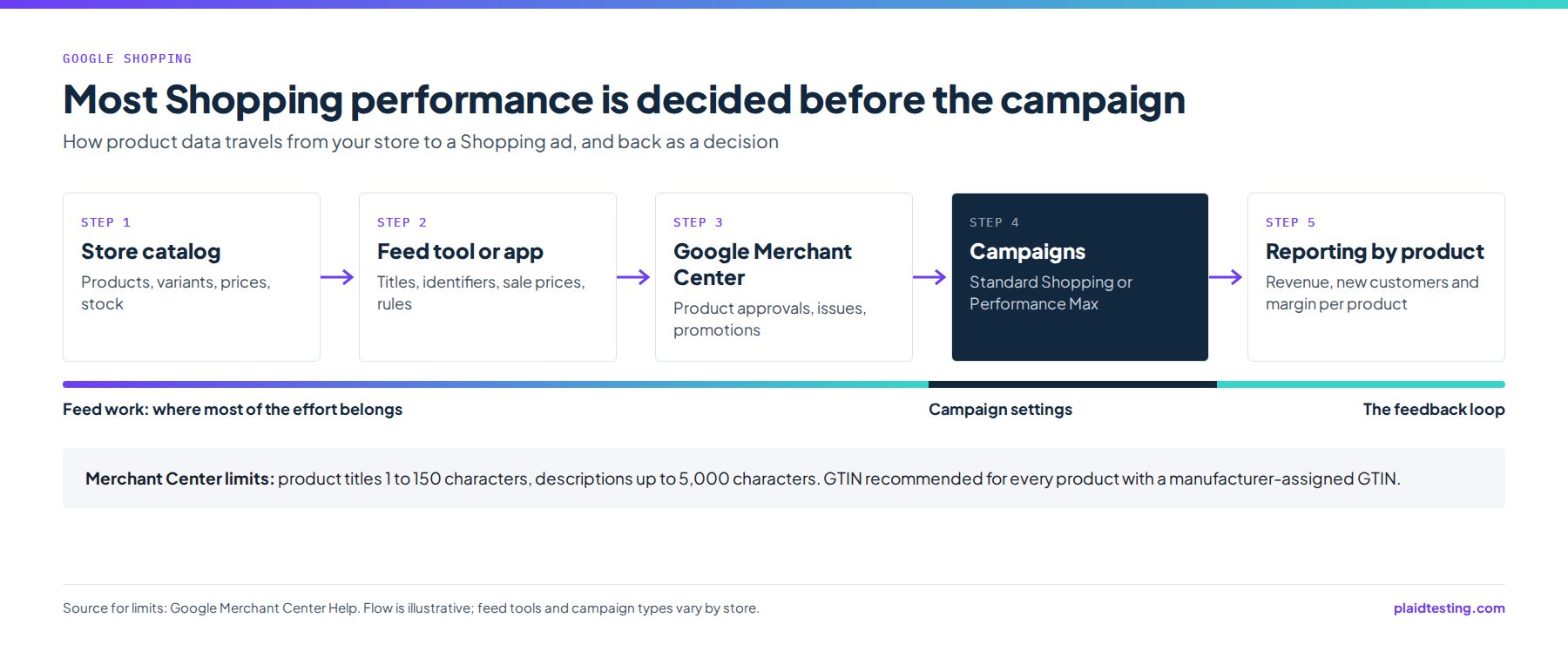
Most of the work sits in three places, and only one of them is the ad account. The first is Merchant Center, the account that holds your product data and reports what is wrong with it. The second is the feed, the file or connection that carries every title, price, image, identifier and stock level from your store to Google. The third is the campaign layer in Google Ads, where budgets, bid targets and campaign types live. Google Merchant Center management and campaign management are often sold as one service, but they are different skills, and it is worth asking who does each.
A competent manager spends the first month mostly in the first two layers. That surprises buyers who expect to hear about bidding, but the order is deliberate: a campaign can only sell the products the feed describes, at the prices the feed states, to the searches the product data can match. In the accounts we take on, the first month is diagnosis and repair, the structure decision follows once the data can be trusted, and testing comes after that.
The same feed does unpaid work as well. Google Merchant Center Help says free listings generate organic traffic across Google Search, Shopping, Maps and more, so the product data you repair for paid campaigns is also the data behind those free placements.
The auction your products enter is not getting quieter, either. Alphabet reported that Google Search and other revenue grew 17% to $63.27 billion in the second quarter of 2026 (Alphabet, 22 July 2026). That line is advertising money paid to Google, which makes it a rough signal of how much spend your listings compete with.
Around those layers sits the work that decides whether any of it pays: agreeing what a conversion is worth, reading results against margin rather than platform revenue, and staying in step with whoever sets prices, promotions and stock. We treat that coordination as part of the job, because a Shopping campaign pushing a product that is about to sell out is paying to disappoint people. What a Shopping manager should not do is set your prices, choose your margins or decide which products the business wants to grow. Those are commercial decisions, and a good manager asks for them in writing before building anything.
Why is the product feed most of the job?
Because in Shopping, product data does the work that keywords do in Search. A Search campaign starts from terms somebody chose. A Shopping ad starts from the title, description, category, price and identifiers in your feed, and every weakness in that data turns into a search you never appeared for or a click that did not convert.
Google’s limits are generous, so the constraint is judgment rather than space. Titles can run from 1 to 150 characters (Google Merchant Center Help) and descriptions up to 5,000 characters (Google Merchant Center Help). A title copied from the storefront, written to sound good on a product page, usually wastes that room. The words a shopper would type, such as product type, material, fit and color, belong at the front. The brand name belongs there when people search for it, and further back when they do not.
Identifiers come next. Google recommends a GTIN for all products that have one assigned by their manufacturer (Google Merchant Center Help). That is a recommendation rather than a blanket requirement, and its scope (products that already have a manufacturer-assigned number) matters to brands that make their own products and never registered identifiers. The job is to supply correct identifiers wherever they exist and never to invent one.
Prices are where feeds and websites drift apart most often. Google Merchant Center Help sets out that a sale price has to be lower than the regular price, that the landing page shows both, and that checkout shows only the sale price (Google Merchant Center Help). A feed that syncs on a delay, or a discount switched on in the store and not in the feed, breaks that rule without anyone deciding to break it. Ask any candidate how often your feed refreshes and what happens to it during a sale.
Feed effort should also follow the catalog’s economics rather than its size. At a womens fashion brand we work with, one hero product accounted for $1.45M in revenue, 10,564 units and 8,517 new-customer orders between January and August 2026, per its Triple Whale account. A product doing acquisition work for the whole catalog deserves its own feed attention and its own budget line: a title tested on purpose, stock watched closely, and funding that never has to compete with the rest of the catalog. Those figures cover every channel the brand sells through. They do not show how much of that revenue came from Shopping, and we are not claiming it did.
Performance Max or Standard Shopping: which should an agency run?
Both are still on the table, and a good manager can explain the choice for your catalog. Google Ads Help records that Smart Shopping campaigns were upgraded to Performance Max in 2022, automatically between July and September. Retailers can still promote online and local inventory with Performance Max using a Merchant Center feed, or with Shopping campaigns (Google Ads Help). The choice is real, and a proposal that presents one of them as the only option has skipped a decision.
The underlying difference is who makes the decisions. Performance Max leans on Google’s automation: the manager’s main levers are the inputs, meaning the feed, the conversion goals and values, the budget and the target, and the system makes more of the choices from there. Standard Shopping leaves more of the structure with the person running the account, including hands-on choices about how products are grouped and funded.
| Question | Performance Max | Standard Shopping |
|---|---|---|
| How it got here | Smart Shopping campaigns were upgraded to it in 2022, automatically from July to September | The long-standing Shopping campaign type, still available to retailers alongside Performance Max |
| Who makes most of the decisions | Google’s automation, working from the inputs you supply | More of them stay with the account manager |
| What the manager controls most directly | Feed quality, conversion goals and values, budget and target | The same inputs, plus more hands-on choices about how products are grouped and funded |
| How much rides on the feed | Very high: with fewer structural levers, product data carries more of the weight | High: the feed still decides which searches a product can match |
| What to ask to see in a live account | Which reports the manager reads each week, and what they changed because of them | How products are grouped, and the rule for moving a product from one group to another |
| When it tends to fit | Clean conversion tracking, values that reflect margin, and a catalog that can share one goal | A budget that must be fenced around specific products, a controlled product test, or thin conversion data |
Three rules cover most catalogs. If conversion tracking is unreliable, fix it before handing more of the account to automation, because automation optimizes toward whatever it is told a conversion is worth. If a few products carry the business, give them a structure where their budget cannot be absorbed by everything else. If the account has plenty of clean conversion data and the catalog is broadly one kind of product at similar margins, Performance Max is a reasonable default, and the manager’s value moves into the feed and the goals.
Some accounts run both, with a written rule for which products live in which campaign so the reporting stays readable. The question worth asking a candidate is not which campaign type they prefer. It is what would make them switch, and what data they would need to see first. We make a similar argument about automation generally in our piece on who runs the AI once AI runs the ads: the system sets the bids, but a person still decides what it is aiming at.
If you cannot tell whether the feed or the campaign type is holding your Shopping results back, that is the first question our paid media work on Google Shopping and Search answers, before any budget moves.
What does Google Shopping management cost?
Four lines make up the bill, and usually only one of them gets quoted. The media is paid to Google. The feed tool is a software subscription. Management is labor, bought from a freelancer, an agency or an in-house hire. And remediation, the work of repairing a neglected Merchant Center account, is often priced as a separate project before the monthly work starts.
Feed tools are the easiest line to price because the vendors publish it. DataFeedWatch lists its Shop plan at $64 a month for 1,000 SKUs and 3 feeds (DataFeedWatch, September 2026), which comes to $768 over 12 months. GoDataFeed’s four plans run from $39 to $399 a month (GoDataFeed on the Shopify App Store, September 2026), and Channable’s listing starts at $104 a month (Channable on the Shopify App Store, September 2026). Feedonomics publishes no price at all, saying cost depends on SKU count, channel type, number of channels and service level, and that it never takes a percentage of revenue (Feedonomics, September 2026).
Freelance rates are public too, with a caveat. Upwork reports that Google Shopping specialists on its platform charge $13 to $36 an hour, with a median of $20 (Upwork, September 2026), against $15 to $40 and a median of $25 for Google Ads experts in general (Upwork, September 2026). It also puts a typical Shopping engagement at anywhere from $500 for a focused feed audit to $8,000 or more for full Merchant Center remediation and a multi-campaign launch (Upwork, September 2026). Those are marketplace figures. They tell you what the market clears at, not whether a particular freelancer has taken a catalog like yours through a peak season.
| Cost line | What it covers | Published price or how it behaves | Source |
|---|---|---|---|
| Feed tool: DataFeedWatch | Feed management software | Shop $64 a month (1,000 SKUs, 3 feeds); Merchant $84; Agency $239; Enterprise custom | DataFeedWatch pricing page |
| Feed tool: GoDataFeed | Feed management software | Lite $39 a month; Plus $99; Pro $199; Premium $399 | Shopify App Store listing |
| Feed tool: Channable | Feed management software | Plans from $104 a month | Shopify App Store listing |
| Feed service: Feedonomics | Feed management as a service | No public price; set by SKU count, channel type, number of channels and service level; never a percentage of revenue | Feedonomics pricing page |
| Freelancer, hourly | Specialist time | Google Shopping specialists $13 to $36 an hour, median $20; Google Ads experts $15 to $40, median $25 | Upwork cost guides |
| Freelancer, project | Audit or remediation | From $500 for a focused feed audit to $8,000 or more for full Merchant Center remediation and a multi-campaign launch | Upwork hiring page |
| Agency, flat monthly fee | Management within a written scope | Stable cost that does not move with spend; the scope has to be defined or it shrinks | Pricing model, no published benchmark |
| Agency, percentage of spend | Management that scales with the account | Rises and falls with media spend, so it peaks when spend peaks, which for many retailers is November and December | Pricing model, no published benchmark |
| Agency, hybrid | A floor fee plus a share of spend above a threshold | Stable at low spend, scales at high spend; the thresholds decide which way it cuts | Pricing model, no published benchmark |
Agencies rarely publish fees, so it is more useful to understand how each pricing model behaves than to chase a benchmark. A flat monthly fee is predictable and does not rise when spend does, but it needs a written scope, or the work quietly shrinks to fit the fee. A percentage of ad spend scales with the account and is simple to administer, but it pays more whenever spend rises, whether or not the extra spend earned its place, and the bill peaks in the same weeks your media does. A hybrid, such as a floor fee plus a percentage above a spend threshold, protects both sides at the extremes and needs the most careful reading. None of these models is dishonest. Each rewards something different, and you should know what that is before you sign. Ask, too, whether the feed tool is included in the fee or billed on top, and whose name the tool account is in.
How do you vet a Google Shopping agency?
Ask to see the work rather than the slides. The most revealing hour in any evaluation is a candidate reading your own Merchant Center account and Google Ads account with you watching, and telling you what they would fix first and why. Strong candidates start with product data and measurement. A pitch that opens with a campaign rebuild has skipped the step that decides whether the rebuild will work.
Then test the commercial thinking. Ask what the account should optimize toward. Revenue is the default answer and often the wrong one, because a sale on a low-margin product and a sale on a high-margin product look identical to bidding unless someone tells it otherwise. A candidate who asks about your margins, your returns and your new-customer targets is thinking about the business. One who asks only for your target ROAS is thinking about the account.
Check ownership and exit terms early, while everyone is still being agreeable. Your Google Ads account, your Merchant Center account and your feed tool should sit in your name, with the provider given access, so the history and the product data stay with you if the relationship ends. Ask what happens to the feed rules and setup notes if you part ways, and who does the work each week: the person in the pitch, or someone you have not met.
| Area | Question to ask | A strong answer | A warning sign |
|---|---|---|---|
| Merchant Center | What would you fix first in our account? | Names specific product issues and the order to fix them in | Moves straight to campaign structure |
| Feed | Which fields will you change, and how will you know it worked? | Titles, identifiers and prices, each with a before and after read | “We optimize the feed” with no specifics |
| Campaign type | Why this campaign type for our catalog, and what would make you switch? | A rule tied to data volume, margin and the need for control | The same answer for every client |
| Measurement | What value will bidding optimize toward? | Asks about margin, returns and new customers before answering | Accepts platform revenue as the goal |
| Pricing | How does your fee change when spend rises in November? | A written model with the thresholds stated | Fee changes that are not in the contract |
| Ownership and exit | Whose name are the accounts in, and what do we keep? | Everything in the brand’s name, with the setup documented | Accounts held by the provider |
| Reporting | What will we see each week, and who explains it? | A named person and a fixed rhythm | Dashboards with nobody to interpret them |
The same scorecard works whether the candidate calls itself a Google Shopping ads agency, a paid search consultant or a freelancer. Score each area as strong, acceptable or missing rather than adding up points. A candidate who is strong on campaigns and missing on measurement is a risk however polished the rest looks, because every decision in the account depends on the numbers being right. If you are hiring with the peak season in mind, start early: the feed and structure work has to be finished well before November, and our BFCM 2026 paid media calendar shows how early those deadlines fall.
When do you not need one?
When the catalog is small and stable, the feed is healthy and Google is a minor share of spend, a specialist retainer can cost more than the problem it solves. A one-off project, such as the focused feed audit that Upwork prices from $500 (Upwork, September 2026), can fix the data once, and someone in house can keep it clean with a feed tool and a monthly check.
You also do not need a Shopping specialist when the constraint sits somewhere else. If the site converts poorly, if margins cannot support paid acquisition at current prices, or if tracking cannot tell you which sales came from new customers, better Shopping management will not fix it. It will spend more efficiently into the same problem, and the report will look better than the business feels.
And sometimes the gap is not a channel at all. Some brands have capable people running Google and Meta separately and nobody deciding how money should move between them, or which products the business wants to grow next. That is a leadership seat, not a channel seat. We have written about how a fractional marketing team is structured and what each seat costs, and about what a fractional marketing director does compared with a CMO, for exactly this situation. Both reflect how we think about the work: it is not the strategies inside the ad account that drive the business, it is the strategic layer above it. When we run Google Shopping as part of our paid media service, it sits under that layer, with budgets set against margin and new customers across every channel rather than one platform’s report.
Before you sign a Shopping retainer with anyone, book a free 30 minute growth audit. We read your Merchant Center and Google Ads setup with you, review the tracking behind it and hand over three fixes you can use whoever ends up running the account.
Common questions
Is Performance Max better than Standard Shopping for ecommerce?
Neither wins for every catalog. Performance Max suits accounts with clean conversion data and values that reflect margin, since it hands more decisions to automation. Standard Shopping suits accounts that need to protect budget for particular products or run controlled tests. Google moved Smart Shopping campaigns to Performance Max in 2022, yet Shopping campaigns remain an option for retailers, so argue the choice from your own data rather than from habit or a default setting.
Do I need GTINs for Google Shopping?
Google recommends a GTIN for every product with a manufacturer-assigned one (Google Merchant Center Help), so if you resell branded goods, supply them. It does not say every product must carry one. If you make your own line and never registered identifiers, read the Merchant Center guidance for your situation and follow it. What you should never do is make up a code just to fill the field.
How long before Shopping results are readable?
It depends on conversion volume more than on the calendar, so we do not work to a fixed period. A change is readable once enough conversions have come in before and after it that one strong or weak day cannot swing the comparison. A high-volume account can get there quickly. Lower-volume accounts should judge changes over longer windows, make fewer and larger decisions, and avoid stacking several edits at once.
Should the same partner run Google Shopping and Meta?
Not necessarily, but one person should own the budget across both. Google and Meta can each claim credit for the same order, and if two separate providers report only their own platform numbers, nobody is accountable for the total. Specialists can run each channel well as long as someone above them reads blended results, sets the split and settles disagreements. If nobody in your business holds that seat, fill it before you hire more channel help.
Related reading
- Fractional Marketing Team: Roles, Cost and Setup: how channel specialists and a strategy lead fit together
- Fractional Marketing Director: Cost, Scope, vs CMO: the seat to fill when execution is covered and direction is not
- AI Runs the Ads Now. Who Runs the AI?: why automated campaigns still need someone setting the goal
- BFCM 2026 Paid Media Calendar for Ecommerce Brands: when feed and campaign work has to be finished before the peak
- Demand Gen vs Performance Max: Which Should an Ecommerce Brand Run?