
A BFCM paid media calendar for 2026 runs from early October to mid December. October sets creative, tracking and offer structure. Early November opens prospecting at scale. The five days from Thursday 26 November to Monday 30 November carry the heaviest spend. December funds repeat purchase. Most of the money is committed before any discount goes live.
The 2026 dates are fixed, so plan against them rather than against last year’s. Thanksgiving Day is Thursday 26 November 2026. Black Friday is Friday 27 November 2026. Cyber Monday is Monday 30 November 2026. Cyber Week is the five days from Thursday 26 November through Monday 30 November 2026. Everything below is anchored to those dates.
When should Black Friday ads start for 2026?
Earlier than the discount, and the reason is a shopper behaviour number rather than a media one. The National Retail Federation reported that 84% of consumers had already begun their holiday shopping by the 2025 Thanksgiving weekend. That single figure reframes the whole exercise. By the time the discount goes live, most of the market has already been browsing, comparing and building a shortlist. The weekend is where the demand converts, not where it is created.
The same National Retail Federation release recorded 202.9 million consumers shopping across the five-day weekend in 2025, at an average spend per person of $337.86. Salesforce put US Cyber Week online sales at $79.6 billion, up 5% year over year in its 5 December 2025 release. Those are big totals competing for a fixed amount of attention over five days.
There is a cost argument too. Meta’s Q4 and full year 2025 results, filed with the SEC on 28 January 2026, show ad impressions across the Family of Apps up 18% year over year in Q4 2025 and average price per ad up 6% year over year. More inventory and a higher clearing price in the same quarter is what a crowded auction looks like from the outside.
So the practical answer is that prospecting should be live and learning in early October, at whatever level the business can absorb, and scaling from the first week of November. Be honest about the tradeoff. October spend usually returns worse on a same-day basis than late November spend, and a brand with thin margin or tight cash may not be able to fund the head start. That is a real constraint, not a failure of nerve.
What does a week by week BFCM 2026 paid media calendar look like?
Here is the calendar, dated against the 2026 weeks. It assumes a brand running paid social and paid search with owned email and SMS alongside.
Read it as a sequence of decisions rather than a list of tasks. Each week exists because something upstream has to be finished before the next thing can be measured. Tracking has to be verified before creative testing starts, or the test results describe a measurement problem rather than a creative one. Creative has to be tested before budget scales, or the scale simply amplifies whichever asset happened to be live. Campaign structure has to be frozen before traffic arrives, because an account still being restructured on the Tuesday of Cyber Week is an account learning on the most expensive inventory of the year. The dates below are the deadlines those dependencies imply, not preferences.
| Week | Dates (2026) | What happens in the account | Why now |
|---|---|---|---|
| Foundation | Thu 1 Oct to Sun 11 Oct | Audit tracking end to end: Google Tag Manager container, GA4 events, Meta Ads Manager and TikTok Ads Manager pixel and conversions API, Shopify checkout events. Confirm Triple Whale or Northbeam is reconciling to Shopify. | Anything broken here is invisible until volume arrives, and then it is too late to fix cleanly. |
| Creative volume | Mon 12 Oct to Sun 18 Oct | Brief and shoot the BFCM creative set. Ship non-discount concepts first: product demonstration, founder explanation, review-led, use case. | Creative production has the longest lead time of anything on this list, and November is the wrong month to discover you have three assets. |
| Offer lock and list build | Mon 19 Oct to Sun 1 Nov | Finalise the offer and the exclusions. Push email and SMS capture hard through Klaviyo, Attentive or Postscript. Build and warm the audiences you will exclude and target in November. | The offer changes every downstream asset. Locking it late forces rushed creative and rushed landing pages. |
| Prospecting opens | Mon 2 Nov to Sun 8 Nov | Scale cold prospecting on the non-discount creative. Hold discount messaging back. Raise budgets in steps rather than in one move. | This is the window that feeds the 84% who start early. It is the cheapest new-customer acquisition you will see in the quarter. |
| Early access test | Mon 9 Nov to Sun 15 Nov | Test one early-access or list-only offer to warm audiences. Read new customer cost per acquisition, not blended return. | A small live test now is worth more than a forecast, and it tells you which creative to fund on 26 November. |
| Warm-up | Mon 16 Nov to Sun 22 Nov | Publish the teaser. Open remarketing at full weight. Stage every campaign, ad set and ad in draft with the correct dates and budgets. | Building campaigns during Cyber Week costs hours you do not have and introduces avoidable errors. |
| Final staging | Mon 23 Nov to Wed 25 Nov | Freeze structural changes. Confirm inventory feeds, Shopify theme, page speed, checkout and Shop Pay. Agree the daily budget ceiling and who can raise it. | Changes made in the last 72 hours are the ones that break on the day nobody can debug them. |
| Cyber Week | Thu 26 Nov to Mon 30 Nov | Run the pre-agreed daily budget shape. Check in at fixed times. Kill underperformers, raise the winners, leave structure alone. | Five days carry a disproportionate share of the quarter. Discipline beats improvisation here. |
| Post-Cyber recovery | Tue 1 Dec to Sun 6 Dec | Step budgets down rather than cutting them. Switch messaging from discount to gifting and shipping confidence. Run the post-purchase flow hard. | Demand does not stop on 30 November, but the discount reflex should. |
| Shipping deadline push | Mon 7 Dec to Sun 13 Dec | Move spend toward last-order-date urgency, gift cards and digital delivery. Reconcile the full period against Shopify. | This is the last window where paid media changes the December number, and the first honest read on what BFCM actually earned. |
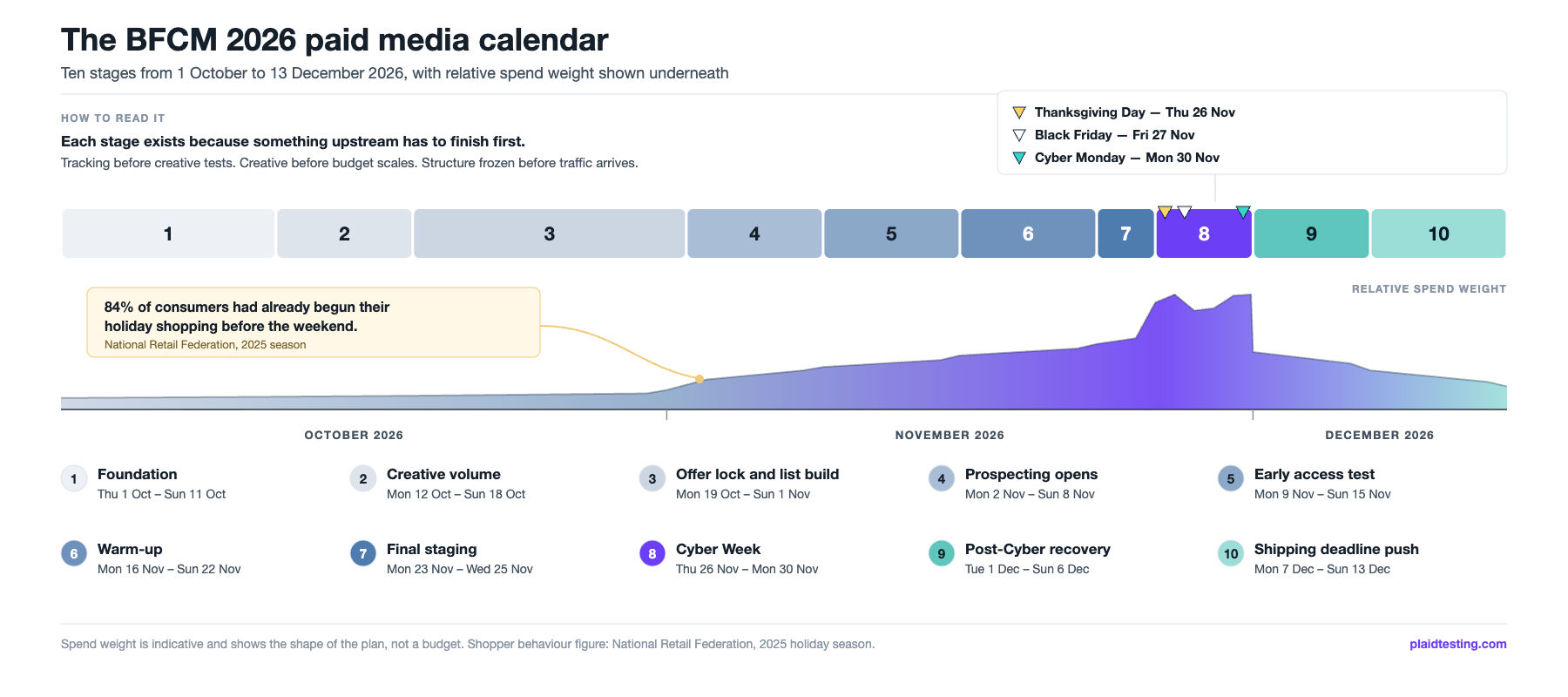
Two things in that table do most of the work. The first is that October is spent on infrastructure and creative rather than on impressions. The second is that campaign structure is frozen before the traffic arrives.
The third point is what the calendar leaves out. There is no week set aside for building the offer, because the offer is a merchandising and margin decision that belongs to the business rather than to the ad account, and it should be settled before any of this begins. If the offer is still being argued about in the first week of November, the calendar does not fix that. It only shows how little time is left to test anything against it, and it makes the case for deciding the offer in September while there is still room to build creative around it.
How should budget be split across the five days of Cyber Week 2026?
Not flat. Adobe Analytics published day-level results for the 2025 season on 2 December 2025, and the shape of those five days is uneven enough to plan around.
| Day (2025 result) | Adobe online sales | Year over year | 2026 equivalent | Pacing note |
|---|---|---|---|---|
| Thanksgiving Day | $6.4 billion | up 5.3% | Thu 26 Nov 2026 | Real volume, lowest of the five. Open, do not max out. |
| Black Friday | $11.8 billion | up 9.1% | Fri 27 Nov 2026 | Fastest growth of the named days. Heavy weight, intraday pacing matters. |
| Saturday and Sunday | Not broken out in Adobe’s 2 December 2025 release | Not published | Sat 28 and Sun 29 Nov 2026 | No public day figure to plan from. Read your own prior-year Shopify data. |
| Cyber Monday | $14.25 billion | up 7.1% | Mon 30 Nov 2026 | Largest single day. Reserve budget for it rather than arriving spent. |
| Cyber Week total | $44.2 billion | up 7.7% | Thu 26 to Mon 30 Nov 2026 | The five days as one unit, against a full-season projection of $253.4 billion, up 5.3%. |
Adobe did not publish separate Saturday and Sunday figures in that release, so no number is given for them here. Your own 2025 Shopify numbers are the better guide for the middle weekend.
Within the days, concentration is sharper still. Shopify reported a peak of $5.1 million per minute at 12:01 PM EST on Black Friday in 2025, alongside $14.6 billion in BFCM GMV, up 27% year over year. A daily budget that spends evenly across 24 hours is not shaped like that.
Device matters for the same reason. Adobe recorded mobile at 57.5% of Cyber Monday online sales in 2025, and Salesforce reported that mobile drove 70% of online orders both globally and in the US across Cyber Week. Creative that is only legible on desktop is creative most of the audience will not read properly.
If you want a second read on budget shape, tracking and offer structure before the October budget is committed, a growth audit is a straightforward way to get one.
What actually changes in the ad account before the discount goes live?
Less than people expect, and earlier than people expect. The October work is mostly measurement and creative, not campaign building.
Measurement first. Google Tag Manager, GA4 and the platform pixels get verified against real Shopify orders, not against a tag assistant screen. Triple Whale or Northbeam gets reconciled to Shopify revenue before the volume arrives, because a small gap in October becomes an argument in December. Server-side event coverage gets checked on the same schedule.
Creative second. The assets that carry cold traffic in early November are usually not discount assets. Product demonstration, founder explanation and review-led concepts do the acquisition work, and the discount is layered on later as a message rather than rebuilt as a campaign.
Offer depth is the third decision, and it is worth setting against what the category actually did. Adobe’s day-level 2025 data shows Cyber Monday average discount depth varying widely by category, from electronics at 31% off listed price down through apparel at 25% and sporting goods at 17%. Apparel and sporting goods sit at different points on that range, which is a useful reality check for any brand about to default to the deepest discount in its category because a competitor did. Basket size is worth checking too: Shopify reported an average cart price of $114.70 across BFCM 2025.
Structure last. Campaigns are staged in draft the week of 16 November and frozen on 23 November. Building an account that late is exactly the work a paid media program should have finished in October, not started in the final week.
How do you tell whether BFCM worked when platform ROAS and the P&L disagree?
By deciding, before 26 November, which number you are managing to. Platform-reported return on ad spend and blended return on ad spend will diverge during Cyber Week, and the gap widens precisely when spend rises fastest. Attribution windows overlap, remarketing claims credit for demand that prospecting created in early November, and the discount itself lifts conversion rate across every channel at once.
The workable answer is to agree one primary business metric and hold it. Blended return on ad spend against Shopify revenue is the usual choice for an ecommerce brand, with new customer cost per acquisition as the secondary read. Platform numbers stay useful for deciding which ad to turn off, which is a different job from deciding whether the quarter worked.
Across six months with an athletic apparel brand we work with, sales are up 35.7% year to date, reaching $9.27M, with paid media investment up 42% year over year and blended ROAS held at 3.36x. That is a year-to-date picture rather than a BFCM result, and it is worth stating plainly what it represents: a deliberate choice to scale rather than to squeeze efficiency, judged on blended ROAS instead of platform-reported ROAS. Holding a blended number steady while investment rises is a different outcome from pushing platform ROAS up on flat spend, and the two decisions lead to very different Decembers.
Write the December reconciliation into the October plan. Agree who runs it, which source of truth wins, and what happens if the two disagree. That conversation is much easier to have in October than on 2 December.
If you want the 2026 calendar built and run against your own numbers rather than a template, our paid media program is the place to start.
Common questions
Do I have to discount to compete during Cyber Week 2026?
No, though you do need a reason for people to act. Adobe’s 2025 data shows average Cyber Monday discount depth differing sharply by category, from 31% off listed price in electronics to 17% in sporting goods. Bundles, early access, gift with purchase and extended returns all give urgency without cutting the headline price. Pick the mechanic your margin supports and commit to it in October.
Should daily budgets be flat across the five days?
No. In 2025, Adobe reported Thanksgiving Day at $6.4 billion, Black Friday at $11.8 billion and Cyber Monday at $14.25 billion. The five days are not the same size, and Shopify’s peak minute of $5.1 million at 12:01 PM EST on Black Friday shows the concentration inside a day as well. Plan a budget shape before 26 November 2026 and agree who is allowed to change it during the week.
What happens in the account in the first week of December 2026?
Step down rather than switch off. Tuesday 1 December through Sunday 6 December 2026 is where gifting intent, shipping confidence and post-purchase flows carry the revenue. Adobe projected the full 1 November to 31 December 2025 season at $253.4 billion online, up 5.3% year over year, so a meaningful share of the season sits after Cyber Monday. Move the message from discount to delivery certainty.
How much creative do I need, and when does it need to exist?
Enough that you can retire fatigued assets during Cyber Week without going dark. Practically, that means the shoot happens in mid October 2026 and the assets are in the account by the week of 16 November. Lead with non-discount concepts for cold traffic, then layer the offer as a message. Mobile-first framing matters, given Salesforce reported mobile drove 70% of online orders during Cyber Week 2025.
When is it too late to start planning for BFCM 2026?
There is no hard cutoff, but the options narrow fast. After late October you are unlikely to shoot new creative, and after 23 November 2026 structural changes carry more risk than upside. A brand starting in mid November can still run a competent Cyber Week on existing assets and a clean offer. It simply gives up the early November window that the National Retail Federation data suggests matters most.
Related reading
- Meta Ads for Black Friday: Structure and Budget Pacing — how the account is structured and how budget is paced across the window
- BFCM Creative Testing: What to Test in October — the October testing plan that feeds this calendar
- All Insights