
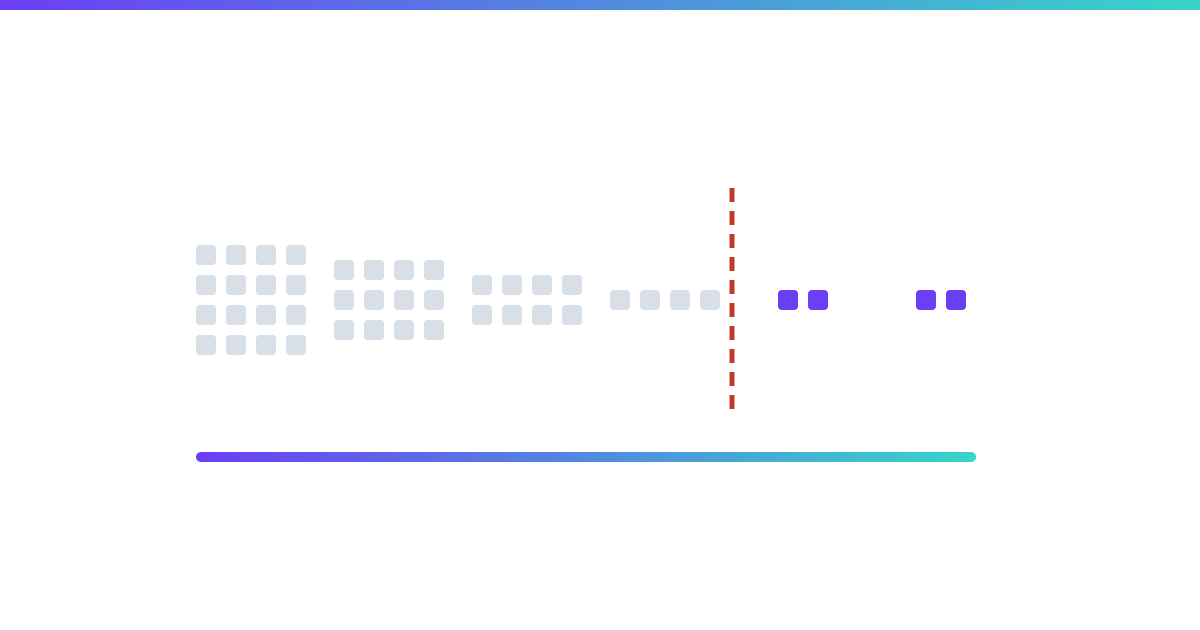
Test hooks, offer framing, format, social proof and landing destination in October, one variable at a time, at normal prices and normal intent. October is the last month where the result you get is actually about the creative. Once the discount window opens, the offer swamps every variable you were trying to isolate.
That is the whole argument of this post, and everything below is the mechanics of doing it without fooling yourself.
What should I test in October?
Five variables, run one at a time: hook, offer framing, format, social proof and landing destination. Each of those answers a different question about why someone buys from you, and a test that moves more than one of them at once answers none of them.
Most brands do not have a creative shortage. They have a feedback shortage. Three assets that differ in five ways at once teach nothing, whatever the result. If the winner has a new hook, a new edit, a new voiceover, a new price callout and a new landing page, all you have learned is that one particular bundle beat another particular bundle in one particular week. You cannot rebuild it. You cannot scale the part that worked, because you do not know which part worked. In three weeks you will be guessing again, only now with more confidence, which is worse.
The discipline is boring and it is most of the job. Hold everything constant except the thing you are asking about. Give each cell enough budget and enough days that delivery settles before you read it. Write the question down in one sentence before the test starts, so you are not tempted to reinterpret the result once you see it.
Here is the matrix we work from. The middle column is the one people skip, and it is the one that decides whether the test was worth running.
| Variable | What you are actually learning | How to isolate it | When to stop |
| Hook (first three seconds) | Which problem or promise earns attention from a cold audience before any brand recognition applies | Same body, same edit, same offer, same landing page. Swap only the opening frames and the opening line. Run in one campaign, one ad set per hook | When one hook holds a clear lead on cost per click and hold rate across several consecutive days, not one good afternoon |
| Offer framing | Whether people respond to price, to bundle value, to shipping, or to scarcity, before you have to commit to a November offer | Identical creative, identical destination. Change only the on-screen and caption framing of the same underlying offer | When the ranking is stable and the losing frames are not close. If two frames tie, keep both for November and stop spending to separate them |
| Format (static, video, Reels-native) | Where your production budget should go for the next eight weeks, and which placements your asset actually survives | Same hook and same offer expressed natively in each format. Do not upload one master and let it crop | When one format wins on cost per purchase at equal spend, or when a format proves it cannot clear your floor no matter the hook |
| Social proof | Whether reviews, user-generated footage, press, or repeat-purchase signals do the reassurance work for your category | One proof element added to an otherwise unchanged control. One proof type per cell | When the lift over control is consistent across two refreshes of the same proof type, which rules out one lucky testimonial |
| Landing destination | Whether the drop-off is the ad or the page, which is the cheapest thing to learn and the most often skipped | Same ad, split traffic between product page, collection page and a dedicated landing page. Verify the split in GA4 and your Shopify analytics before you trust it | When conversion rate separates at stable traffic levels, or when the pages tie and you can stop building new ones |
Why does a test run in the discount window teach you nothing?
Because by then the offer is the largest variable in the account, and it is not the one you are testing.
Adobe Analytics reported that on Cyber Monday 2025, average discount depth reached 25% off listed price in apparel, 31% in electronics and 28% in toys (Adobe Analytics, 2 December 2025). A quarter off is not a garnish on top of the creative. For a large share of buyers it is the reason they clicked. Run two hooks against each other inside that window and the gap you measure is mostly noise sitting on a much larger price effect.
Salesforce data points the same direction. Across Cyber Week 2025, Salesforce reported average selling price up 6% year over year while order volume rose 2% globally and 1% in the US (Salesforce, 5 December 2025). The growth came far more from what things sold for than from how many things sold. That is a market where price is doing the heavy lifting, which is exactly the condition under which a creative test stops being readable.
Now add the other things that move in the same fortnight. Budgets step up. Promotions change mid-week. Competitors stack their own offers. Audiences that were cold in October have seen you four times. The creative variable you were carefully isolating is now the fifth most important thing happening in the auction, and you have no clean way to pull it back out.
So the honest framing is this. November is for harvesting. October is for learning. A test run in the last week of November tells you about the discount, not about the creative, and if you act on it in January you will be building against a conclusion that was never true.
Is winning Q4 a bidding problem or a creative problem?
Mostly a creative problem. In its Q4 and full year 2025 results filed with the SEC on 28 January 2026, Meta reported that ad impressions delivered across the Family of Apps increased 18% year over year in Q4 2025, while the average price per ad increased 6% (Meta Platforms, 28 January 2026). The same filing shows impressions up 12% and average price per ad up 9% for the full year 2025.
Be careful with what that does and does not mean. It is a company-level figure across the whole Family of Apps and it does not predict what your CPM will do in November. Your own auction is a function of your category, your audience, your bid strategy, your creative quality and how many other advertisers want the same person on the same day. Plenty of individual apparel accounts saw costs move far more than the company average. Anyone who tells you otherwise is selling you a forecast.
What the filing does support is a directional point worth planning around. Supply expanded faster than price. Meta kept finding more places to show ads. In that environment, the binding constraint for most advertisers is not what they are willing to pay. It is which creative earns the impression once they are already in the auction. A brand with four assets it can defend will struggle in Q4 regardless of how the bid is configured, and a brand with a tested library will find places to spend.
There is one more constraint that is real and that we are not going to put a number on. New ad sets go through a period of unstable delivery while Meta’s system works out who to show them to. We will not quote a conversion threshold for that, because there is no published figure we can point you to. Treat it as a scheduling fact rather than a target: changes cost you days, and days in late November are the most expensive days you own.
If your October results are coming back unreadable, the problem is usually upstream of the creative. A growth audit is a reasonable first move, because unreadable tests are far more often a tracking and structure problem than a creative one.
What should October creative actually be built for?
A vertical screen, with the sound off, in a feed someone is already scrolling quickly.
Adobe Analytics reported that mobile accounted for 57.5% of Cyber Monday online sales in 2025 (Adobe Analytics, 2 December 2025). Salesforce put the share higher across the full week, reporting that mobile drove 70% of online orders both globally and in the US (Salesforce, 5 December 2025). The National Retail Federation counted 75.9 million people shopping online on Cyber Monday, of whom 46.9 million were on mobile (National Retail Federation, 2 December 2025). Three organizations, three methodologies, one instruction: build for the phone first.
That changes what a format test is. Taking a landscape product film and letting Meta Ads Manager crop it into Reels is not a format test, it is a compression test, and it usually fails for reasons that have nothing to do with the idea. If you want to know whether video beats static for your category, the video has to be shot or edited vertical, legible without audio, and paced for a thumb. The same applies if you are running the parallel test in TikTok Ads Manager. Native means built native, not resized.
Timing matters as much as shape. The National Retail Federation also found that 84% of consumers had already begun their holiday shopping by the Thanksgiving weekend. Your October audience is not a warm-up crowd. They are in market, comparing, and building a shortlist that your November ads will either be on or absent from. Creative that is tested in October and proven in October is the asset that puts you on that list.
This is the part of the work we treat as performance creative rather than production. The asset exists to answer a question, the question is written down before the asset is made, and the brief specifies the one thing that is allowed to change.
When does testing stop, and how do you judge what actually won?
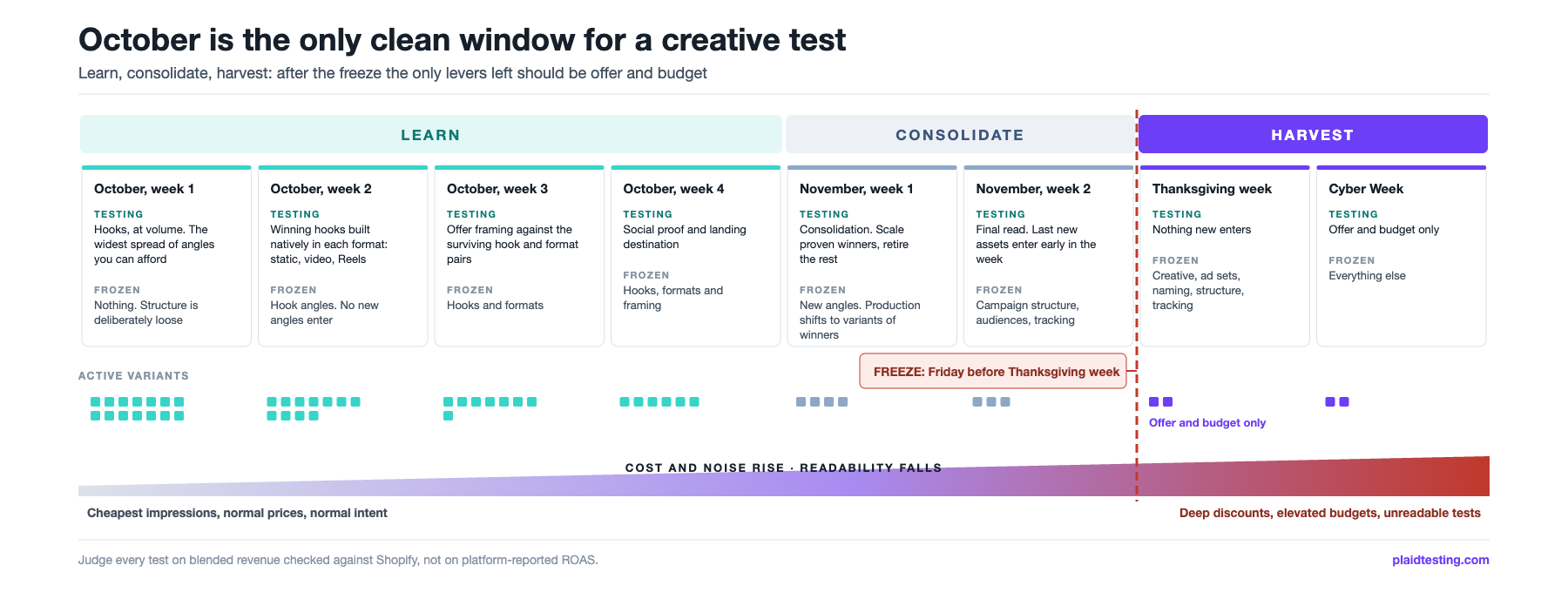
Testing stops before Cyber Week, not during it. The schedule below is the shape we plan to, expressed in weeks rather than fixed dates so you can map it onto whichever calendar the year gives you.
| Week | What is being tested | What is frozen | Why |
| October, week 1 | Hooks, at volume. Widest spread of angles you can afford | Nothing. Structure is deliberately loose | Cheapest impressions of the quarter and the cleanest read you will get all year |
| October, week 2 | Winning hooks expressed in each format: static, video, Reels-native | Hook angles. No new angles enter | You cannot judge format if the message is also moving |
| October, week 3 | Offer framing against the surviving hook and format pairs | Hooks and formats | Framing is the variable that will carry into November, so it gets a clean week |
| October, week 4 | Social proof and landing destination | Hooks, formats and framing | Two cheap tests that usually move conversion rate more than another round of hooks |
| November, week 1 | Consolidation. Scale proven winners, retire the rest | New angles. Production shifts to variants of winners | Delivery needs time to stabilize on what you intend to run at peak |
| November, week 2 | Final read. Last new assets enter early in the week | Campaign structure, audiences, tracking | Anything entering later cannot be evaluated before it matters |
| Freeze: Friday before Thanksgiving week | Nothing new enters | Creative, ad sets, naming, structure, tracking setup | Changes reset delivery and you cannot diagnose anything at peak volume. The freeze protects the read you spent October buying |
| Cyber Week | Offer and budget only | Everything else | The only levers left should be the two you planned for, pulled from a library you already trust |
Judge the result on the blended number, not the platform number. Meta Ads Manager reports what Meta can attribute to itself, and that view is useful for in-platform decisions like which ad set gets budget. It is not the same as the business result. Read the test against blended revenue in Triple Whale or Northbeam, checked against your Shopify reporting, with GA4 and Google Tag Manager confirming that the events you are counting are the events you think you are counting. When platform-reported ROAS and the blended number disagree, the blended number is the one you have to explain to the owner.
We work with an athletic apparel brand whose sales are up 35.7% year to date, reaching $9.27M, on paid media investment up 42% year over year, with blended ROAS held at 3.36x across six months. That was a deliberate decision to scale rather than squeeze efficiency, and it was only a defensible decision because it was measured on blended ROAS rather than on platform-reported ROAS. A creative test has to be judged the same way. An asset that lifts platform-reported ROAS while blended revenue stays flat has not won anything.
The creative calendar and the paid media program have to be planned as one thing. A creative freeze that is not matched by a freeze on campaign structure, audiences and tracking is not a freeze, and the first week of a Meta Conversions API change landing on Black Friday is not a week anyone enjoys.
Common questions
How many creative variants should I run in a single October test?
Enough cells that the comparison is meaningful, few enough that each one gets real spend for several consecutive days. The failure mode is not too few variants, it is too many underfunded ones. If your budget divided by your cells leaves each cell with a trickle, cut the number of cells rather than shortening the test. A slow clean answer beats a fast unreadable one.
Can I test creative during Cyber Week at all?
You can run new creative, but you should not call it a test. Discounts are deep, budgets are elevated and competitors are moving, so a difference between two assets in that window cannot be attributed to the assets. Adobe Analytics reported apparel discounting at 25% off listed price on Cyber Monday 2025, which tells you what is actually driving the click. Run what you proved in October and read the week as a revenue outcome.
Should I test the same creative on Meta and TikTok at once?
You can, provided you treat them as two separate reads rather than one. Build the asset natively for each, run it in Meta Ads Manager and TikTok Ads Manager on their own schedules, and do not average the results. A hook that wins in one feed frequently loses in the other, and that difference is information about the platform, not a contradiction to resolve.
What if my October budget is too small for a clean read?
Then test fewer things properly. Pick the single variable that matters most in your category, usually hook or offer framing, and spend the whole October testing budget resolving it. Two clean answers going into November are more useful than five ambiguous ones. Everything you do not resolve becomes a decision you make on judgment, which is acceptable as long as you know that is what you are doing.
When should October testing actually begin?
Earlier than most brands start. The first week of October should already be running, which means briefs, production and tracking checks happen in September. If you are still building assets in mid-October, you will get one usable round instead of four, and the freeze date does not move to accommodate you.
If you want the October testing plan built and run against your own account and your own margin structure, that is what our performance creative work is for. Start there, or start with a conversation about what your last Q4 actually told you.
Related reading
- BFCM 2026 Paid Media Calendar for Ecommerce Brands — where the October testing window sits in the wider plan
- Meta Ads for Black Friday: Structure and Budget Pacing — how to pace budget once the testing is done
- All Insights