
Build three durable campaign layers, keep them live all year, and pace budget by phase rather than by day. The account changes less than most teams expect at Black Friday. What changes is the offer, the creative, and how fast you feed budget in. The pre-sale dip is the part that breaks plans.
That last point is where most November plans come apart, so it gets a section of its own below. Structure first.
How should I structure Meta ads campaigns for Black Friday?
Run in November what you ran in September, with the offer swapped in. A rebuild three weeks out throws away the delivery history that makes the four days work, and a fresh campaign starts its learning period from nothing at the moment you can least afford instability. Meta does not publish a public rule for when that period ends, so treat it as a cost attached to every structural change rather than a number you can manage against.
Three layers carry the work. A prospecting layer holds most of the budget and most of the creative variety. A retargeting layer stays small in budget and does a disproportionate share of the closing across the window. A capture layer, branded search in Google Ads alongside a catalog campaign in Meta Ads Manager, picks up demand the first two layers created and would otherwise hand to whoever bids on your name.
| Campaign layer | Objective | What sits in it | What you change during Cyber Week |
|---|---|---|---|
| Prospecting, broad | Sales, purchase optimization | Broad audiences, the widest creative set, your best performing evergreen angles plus offer-led variants | Budget up, offer creative rotated in, weakest ad sets paused rather than restructured |
| Advantage+ shopping | Sales, purchase optimization | Catalog and creative feed, existing customer budget cap set deliberately | Budget up, existing customer cap reviewed, new creative added to the same campaign |
| Retargeting | Sales, purchase optimization | Site visitors, add to cart, viewed product, engaged social, email non-openers | Budget up sharply for four days, frequency watched daily, offer stated plainly in the first frame |
| Branded search and catalog | Sales and capture | Brand terms in Google Ads, catalog or collection ads in Meta Ads Manager | Budget uncapped within reason, since this is the cheapest demand you will see all year |
The column that matters is the last one. Almost nothing in the architecture should change during Cyber Week. Budgets move, creative rotates, exclusions tighten, offer copy changes. The campaign map stays where it was. Every structural change made in the final week is a change you pay for in delivery instability during the only five days of the year that price instability at a premium.
Do Black Friday CPMs on Meta really explode?
Something moves, but the folklore describes it badly. In its Q4 and full year 2025 results, filed with the SEC on 28 January 2026, Meta reported that ad impressions delivered across the Family of Apps increased 18% YoY in Q4 2025, while the average price per ad increased 6% YoY in Q4 2025. The same filing reports ad impressions up 12% and average price per ad up 9% for the full year 2025.
Read that carefully, including what it cannot tell you. It is a company-level average across every country, placement, objective and advertiser on the platform. It is not a description of your account. Your prospecting CPM in US apparel on Black Friday is set by the advertisers bidding for the same people you want, and a global average says nothing about that auction. Meta also reported Family daily active people of 3.58 billion on average for December 2025, up 7% YoY, in the same filing.
What the figures do undercut is the reflex behind most Q4 planning. “CPMs explode, so bid higher” assumes a fixed pool of inventory and a bidding war over it. Meta’s own reporting for Q4 2025 shows inventory expanding as well. Supply grows alongside demand, and the auction still rewards whichever ad earns the impression at the price it is worth.
The practical consequence is that your lever in a crowded auction is rarely the bid. It is the ratio of value to cost your creative and your product page produce. Raising a cost cap in the last week usually buys volume you were losing for a different reason, and it buys it at the worst price of the year.
Why does ROAS sag in the weeks before the sale?
Because shoppers stop buying and start comparing. Through the first three weeks of November, people click, browse, add to cart, then wait for the discount they know is coming. Purchases that would have closed in an ordinary week get deferred into the window. Reported return falls while demand is quietly building, and the account looks its worst at exactly the moment it is doing its most valuable work: assembling the audience that converts on Black Friday.
Depth and timing vary. This shows up differently in every account, and in some it barely shows up at all. Brands that rarely discount see less of it. Brands that have trained a list to expect one big sale a year see a lot of it. There is no published figure that describes it, and any number you have been handed for it came out of somebody else’s account.
The dip is not the problem. The response to it is. Cutting spend through the dip removes the audience you need on 27 November, and there is no way to rebuild that audience in the four days when everyone else is bidding for it too. The account that looks disciplined on 15 November is often the account that has nothing to sell to on 27 November.
Reading the dip correctly is a measurement problem before it is a media problem, which is why tracking and attribution work belongs upstream of the November plan rather than inside it. Across a fashion apparel and accessories brand we work with, spend scaled 4x and the reporting had to change with it. We tracked new customer cost per acquisition and new-customer ROAS throughout, and reported blended sales and margin to the ownership team rather than platform-reported return alone. Over that period sales rose 249% and net profit rose 205% year over year, which was a full-year result and not a four-day one.
If you are not sure whether your current reporting would let you tell a pre-sale dip apart from a genuine problem, a growth audit will tell you before November does.
How should I pace budget across the Black Friday window?
By phase, and not evenly inside the phase. Shopify reported that its merchants hit a peak of $5.1 million per minute at 12:01 PM EST on Black Friday in 2025, in the same announcement covering $14.6 billion in Black Friday Cyber Monday GMV, up 27% YoY. That is the argument against a daily budget left to pace itself evenly across 24 hours. Demand inside the day is spiky, and a budget that spends a twenty-fourth of itself every hour is underweight during the hours that matter and overweight at 4am.
| Phase | Direction of budget | Bid or cost control posture | What you are watching |
|---|---|---|---|
| Pre-window, roughly 1 to 15 November | Hold at or slightly above October levels | Unchanged. Do not tighten cost controls because return softened | Add to cart and email list growth, not daily ROAS |
| The dip, roughly two to three weeks before the offer | Hold. Cutting here is the common and expensive mistake | Unchanged, or loosened slightly on prospecting | Audience build, cost per add to cart, landing page rate |
| Cyber Week, Thanksgiving through Cyber Monday | Up, in planned steps rather than one jump, with retargeting up sharply | Loosest of the year on retargeting, disciplined on prospecting | Blended return, margin after discount, intraday delivery and frequency |
| Post Cyber Monday | Down in steps, not off | Retightened to pre-window posture | New customer CPA, repeat rate, December gifting demand |
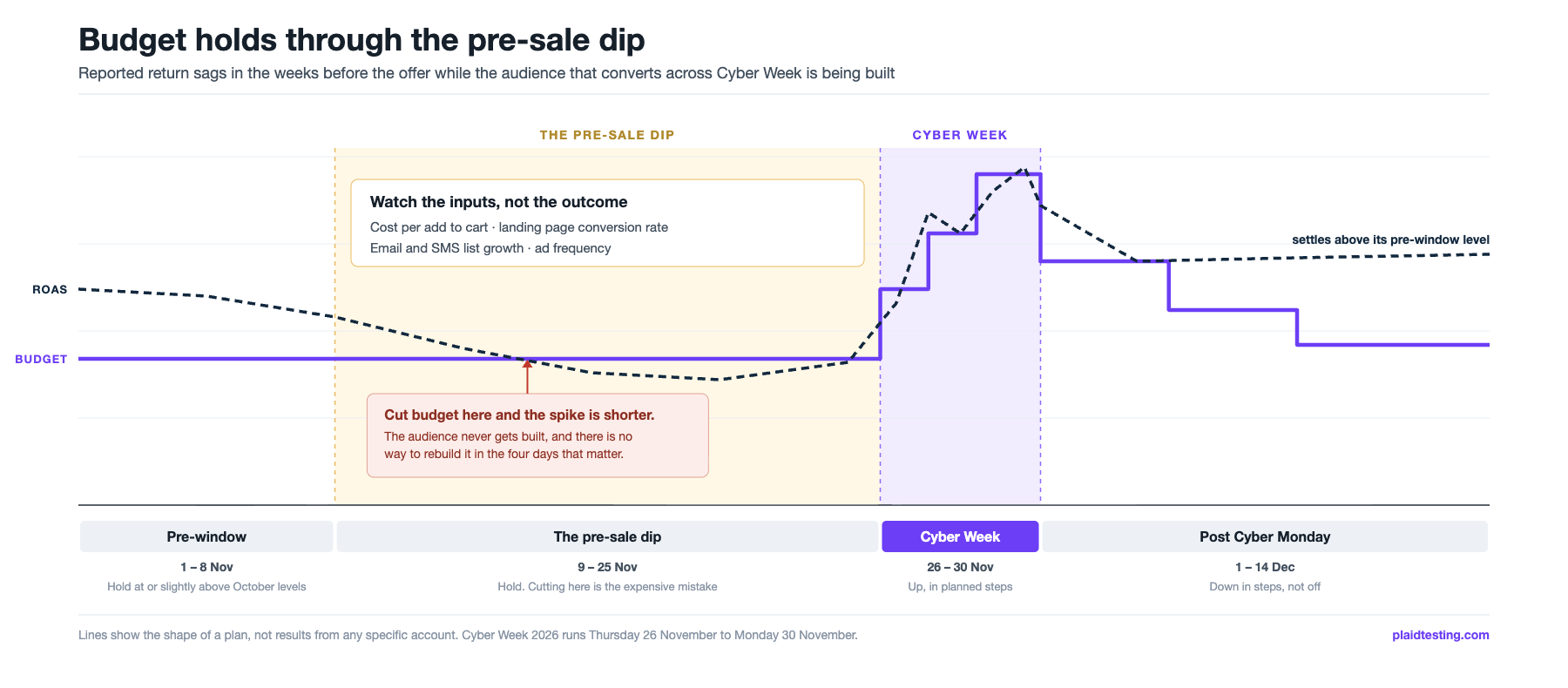
Three mechanics matter more than the numbers in that table. First, step budgets rather than doubling them overnight, because every large change resets the delivery system’s picture of the campaign. Second, decide before the window whether budget sits at campaign level or ad set level, because campaign budget optimization will move money toward whichever ad set is winning on the day and that is a feature during Cyber Week and a problem in the weeks before it, when you still want deliberate spend behind audiences you are building. Third, use dayparting or manual intraday increases on the days you know are spiky instead of asking a flat daily budget to be clever. This is ordinary paid media discipline applied to a week where the cost of getting it wrong is concentrated rather than spread out.
Should Black Friday and Cyber Monday get the same budget?
No, because they are different shapes. Adobe Analytics reported Black Friday 2025 online sales of $11.8 billion, up 9.1% YoY, and Cyber Monday 2025 online sales of $14.25 billion, up 7.1% YoY, in its Cyber Monday record announcement published 2 December 2025. The bigger day grew more slowly than the day before it. The National Retail Federation, in its post-weekend release published 2 December 2025, reported 85.7 million consumers shopping online on Black Friday against 75.9 million online on Cyber Monday. More people online on Friday, more dollars online on Monday.
Device behavior splits the two days as well. Adobe reported mobile at 57.5% of Cyber Monday online sales in 2025, while Salesforce reported in its Cyber Week results published 5 December 2025 that mobile drove 70% of online orders both globally and in the US. Those are different measures, share of sales against share of orders, from different methodologies, so they are not two versions of one number. Both point the same way for creative and checkout: build for the phone first, and treat Shop Pay or an equivalent accelerated checkout as part of the ad experience.
The Salesforce release contains the line worth the most planning attention. Average selling price rose 6% YoY while order volume rose 2% globally and 1% in the US. Growth came mostly from price, not from a meaningfully larger number of transactions. Adobe also reported average Cyber Monday discount depth in apparel of 25% off listed price in 2025. Plan for a market where your competitors are discounting hard, order counts are close to flat, and average order value is doing the work.
Common questions
Should I pause my evergreen campaigns and run a dedicated Black Friday campaign?
Usually not. A new campaign enters its learning period with no delivery history at the most expensive time of year, and the offer can be introduced through creative inside campaigns that already perform. A separate campaign makes sense if the offer targets a genuinely different audience, such as a lapsed customer win-back with different exclusions and a different landing page.
Does Advantage+ shopping replace my prospecting structure?
It can carry a large share of spend without replacing the reason the other layers exist. Retargeting exclusions, branded capture and a manual prospecting layer still give you places to test angles and control what the automated campaign does not see. Review the existing customer budget cap before the window, because a default setting will quietly change what the campaign is buying.
My return is down in mid-November. How do I tell a dip from a real problem?
Look at the inputs rather than the outcome. If cost per add to cart, landing page conversion rate and email capture are stable or improving while purchases lag, that pattern is consistent with deferral. If cost per add to cart is rising and creative fatigue metrics are climbing alongside it, that is a real problem and the window will not fix it.
Should I raise cost caps on Black Friday?
Raise them deliberately on retargeting, where intent is highest and the window is short. Be slower on prospecting. Meta’s Q4 2025 filing shows impressions growing faster than average price per ad at the company level, so the assumption that you must outbid everyone to be delivered is weaker than it sounds. Creative quality moves your delivered cost more reliably than the cap does.
How fast should budget come down after Cyber Monday?
In steps over the following week or two, not overnight. December gifting demand is real and a hard cut strands the audience you just paid to build. Watch new customer cost per acquisition and repeat purchase rate as they normalize, and keep the retargeting layer funded longer than the prospecting layer.
If your November plan still depends on a rebuild in the last three weeks, fix the structure now while a mistake is cheap. Our paid media team can review your current campaign architecture and pacing plan before the window opens.
Related reading
- BFCM 2026 Paid Media Calendar for Ecommerce Brands — the week by week plan this pacing sits inside
- BFCM Creative Testing: What to Test in October — how to build the creative library before the freeze
- All Insights