
NC-ROAS, or new customer ROAS, is revenue from first-time customers divided by total ad spend across every channel. It leaves out repeat orders that would have arrived anyway, so it shows whether the budget is growing the customer base. Triple Whale defines it as new customer order revenue divided by blended ad spend.
Search for “nc roas” today and most results explain ordinary ROAS, with no new customer split at all. That gap matters at $50K a month and above, because blended ROAS rises whenever loyal customers buy more, whatever the ads did. Acquisition is also getting dearer: Northbeam’s review of its advertisers found median customer acquisition cost up about 10% in the first half of 2026 against the first half of 2025, with ad spend up 12.38% (Northbeam, 6 August 2026). When each new customer costs more, the ratio that isolates them is the one to manage.
What is NC-ROAS, and how is it calculated?
The formula has two parts, and both need a precise definition. The numerator is revenue from orders placed by first-time customers. Triple Whale sums order revenue where the order is flagged as a new customer order, and flags an order as new when no earlier order exists for the same customer, matched on customer ID, email or phone (Triple Whale documentation). The denominator is blended ad spend: everything spent on paid media across Meta, Google, TikTok and the rest, plus any custom spend entered by hand (Triple Whale documentation). Platform-attributed revenue plays no part.
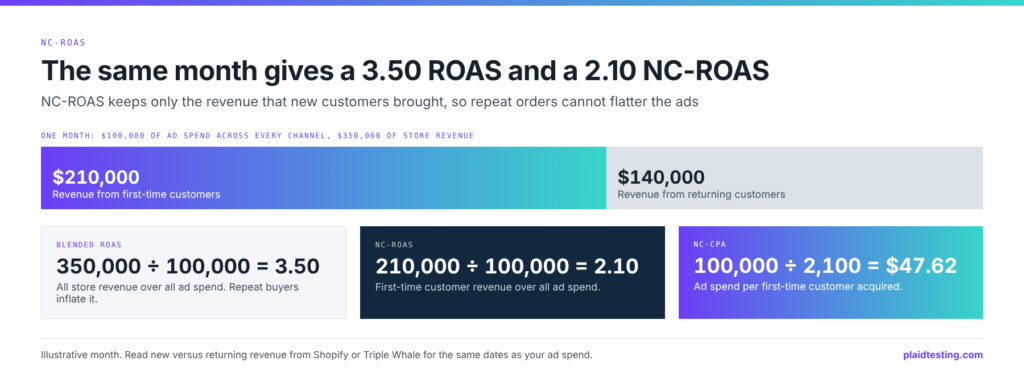
Two related metrics complete the picture. NC-CPA, which Triple Whale calls NCPA, is blended ad spend divided by new customer orders (Triple Whale documentation). First-order AOV is new customer revenue divided by new customer orders. The three are tied together: NC-ROAS equals first-order AOV divided by NC-CPA. That identity is useful when the number moves, because it says whether the change came from what new customers spend or from what they cost.
| Metric | Formula | What it tells you |
|---|---|---|
| Blended ROAS | All store revenue ÷ all ad spend | Whether total spend is covered by total revenue, repeat orders included |
| NC-ROAS | First-time customer revenue ÷ all ad spend | Whether ads are paying for growth in the customer base |
| NC-CPA | All ad spend ÷ new customer orders | What one new customer costs, across every channel |
| First-order AOV | First-time customer revenue ÷ new customer orders | What a new customer spends on the first order |
One caution on comparisons over time: Triple Whale changed its new customer logic on 5 October 2025, so a trend that crosses that date compares two definitions.
How do you pull NC-ROAS from Shopify or Triple Whale?
In Triple Whale, NC-ROAS and NCPA sit on the summary page and can be read for any date range. In Shopify, the inputs exist but need assembling. Shopify defines a first-time customer as one who placed their first order, judged across the store’s full history rather than the report window (Shopify Help Center). Its query language can group net sales by a new-or-returning customer dimension (Shopify developer documentation). Use net sales rather than total sales for the numerator, because Shopify’s first-time total sales figure includes taxes, shipping and duties.
The steps we follow are short:
- Pick the date range and pull net sales grouped by new or returning customer for it.
- Add up ad spend for the same dates from every platform, including any spend that runs through an agency or a creator platform.
- Divide first-time customer net sales by total ad spend for NC-ROAS, and total ad spend by first-time orders for NC-CPA.
- Write down which tool and which definition you used, and keep them fixed.
The last step matters because tools disagree. Triple Whale labels every order new or returning, while Shopify uses first-time, returning and a third, unassigned group, so their counts rarely match (Triple Whale documentation). Northbeam’s version divides attributed new customer revenue by spend rather than all new customer revenue. Each is defensible; switching between them halfway through a quarter is not.
Separating new from returning revenue is the step most accounts skip, and it is where our tracking and attribution work starts: the new customer split is checked against the store before any NC-ROAS target is set.
Why does NC-ROAS matter more than blended ROAS for growth?
Blended ROAS answers whether the ad budget is covered by revenue. It cannot say where that revenue came from, and returning customers can carry it a long way. Across Klaviyo’s customers over the five peak days of Black Friday and Cyber Monday 2025, returning customers accounted for 52.2% of apparel revenue, 55.4% in health and beauty and 70.2% in food and beverage (Klaviyo), and Klaviyo reported repeat purchases up nearly 14% year over year against 9% for new buyers (Klaviyo, 2 December 2025). In weeks like those, blended ROAS can climb even if the ads find fewer new customers.
The platforms’ own structure pushes the same way. Retargeting reaches people who already know the brand, and its conversions look cheap. In Haus’s review of 640 Meta incrementality experiments, retargeting held at roughly 15% of spend, and about 70% of the measured impact of Advantage+ campaigns came from new customers, against 65% for manual campaigns (Haus, 28 July 2025). Even well-run campaigns spend part of their budget on existing customers.
At a heritage fashion brand we work with, NC-ROAS rose from about 2.39 in the first quarter of 2025 to about 3.17 in the first quarter of 2026, per its Triple Whale account: new customer revenue of $879,650 on $368,198 of blended ad spend, then $6,060,308 on $1,912,212. Spend grew more than fivefold and the new customer return per dollar still improved. These are blended figures across every paid channel, no incrementality test isolated what the ads caused, and product and merchandising decisions moved them as well. It is the number the brand’s growth was judged on, which is why we report it beside blended ROAS every week.
What is a good NC-ROAS?
A good NC-ROAS is one that pays back what a new customer costs within a period the business can fund. Set the floor from first-order economics, then decide how much repeat value you are willing to count. If the first order must break even on its own, the most you can pay for a new customer is the contribution that order leaves, and the NC-ROAS floor is first-order AOV divided by that contribution. If repeat orders reliably follow within 90 or 180 days, add their contribution to what a customer is worth, and the floor drops.
| Payback assumption | Most you can pay per new customer | NC-ROAS floor |
|---|---|---|
| First order must break even ($90 first order, 45% contribution margin) | $40.50 | 2.22 |
| First order plus $15 of contribution from repeat orders within 90 days | $55.50 | 1.62 |
| First order plus $25 of contribution from repeat orders within 180 days | $65.50 | 1.37 |
The illustrative table shows how quickly the floor falls when repeat value is counted, which is exactly why that value has to be measured in cohorts rather than assumed. Count repeat contribution only for the window you can fund and only at the rate past cohorts actually achieved. First orders also carry costs repeat orders do not: welcome discounts, free shipping thresholds and higher return rates on a customer’s first purchase. Build first-order contribution margin with those included; the break-even ROAS calculator has a first-order discount field for that reason.
How do you steer Google and Meta toward new customers?
Google’s customer lifecycle goals give two modes for acquisition. New customer value bids higher for new customers than existing ones, and new customer only bids for new customers alone; both are available in Search, Performance Max, Shopping and Demand Gen, and Google recommends the first for most purchase goals (Google Ads Help). Google identifies existing customers by autodetection from up to 540 days of account activity, and you can sharpen it with Customer Match lists, which need at least 100 active members, and a new customer parameter in the conversion tag (Google Ads Help).
Meta removed the old shortcut. The existing customer budget percentage is not available in new Advantage+ campaigns, and Meta’s developer documentation now points to a structural replacement: one ad set that includes the existing customer audience with a daily spend cap, and one that excludes it (Meta for Developers). In practice that means keeping customer lists current, excluding them from prospecting ad sets and capping what retention ad sets can spend.
Neither platform’s own new customer reporting replaces the store-side number. Use the settings to steer bidding, then judge the result on NC-ROAS and NC-CPA from Shopify or Triple Whale. Our paid media management reallocates budget across platforms on those two figures each week.
Why can NC-ROAS fall while sales rise?
Because the two numbers measure different things, they can move in opposite directions, and the reason usually shows up in one of five places. First, spend shifted toward retargeting or toward broad campaigns that found existing customers, so repeat revenue rose and new customer revenue did not. Second, first-order AOV fell, often because a heavier welcome discount or a cheaper entry product lowered what new customers spend. Third, scaling ran past the efficient part of the curve, so each extra dollar bought fewer new customers; our guide to marginal ROAS covers how to find that point.
Fourth, the season changed. Peak weeks bring loyal customers back in force, so a falling NC-ROAS in late November can be the calendar rather than the ads. Fifth, the definition changed: a new tool, a new customer matching rule or a change in how guest checkouts are matched can move the new customer count without any change in buyers.
Check them in that order of likelihood, starting with the split of spend between prospecting and retention and the first-order AOV, before changing bids. If NC-ROAS is falling and you cannot tell which of the five is behind it, book a free 30 minute growth audit. We will split your revenue into new and returning, rebuild NC-ROAS and NC-CPA for the last two quarters and show where the change came from.
Common questions
What does NC-ROAS mean?
NC-ROAS stands for new customer return on ad spend. It is revenue from first-time customers divided by total ad spend across every channel. Unlike blended ROAS, it leaves out repeat orders, so it shows how much new customer revenue each dollar of advertising is associated with. Triple Whale reports it as new customer order revenue divided by blended ad spend.
What is the difference between NC-ROAS and ROAS?
Blended ROAS divides all store revenue by all ad spend, so returning customers count toward it. NC-ROAS divides only first-time customer revenue by the same spend. Platform ROAS is different again: it is the revenue one platform credits to itself. A brand with a loyal base can show a strong blended ROAS and a weak NC-ROAS at the same time.
What is a good NC-ROAS?
It depends on first-order margin and on how much repeat value you can count. If the first order must pay for itself, the floor is first-order AOV divided by first-order contribution: about 2.2 for a $90 order with a 45% contribution margin. Counting measured repeat contribution within a funded payback period lowers that floor.
Why does my new customer count not match Shopify?
Tools classify customers differently. Triple Whale labels each order new or returning by matching customer ID, email or phone, while Shopify groups customers as first-time, returning or unassigned. Guest checkouts, merged customer records and changes to matching rules all move the counts. Pick one source, document its definition and keep it fixed when comparing periods.