
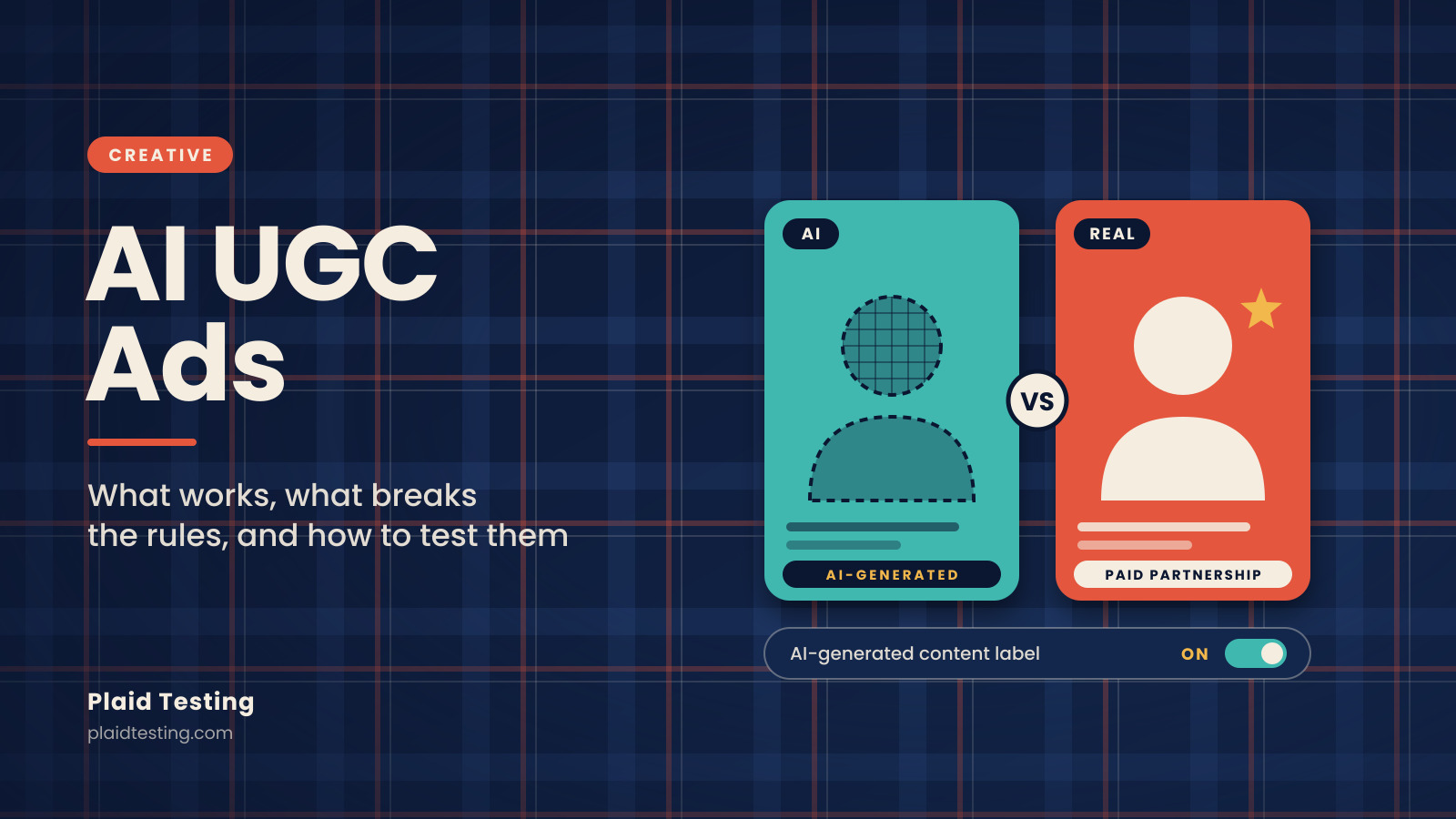
AI UGC ads use AI-generated presenters, voices or footage to imitate the look of creator content. They are useful for fast hook and script testing, but an AI avatar presented as a real customer is a fake testimonial under the FTC’s 2024 rule, and Meta and TikTok now label ads with realistic AI-generated people.
Brands are under pressure to produce more creative, faster, and AI tools promise exactly that. Used well, they shorten the testing cycle. Used carelessly, they create legal exposure and ads that viewers quickly learn to scroll past. This guide covers where they fit, the rules that apply, and a simple way to test them against real creators.
What AI UGC Ads Are
“UGC” in paid social usually means creator-style content: a person talking to camera about a product, filmed on a phone, in a home or on the go. AI UGC ads recreate that look with generated or synthetic elements. In practice they fall into four types:
| Type | What it is | Typical use |
|---|---|---|
| AI avatar presenter | A generated person reads a script to camera | Testing hooks and scripts quickly |
| AI voiceover | Synthetic voice over real product footage | Demos, translations, fast variants |
| AI-generated scenes | Generated b-roll, settings or product shots | Backgrounds and lifestyle context |
| AI-edited creator video | Real creator footage cut, resized or dubbed with AI | Extending a proven ad into new formats and languages |
Tools such as MakeUGC, Creatify, Arcads and HeyGen produce avatar-style videos from a script and product images. We name them as examples of the category, not as recommendations, and each has its own terms on likeness rights and commercial use that you should read before running paid ads.
Where AI UGC Actually Helps
The strongest case for AI creative is speed of learning. Meta’s delivery now rewards accounts that feed it genuinely different concepts, as our explainer on Meta Andromeda covers, and few brands can brief, ship and edit enough creator videos to keep up. AI tools let a team test ten opening lines or five angles in days, then spend the creator budget on the winners.
They also help with jobs that do not need a human face to be persuasive: translating a proven ad into another language, cutting a long demo into short variants, adding voiceover to product footage, or producing quick explainers for features and sizing. Where they help least is trust. When the point of the ad is that a real person tried the product and liked it, a synthetic person cannot deliver that honestly. Our guide to who runs the AI when AI runs the ads covers the broader question of where human judgment still matters.
The Rules: FTC, Meta And TikTok
Three sets of rules now apply to AI UGC ads for US brands.
| Source | What it says | What to do |
|---|---|---|
| FTC rule on fake reviews and testimonials (announced August 14, 2024) | Bans reviews and testimonials that falsely claim to come from someone who does not exist, including AI-generated fakes, and allows civil penalties for knowing violations | Never present an AI person as a customer with a real experience |
| Meta generative AI ad transparency (updated June 2026) | Labels ads made or significantly edited with Meta’s AI tools, shows the label next to “Sponsored” when a photorealistic AI person is added, and is starting to detect third-party AI ads and apply an “AI info” label | Assume realistic AI people will be labeled, and write ads that still work when they are |
| TikTok ad disclaimers | Requires a disclaimer for AI-generated, synthetic or manipulated media, switched on with the AI-generated content toggle in Ads Manager | Turn the toggle on for any ad with AI people, voices or scenes |
Sources: the FTC’s final rule announcement, Meta’s post on generative AI transparency in ads, and TikTok’s help page about ad disclaimers. Rules change often, so check each before a launch, and treat this as marketing guidance rather than legal advice.
What Crosses The Line And What Is Generally Fine
| Generally fine with disclosure | Crosses the line |
|---|---|
| An AI presenter explaining features, clearly as a brand spokesperson | An AI avatar saying “I have used this for three months and my skin cleared up” |
| AI voiceover on a real product demo | AI-generated before and after results |
| Dubbing a real creator’s ad with their written permission | Cloning a real creator’s face or voice without consent |
| Generated backgrounds around real product footage | Generated product footage that shows features the product lacks |
| Real reviews quoted on screen with permission | Invented reviews attributed to AI personas |
The test is simple: would a reasonable viewer believe a real customer had this experience? If yes, and no real customer did, do not run it. Health, beauty and supplement claims deserve extra care, because the underlying claim has to be substantiated whoever delivers it.
Thinking about adding AI creative to your testing? Schedule your free growth audit to see where it fits in your current creative mix; the call runs 30 minutes.
How To Test AI UGC Against Real Creators
Do not decide on AI creative by opinion. Run a controlled comparison where the only difference is the presenter.
| Step | What to do |
|---|---|
| 1. Pick one proven script | Use a concept that already works with a real creator |
| 2. Make matched versions | Same script, offer, length and edit, with an AI presenter in one and the creator in the other |
| 3. Run side by side | Same campaign and budget, with disclosure toggles on for the AI version |
| 4. Read the right metrics | Hook rate, hold rate, click-through rate, cost per purchase and new customer share |
| 5. Decide by job | Keep AI where it matches the creator on testing tasks; keep creators where trust drives the sale |
Give the test enough purchases on each side to compare before deciding, and repeat it on a second concept before changing your whole production plan. Many brands find AI presenters useful for finding hooks and weaker at closing sales, but your account is the only evidence that counts. Log every test in a shared sheet with the script, the presenter type and the result, so the team builds a record of what works for your buyers rather than relying on memory.
How To Brief AI UGC So It Does Not Look Generic
Most AI UGC fails for the same reason weak creator content fails: a vague brief. Viewers now recognize the stock avatar reading a stock script, and they scroll. The fix is to brief AI tools the way you would brief a good creator.
- Start from a real customer insight. Pull the exact objection or phrase from reviews, support tickets or post-purchase surveys, and build the script around it.
- Write one idea per video. A single problem, a single proof point and a single action. Scripts that list five benefits test nothing.
- Show the real product. Use your own footage of the product in use wherever possible, with the AI presenter or voice framing it, not replacing it.
- Match the presenter to the buyer. Pick voices and settings that fit the audience you are testing, and vary them across concepts.
- Keep claims you can prove. If a statement would need substantiation from a creator, it needs the same from an avatar.
A Creative Workflow That Uses Both
The practical answer for most brands is a split. Use AI to draft scripts, test hooks and angles, translate and resize, and keep real creators for the ads that carry the brand: reviews, try-ons, demonstrations and anything with a claim about results. Every AI asset gets a human review for accuracy, likeness rights and disclosure before it ships.
On TikTok, real creator posts boosted with permission usually outperform anything synthetic; our guide to TikTok Spark Ads explains the setup, and our TikTok ads management page shows how we run it. For apparel brands, our list of clothing ads that sell marks which formats suit AI and which need a real wearer. Our performance creative service runs this mixed workflow, and our Meta ads management puts the winners into a structure that scales.
Not sure where AI belongs in your creative plan? Get a growth audit from Jason Lu, free, and leave with a test plan that matches AI and creator content to the right jobs.
AI UGC Ads FAQs
Are AI UGC ads legal?
Using AI in ads is legal, but presenting an AI-generated person as a real customer with a real experience can violate the FTC’s 2024 rule on fake reviews and testimonials. Disclose AI content and avoid fake testimonials.
Do AI UGC ads need a label on Meta and TikTok?
TikTok requires a disclaimer for AI-generated, synthetic or manipulated media through its Ads Manager toggle. Meta labels ads made or significantly edited with its AI tools and is starting to detect third-party AI ads.
Do AI UGC ads perform as well as real creators?
It varies by account and concept. Test matched versions with the same script and offer, and judge on cost per purchase and new customer share, not views.
What are UGC ads?
UGC ads are paid ads that use creator-style content, usually a person filmed on a phone talking about or using a product, rather than polished studio footage.
Can I use AI to translate my existing creator ads?
Yes, with the creator’s written permission for their likeness and voice, and with platform disclosure turned on where required.