
The best Cyber Monday marketing ideas build on Black Friday rather than repeat it with a bigger discount: a Monday-only bundle or category, early messages to people who have bought before, paid budget focused on warm audiences, and a phone checkout with no surprise costs. Each one aims to add orders without cutting the price of every unit.
Cyber Monday 2026 falls on Monday 30 November, three days after Black Friday on Friday 27 November. The ideas are grouped by the job they do, and each comes with a note on what it costs in margin, so you can pick the ones your numbers can carry.
How is Cyber Monday different from Black Friday?
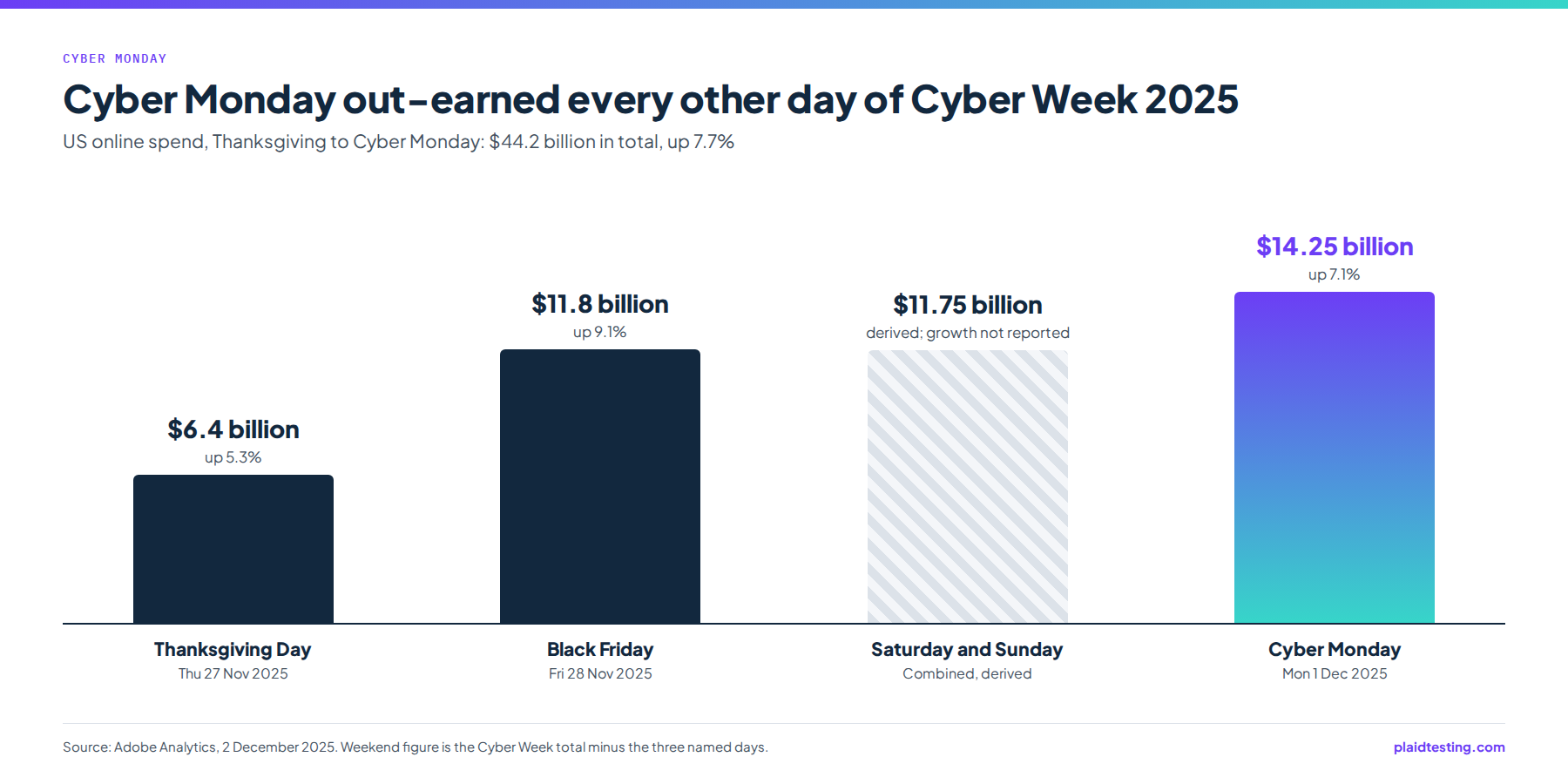
In 2025, Cyber Monday took in more money online than Black Friday, from fewer online shoppers. Adobe put US online spend on Cyber Monday 2025 at $14.25 billion, up 7.1%, against $11.8 billion on Black Friday, up 9.1%, and $6.4 billion on Thanksgiving Day, up 5.3% (Adobe, 2 December 2025). Adobe’s Cyber Week total, Thanksgiving through Cyber Monday, came to $44.2 billion. That leaves $11.75 billion for Saturday and Sunday combined ($44.2 billion minus $6.4 billion, $11.8 billion and $14.25 billion), so Monday alone out-earned the whole weekend.
The NRF counted people rather than dollars, and its count runs the other way. Its survey found 85.7 million people shopped online on Black Friday 2025 and 75.9 million on Cyber Monday (NRF, 2 December 2025). Put the two sources side by side and Monday looks like a day of fewer online shoppers who each spend more. The two sources measure different things, one dollars and one people, so the comparison shows a direction rather than a precise ratio. For planning it means Monday rewards the shopper who comes back with intent, not the one who is still browsing.
Two more figures from the same Adobe release shape the Monday plan. Mobile accounted for 57.5% of Cyber Monday online sales, or $8.2 billion, up 8.0%, and buy now, pay later drove $1.03 billion, up 4.2%, an all-time high. For marketing, the difference is less about the calendar than about who is still shopping. By Monday, many buyers have seen the Black Friday offers, have a list in progress and are coming back to finish it. Ideas that reward people who already know you, recover abandoned carts and make a phone checkout quick suit that shopper better than a fresh round of discounting.
| Measure (US, 2025) | Black Friday | Cyber Monday | Source |
|---|---|---|---|
| Online spend | $11.8 billion | $14.25 billion | Adobe, 2 December 2025 |
| Growth in online spend, year over year | 9.1% | 7.1% | Adobe, 2 December 2025 |
| People shopping online | 85.7 million | 75.9 million | NRF, 2 December 2025 |
| People shopping in store | 80.3 million | Not reported | NRF, 2 December 2025 |
| Mobile share of online sales | Not in our sources | 57.5% ($8.2 billion, up 8.0%) | Adobe, 2 December 2025 |
| Buy now, pay later spend | Not in our sources | $1.03 billion, up 4.2%, an all-time high | Adobe, 2 December 2025 |
Which offer ideas protect margin on Cyber Monday?
Every extra point of discount comes out of contribution on every unit sold, including units that would have sold at the Black Friday price anyway. The ideas below add a reason to buy on Monday without widening the cut across the whole catalog. For the arithmetic on how deep a discount your margin can carry, our guide to the average Black Friday discount and what to offer in 2026 works through it step by step.
Extend the offer and change one element. Keep the Black Friday offer running and add one new thing on Monday: a category that was not in the sale, a bundle, or a gift above a spend level. People who saw Friday’s ads get a reason to look again, and your list does not learn that waiting three days earns a bigger cut.
Build a Monday-only bundle. Pair a product that sells well on its own with one that moves slowly, and price the pair below the two bought separately. The saving is spread across the set rather than applied to your best seller alone, and the slower product gets a push before January.
Offer a gift above a threshold. A gift costs you its landed cost on qualifying orders only, while a percentage off costs you a share of every order. Set the threshold from your own average order value. For scale, Shopify merchants averaged a cart of $114.70 across BFCM 2025 (Shopify, 2 December 2025), but that blends very different stores and is no substitute for your own figure.
Use shipping instead of more percentage. In Baymard Institute’s abandonment research, updated 22 September 2025, extra costs that felt too high drove 40% of US shoppers who quit a checkout for a reason other than browsing, and 20% of the same group cited delivery that was too slow. Free shipping over a threshold speaks to the first complaint and a free upgrade to faster delivery to the second, each at a cost you can model per order.
If Monday does bring a new price rather than a new element, check the feed before you schedule it. Google shows a sale price annotation in US Shopping ads only when the discount sits above 5% and below 90%, and only when the regular price was charged on 5 of the last 30 days or 15 of the last 200 (Google Merchant Center Help).
Which paid media ideas work best on Cyber Monday?
Monday is a poor day to build anything new in an ad account. The paid media ideas that hold up on Cyber Monday are changes you plan in October and schedule in advance, not launches on the day.
Give Monday its own seasonality adjustment only if its offer changes. Google positions seasonality adjustments for short events lasting 1 to 7 days and cautions that they can be less effective once a period runs beyond 14 days. They can be used in Search, Shopping and Display campaigns that bid to a Target ROAS or Target CPA, and in Performance Max with any bid strategy, and Google advises using them only for major expected shifts in conversion rate, since Smart Bidding already accounts for seasonal events (Google Ads Help). If Monday carries Friday’s offer, the adjustment you scoped to 26 to 30 November already covers it. If Monday brings an offer you expect to convert very differently, split the window instead: one adjustment for Thursday 26 to Sunday 29 November and a separate one for Monday 30 November alone, each sized from your own data, so the two never overlap. Our Black Friday Google Ads playbook covers the settings in full.
Move Meta budget toward warm audiences within the structure you already have. People who viewed products or left a cart over the weekend are the audience to reach, with Monday’s addition in the copy. Shift budget inside the campaigns you set for Black Friday rather than launching new ones, which would start from no history at the worst moment. If that structure is not settled yet, start with how we set up and pace Meta campaigns for Black Friday.
Swap in Cyber Monday creative on the day it becomes true. Load and approve Monday ads in advance, then schedule them to replace Friday’s lines. Our Black Friday ad copy examples include Cyber Monday and last-chance lines written for exactly this switch.
Pace from your own 2025 orders. Set Monday’s budget from what your account did on Cyber Monday 2025 and check spend against it during the day. Our public sources give no reliable hour-by-hour pattern for the day, so the plan leans on your own order log instead. The BFCM 2026 paid media calendar shows where Monday sits in the wider plan, and our paid media service runs Google and Meta against one budget so Monday’s shifts happen in both at once.
If you are setting Cyber Week budgets now and want them checked against your margin before they go live, see how our paid media team plans and paces Cyber Week spend across Google and Meta.
Why should returning customers come first?
Someone who has bought from you already trusts the store, knows the sizing and may have a saved account or payment method. Reaching them by email or SMS usually costs less than paying again for their attention on Meta or Google, which makes them the natural first audience for a Monday offer.
Returning customer revenue rose 52.0% at an athletic apparel brand we work with, from the first half of 2025 to the first half of 2026, measured in its Triple Whale account. It illustrates why we plan Cyber Monday around people who have bought once: that revenue already exists in the business, and Monday’s job is to give it a reason to come back. The figure is a half-year number that reflects product and retention work alongside media, and it is not a Cyber Monday result.
The timing supports it. By the Thanksgiving weekend of 2025, 84% of shoppers in the NRF survey published 2 December 2025 had begun holiday buying, and they still had 53% of it ahead of them. So many of the people you reach on Monday are part way through a list, not starting one. Ideas that fit:
- Customers hear first. Send the Monday offer to past buyers by email and SMS before paid media starts reaching new audiences with it.
- Build the offer from what they own. A refill, the matching piece or the next size up is an easier yes than a random discount, and it keeps the offer relevant.
- A customer-only extra instead of a deeper cut. Free shipping at any order size, or early access to the Monday bundle, rewards loyalty without lowering the unit price.
- Separate buyers from prospects. Exclude recent purchasers from prospecting campaigns and give them their own ads showing products that complement what they bought.
- Do not resend a used offer. Suppress anyone who ordered on Black Friday from the same message and send them the Monday addition instead.
Which mobile and checkout ideas recover orders?
Most holiday online spend moves through a phone. Adobe’s season figures show smartphones accounted for 56.4% of US online spend from 1 November to 31 December 2025, up from 54.5% in 2024, and buy now, pay later reached $20 billion for the season, up 9.8% (Adobe, 7 January 2026). A checkout that works well on a laptop can still lose orders on a small screen.
Averaged across 50 studies, the documented cart abandonment rate is 70.22%, according to Baymard Institute, updated 22 September 2025. Of the US shoppers who left for a reason other than browsing, 18% were put off by a demand to open an account and 17% by a checkout that was too long or complicated. Baymard’s view is that better checkout design could raise conversion rate by 35.26% for the average large ecommerce site. Those are the fixes to make before the peak, not during it:
- Guest checkout by default. Offer account creation after the order, not before it.
- Express wallets near the top. Shop Pay was used on 32% of Shopify merchants’ BFCM 2025 orders, according to Shopify’s release of 2 December 2025, so accelerated wallets deserve a place above the form fields.
- Costs and delivery dates on the product page. Show shipping cost, any threshold and an estimated delivery date before the cart, so nothing new appears at the last step.
- Discounts that apply through the link. Typing a code on a phone is a step you can remove by applying the offer automatically from the email or ad.
- Payment options stated early. If you offer buy now, pay later, say so on the product page rather than only at payment.
- Cross-border basics. Cross-border orders were 16% of Shopify merchants’ BFCM 2025 orders in the same Shopify release. If you ship abroad, show prices and duties clearly for those shoppers.
Test the whole path on a real phone, from ad to confirmation page, by Friday 13 November, the date our Black Friday checklist for ecommerce brands sets for finishing site and checkout work.
Which ideas should you pick first?
Not every idea suits every brand, and few teams have time for all of them in November. The scorecard rates each idea on what it does to margin, how much work it takes and where it fits best. The ratings are our qualitative judgment from planning Cyber Week, not measured results, so adjust them for your own costs and catalog.
| Idea | Margin effect | Effort | Best fit |
|---|---|---|---|
| Extend the Black Friday offer and add one Monday element | Neutral to positive: no deeper cut | Low | Brands whose Black Friday offer is already healthy |
| Monday-only bundle | Positive when the bundle price covers both products’ costs | Medium: new product page and feed entry | Catalogs with a strong seller and slower products |
| Gift above a spend threshold | Cost limited to qualifying orders | Medium: gift stock and fulfillment rules | Brands with a useful, low-cost add-on |
| Free or faster shipping over a threshold | Cost only on orders above the line | Low | Mid-priced products where shipping cost deters buyers |
| Customer-only early access or extra | Positive: little or no paid media cost | Low | Brands with an engaged email and SMS list |
| Warm-audience budget shift on Meta | Neutral: same budget, closer targeting | Low | Accounts with enough weekend traffic to retarget |
| One-day seasonality adjustment in Google Ads | Neutral: changes bidding, not price | Low, but easy to misapply | Accounts with a distinct Monday offer |
| Guest checkout and express wallets | Positive: recovers orders at no price cost | Medium: settings plus testing | Every store, before site work closes |
| Deeper sitewide discount on Monday | Negative on every unit sold | Low | Rarely; clearance goals with margin to spare |
Start with the rows that are low effort and neutral or positive for margin: extending the offer with one Monday element, customer-first messaging and the warm-audience shift. Then add one medium-effort idea, usually a bundle or a gift threshold, and only if it can be ready by Friday 30 October, when offers should be locked. Checkout fixes are the exception to the effort rule, because they pay back on every day of the season and not only on Monday.
The deeper sitewide discount sits at the bottom deliberately. It is easy to set up, which is why it is tempting, but it gives away margin on orders you would have won anyway and makes the following year’s offer harder to hold.
What should you do after Cyber Monday?
Cyber Monday ends the peak, not the season. Adobe’s season total for 1 November to 31 December 2025 was $257.8 billion in US online spend, up 6.8%, which puts the $44.2 billion of Cyber Week at about 17.1% of the two months ($44.2 billion divided by $257.8 billion). Salesforce, measuring differently, put 2025 holiday online sales at $294 billion in the US, up 4%, and $1.29 trillion globally, up 7% (Salesforce, 8 January 2026). Most of the season’s money is spent outside those five days.
Some of it arrives late. In Google’s research with Ipsos, shoppers placed the high point of their holiday spending after Christmas Day, 25 December (Think with Google, 14 November 2025). On Tuesday 1 December, start stepping budgets down, confirm any seasonality adjustment has ended and swap sale copy for gifting lines with real shipping cutoffs. As the month runs on, move toward gift cards and post-Christmas demand rather than switching the account off.
Then judge Cyber Monday on margin after returns, not on revenue. Retailers told NRF and Happy Returns (15 October 2025) they expected 17% of holiday sales to come back. The same report put expected returns at 19.3% of online sales for 2025, and 82% of consumers called free returns a major consideration. Compare Cyber Monday 2026 with 2025 on contribution after returns, the split between new and returning customers, average order value and return rate by offer. If Google, Meta and your store disagree on those numbers, fix the tracking before January planning; that is where our tracking and attribution work starts.
Not sure which of these ideas your margin can carry? Our growth audit for Cyber Week planning takes 30 minutes, costs nothing, and ends with three specific changes to make before offers lock on 30 October.
Common questions
Should Cyber Monday deals differ from Black Friday deals?
They should differ in one element, not in depth. Keep Friday’s core offer so early buyers do not feel penalized for acting first, and add something specific to Monday: a new category, a bundle or a gift above a spend level. That gives people who saw your Black Friday ads a reason to return without teaching them to hold out for a bigger discount next November.
Should we extend Black Friday sales through Cyber Monday?
Usually, yes. One continuous window from Thursday 26 to Monday 30 November is simpler for shoppers and keeps ad sets running without a restart. The case against is margin: if the Friday offer is too deep to hold for five days, end it sooner and give Monday a lighter, different offer. Decide before offers lock on 30 October, and schedule both versions in advance.
Is Cyber Monday bigger than Black Friday?
By online spend, yes. Adobe measured $14.25 billion on Cyber Monday 2025 and $11.8 billion on Black Friday. By the number of people shopping online, no, since the NRF survey counted 85.7 million on Black Friday and 75.9 million on Cyber Monday. Which day is bigger for your brand is a question for your own 2025 orders, so check both before you split the budget.
What time do people shop on Cyber Monday?
None of the public sources we rely on publish a reliable hour-by-hour pattern for Cyber Monday, so we do not plan around one. Your own data is the better guide: export hourly orders and sessions from Cyber Monday 2025, note when your busy and quiet spells fell, and time budget checks and email sends around them. Keep watching on the day, since 2026 may not repeat 2025.
Related reading
- Average Black Friday Discount: What to Offer in 2026: the margin math behind any Monday discount
- BFCM 2026 Paid Media Calendar for Ecommerce Brands: where Cyber Monday sits in the full Cyber Week plan
- Black Friday Google Ads: 2026 Playbook for Ecommerce: seasonality adjustments, feed prices and Cyber Week bids
- Black Friday Checklist for Ecommerce Brands (2026): the deadlines for offers, ads and checkout work