
Black Friday ad copy that sells does four things in one or two lines: it states the offer in plain numbers, names the product it covers, gives a real end date and adds one reason to trust the deal. The 30 examples below cover ten offer types, and every headline fits Google’s 30-character limit.
We wrote them the way we brief copy in the accounts we run: one idea per line, the number early, and no claim the brand could not back up if a customer or a platform asked. Treat the offer values as placeholders and replace them with your own before anything goes live.
What makes Black Friday ad copy work?
In late November your ad is not competing with ordinary ads. It is competing with every other sale in the feed, and most of them say the same thing. Salesforce counted $336.6 billion in global online sales during Cyber Week 2025, up 7%, yet order volume rose only 2% globally and 1% in the US while the average selling price rose 6% (Salesforce, 5 December 2025). Most of that growth came from higher prices rather than from many more orders, so your copy is fighting for a share of an order pool that barely grew.
The ads also cost more to show. Meta reported that ad impressions rose 14% year over year in the second quarter of 2026 and the average price per ad rose 12% (Meta, 29 July 2026). When the average ad costs more to show, a vague line wastes more money than it did a year before. The line is also read on a phone: the same Salesforce release of 5 December 2025 says mobile drove 70% of online orders during Cyber Week 2025, globally and in the US. Whatever matters has to sit in the opening words.
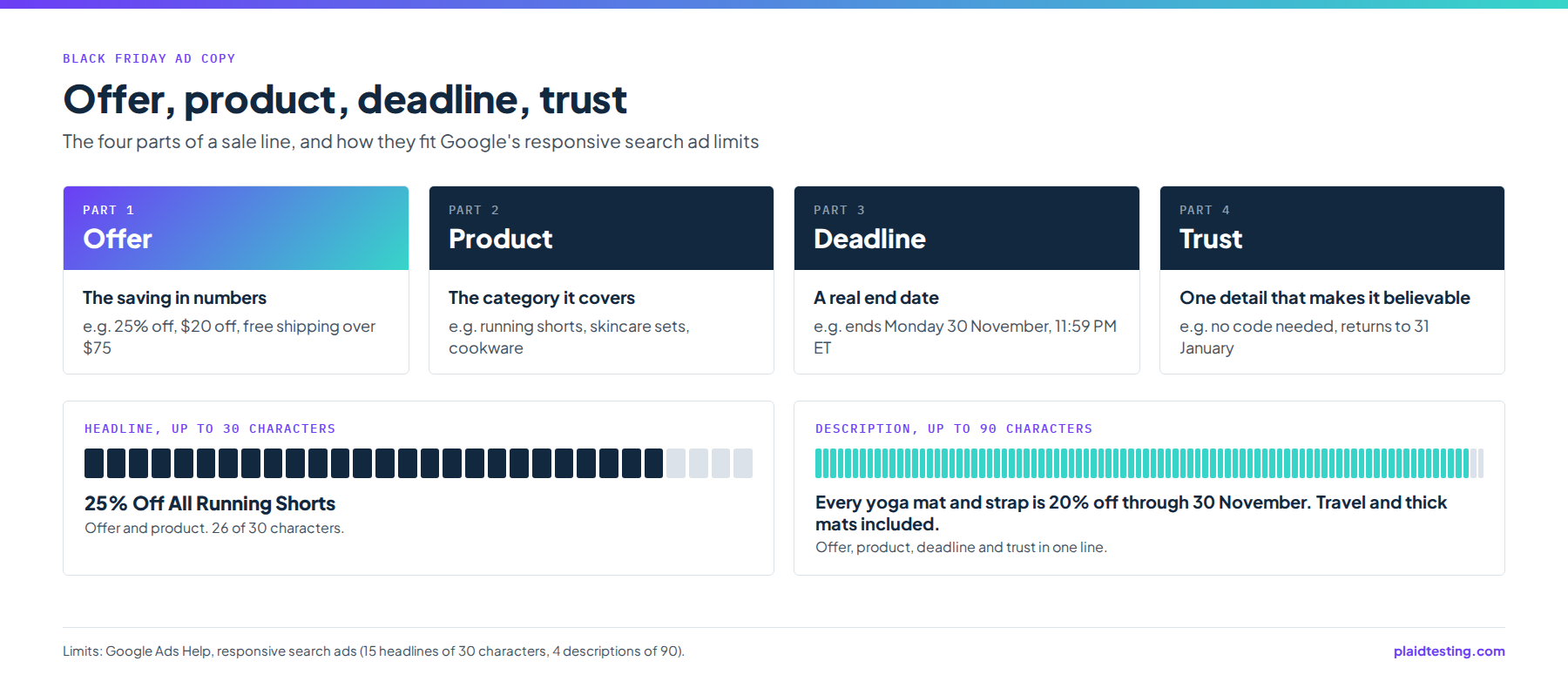
The formula we use has four parts. Offer: the saving in numbers, such as “25% off”, “$20 off” or “free shipping over $75”. Product: the category it applies to, so the shopper knows it is relevant before clicking. Deadline: a real end date, with a time zone once the end is close. Trust: one detail that makes the claim believable, such as “no code needed”, a return window or the regular price the saving is measured from. Drop the product and the offer could belong to anyone. Drop the deadline and there is no reason to act before Monday.
Copy should also be judged by what it does to the basket, not only by clicks. Comparing January to June 2026 with January to June 2025, average order value at an athletic apparel brand we work with rose 6.9%, per its Triple Whale account. That is the kind of number value framing (bundles, spend tiers, shipping thresholds) is built to move, and it is why several examples below ask for a bigger basket instead of a deeper cut. It does not show that copy caused the rise: product, pricing and merchandising changed over the same months, and we attribute no lift to any line of copy.
30 Black Friday ad copy examples by offer type
The three tables group the examples by the part of the formula that leads the line. Rows 1 to 10 lead with the offer, rows 11 to 20 lead with the product and the person it is for, and rows 21 to 30 lead with the words a shopper types into Google. Each table runs through the same ten offer types in the same order, so you can compare three ways of saying the same kind of deal and choose which angle to test first.
A few ground rules apply to all 30. Product categories are generic and no brand is named. The offer values, thresholds and shipping dates are placeholders that show structure, not recommended discount levels. For context, Adobe measured peak Cyber Monday 2025 discounts off listed price of 25% in apparel, 19% in furniture and 17% in sporting goods (Adobe, 2 December 2025). None of the lines use reviews, ratings, stock counts or superlatives about price, because each of those needs proof an example cannot supply. Every date in the tables sits on the 2026 calendar, where Black Friday lands on 27 November and Cyber Monday on 30 November.
Examples 1 to 10: lead with the offer
| # | Offer type | Headline (30 characters or fewer) | Primary text | Why it works |
|---|---|---|---|---|
| 1 | Percentage off | 25% Off All Running Shorts | Every pair of running shorts is 25% off from Friday 27 November to Monday 30 November. Lined, unlined and trail styles are all included. | The number and the category come first, so the deal reads at a glance. |
| 2 | Dollar off | $20 Off Any Skincare Set | Take $20 off any skincare set through Cyber Monday. No code needed: the discount shows in your cart. | A fixed amount is easy to picture on a mid-priced set, and “no code” removes a step. |
| 3 | Tiered spend | Save $10, $25 or $50 | $10 off orders over $75, $25 off over $150 and $50 off over $250, sitewide from 26 to 30 November. Applied automatically at checkout. | Each tier is a reason to add one more item, so it works on basket size, not just orders. |
| 4 | Bundle or set | Hat, Scarf and Gloves Set | Get the knit hat, scarf and gloves together for less than buying the three separately. Available in every colorway. | The saving is a comparison the shopper can check on the page, with no former price involved. |
| 5 | Gift with purchase | Free Tote With Any Coat | Order any winter coat between 26 and 30 November and a canvas tote ships with it at no charge. | Adds value without cutting the price of a high-ticket item. |
| 6 | Free shipping threshold | Free Shipping Over $75 | Free standard shipping on every order over $75 from 26 to 30 November. A beanie or a pair of gloves is an easy way to close the gap. | Names the threshold and suggests how to reach it. |
| 7 | Early access | Early Access for Subscribers | Email subscribers shop the full sale from Thursday 19 November, eight days before Black Friday. Sign up to get the link. | Rewards people who opted in and spreads orders over more days. |
| 8 | No-discount value | Holiday Returns to 31 January | No markdown on our leather boots, but anything bought in November can be returned until 31 January. | Takes away the gift buyer’s risk instead of lowering the price. |
| 9 | Cyber Monday extension | Cyber Monday: Extra 10% Off | The bedding sale runs through Cyber Monday, with an extra 10% off sheet sets on Monday 30 November only. | Gives Monday its own reason to buy instead of repeating Friday’s offer. |
| 10 | Last chance | Sale Ends Monday 11:59 PM ET | Luggage is 20% off until 11:59 PM Eastern on Monday 30 November. After that, prices go back to normal. | A real deadline with a time zone is urgency the shopper can verify. |
Offer-first lines are the default because a shopper can judge the deal at a glance. Their weakness is sameness, since every competitor can write “25% off” too. The product-led lines in the next table give the same offer types a person and a use, which matters when the reader is part way through a gift list. NRF found that 84% of holiday shoppers had already started by the 2025 Thanksgiving weekend, with 53% of their shopping still to do (NRF, 2 December 2025). A line that names the skier, the new dog owner or the parent of a growing child speaks to that half-finished list.
Examples 11 to 20: lead with the product and the person
| # | Offer type | Headline (30 characters or fewer) | Primary text | Why it works |
|---|---|---|---|---|
| 11 | Percentage off | Ski Season Layers, 20% Off | Heading to the mountains this winter? Base layers, ski socks and neck gaiters are 20% off through Cyber Monday. | Opens with a plan the shopper already has, so the discount reads as help with it. |
| 12 | Dollar off (was/now) | Wool Throw: Was $120, Now $90 | Our heavyweight wool throw is $90 through Monday 30 November, down from the $120 it sells for the rest of the year. | Shows the saving in dollars. Valid only if $120 is the genuine regular price. |
| 13 | Tiered spend | Stock Up on Socks, Save More | Buy three pairs of merino socks and save 10%, or six pairs and save 20%. Mix sizes and colors for everyone on your list. | Suits a gift that is often bought for several people at once. |
| 14 | Bundle or set | The Complete Dog Walk Kit | Leash, collar and treat pouch in one set, priced below the three bought separately. Sized for small to large dogs. | Sells the whole job, which helps a new owner who does not know what to pick. |
| 15 | Gift with purchase | Free Scraper With Any Skillet | Every cast iron skillet ordered from 26 to 30 November comes with a chain mail scraper for cleaning it. Nothing to add at checkout. | The gift is useful with the product, so it adds value rather than clutter. |
| 16 | Free shipping threshold | Stocking Stuffers Ship Free | Lip balm, hand cream and bath salts make it easy to reach $50. Every order over $50 ships free until 30 November. | Points to small add-ons that close the gap to the threshold. |
| 17 | Early access | Past Customers Shop First | Rain jackets and fleece open to past customers on Wednesday 18 November. Check your inbox for the early link. | Rewards buyers who already trust the store without a deeper discount. |
| 18 | No-discount value | Free Repairs on Every Bag | No Black Friday markdown on our canvas bags. Every bag bought this season comes with free repairs if a seam or zipper fails. | Protects full price with a reason to buy that a discount cannot match. |
| 19 | Cyber Monday only | Cyber Monday: Desk Setup Deals | Monday only: desk lamps, monitor stands and cable kits are 15% off, for the home office upgrade you keep putting off. | A Monday-only category gives returning visitors something new to see. |
| 20 | Last chance | Last Day: Kids’ Winter Gear | Snow boots, mittens and kids’ puffer jackets go back to full price after Monday 30 November. Sizes 2 to 14. | Speaks to a parent who needs the gear anyway, using the sale’s real end date. |
Row 12 is a was/now line, and so is row 22. Use either one only if the former price meets the FTC rule explained further down: the higher figure has to be a price the item was genuinely and openly offered at, on a regular basis, for a reasonably substantial period. If it was not, write the offer as a plain percentage or dollar amount instead. The search-led lines in the last table keep their primary text to 90 characters or fewer, so each can double as a responsive search ad description without edits.
Examples 21 to 30: lead with the search term
| # | Offer type | Headline (30 characters or fewer) | Primary text | Why it works |
|---|---|---|---|---|
| 21 | Percentage off | Black Friday Yoga Mats 20% Off | Every yoga mat and strap is 20% off through 30 November. Travel and thick mats included. | Mirrors the search term, so the ad reads as a direct answer to the query. |
| 22 | Dollar off (was/now) | Coffee Grinder Black Friday | Burr grinder was $150, now $120 through 30 November. Grinds for espresso to French press. | Pairs the query with a saving the shopper can check. Valid only if $150 is the genuine regular price. |
| 23 | Tiered spend | Black Friday Cookware Deals | Save $25 on orders over $150 or $60 over $300 on pans, pots and knives. Ends 30 November. | Tier amounts sit in the description, leaving the headline free for the search term. |
| 24 | Bundle or set | Gift Sets for Tea Drinkers | Loose leaf tea, a glass infuser and two mugs in one boxed set, priced below buying each. | A ready-made gift answers a search from someone shopping for another person. |
| 25 | Gift with purchase | Black Friday Hiking Boots | Free merino hiking socks with every pair of boots ordered from 26 to 30 November. | The query earns the click; the free gift is a reason to choose this store. |
| 26 | Free shipping threshold | Candle Gift Sets Ship Free | Candle orders over $50 ship free through 30 November. Order by 14 December for Christmas. | Answers a gift buyer’s two questions: what shipping costs and when the parcel arrives. |
| 27 | Early access | Black Friday Early Access | Free rewards members shop the sale from 18 November. Joining takes one email address. | Free to join, so it stays clear of Google’s bar on promotions that need a paid membership. |
| 28 | No-discount value | Leather Wallets for Gifting | Full price, gift ready: every leather wallet ships boxed with free gift wrap in December. | For gift searches, presentation is value the shopper would otherwise pay for. |
| 29 | Cyber Monday only | Cyber Monday Headphones Deal | 30 November only: wireless headphones are $40 off with a free case. Ends 11:59 PM ET. | Pairs the event name with the product for shoppers who search both together. |
| 30 | Last chance | Pajama Sale Ends Tonight | Flannel and cotton pajamas return to full price at 11:59 PM Eastern tonight, 30 November. | Specific and checkable. Schedule it to run on the final day only. |
Read across the tables and one pattern holds: the same offer can be framed as a deal, as a gift or as an answer to a search, and each framing suits a different placement. None of the last-chance lines invent scarcity. Rows 10, 20 and 30 point to when the sale actually ends, which is the only kind of urgency we write, and they should run only once that deadline is close and true. The shipping cutoff in row 26 is also a placeholder; use the date your carrier and warehouse can actually meet.
If you would rather have these angles tested inside a system than guessed at, our performance creative testing program plans the copy and creative tests, reads the results each week and runs production through your own creators.
How do you write to Google’s character limits?
A responsive search ad accepts as many as 15 headlines and 4 descriptions, and it needs at least 3 of the first and 2 of the second. Each headline can use 30 characters, each description 90 and each display path 15 (Google Ads Help). Spaces and punctuation count, so “Save $10, $25 or $50” uses 20 of the 30. Treat 30 as a hard cap: a 31-character headline has to be rewritten before it goes in.
Google assembles each ad from your pieces, and that changes how you write them. Every headline has to make sense next to any other headline, in any order. We write a Black Friday ad group as a set of jobs rather than 15 versions of one line: a few headlines that state the offer, a few that name the product, one or two carrying the end date, one with a trust detail such as free returns, and one that mirrors the search term. If five headlines all say “25% off”, Google has little to combine and the shopper learns nothing new from the second line.
Qualifiers belong in the same headline as the claim they qualify. “Free Shipping Over $75” works as a unit; “Free Shipping” in one headline and “On Orders Over $75” in another can be served apart, which turns an honest offer into a misleading one. Google does not recommend pinning for most advertisers, so keep it for the rare line that must always show and accept that it narrows what Google can test. Display paths are small but useful: “black-friday” fits in 12 characters and tells the shopper what the page is about.
Counting is dull, so automate it. Keep every headline in a spreadsheet with a length formula beside it and flag anything over 30 before it reaches the ads editor. Meta’s primary text allows longer lines, but a shopper scrolling a feed may read only the opening, so the offer and product still belong in the first words. For the campaign settings around these ads (sale prices in the feed, seasonality adjustments, budgets), our Black Friday Google Ads playbook covers each one, and our paid media team can build the Search side for you.
What pricing rules apply to “was” and “now” claims?
A was/now line is a claim about history. The FTC’s Guides Against Deceptive Pricing (16 CFR 233.1) accept a former price as a legitimate basis for a comparison only if it is “the actual, bona fide price at which the article was offered to the public on a regular basis for a reasonably substantial period of time.” An inflated or fictitious former price, in the words of the same guides, makes the bargain “a false one.” Raising a price in October so it can be marked down in November fails that test, and so does a “compare at” price the item was never actually offered at.
Sale claims do get checked. In a WalletHub study covered by NBC Chicago, 36% of online items showed no saving at all against what they cost before Black Friday, and the real discount averaged around 24% (NBC Chicago, 26 November 2025). A was price that does not hold up costs you trust with exactly the buyers who compare before they order.
Google layers its own rules on top. In Merchant Center, the sale price must be lower than the regular price, the landing page should show both prices and checkout should show only the sale price (Google Merchant Center Help). For a sale price annotation, the markdown has to sit between 5% and 90% (more than the first, less than the second), and in US Shopping ads the base price must already have been charged on at least 5 of the previous 30 days, or 15 of the previous 200 (Google Merchant Center Help). US merchant promotions must offer 5% or $5 off at minimum, run for 183 days at most and never hinge on a paid membership (Google Merchant Center Help). That last point shapes early-access copy: access through a free email list or free rewards program does not trip the paid-membership bar, while access sold as a paid membership cannot run as a Merchant promotion.
The practical control is a price log. Record each product’s regular price and the dates it was charged, and check every was/now line against it before the ad is approved. Wherever your store keeps its was or compare-at prices, review them for every product in the sale, not only the ones in your ads. This is general guidance rather than legal advice, and borderline cases belong with your counsel, but a written price history is the evidence you would want on file if a claim is ever questioned.
How should you test Black Friday copy before the sale?
You cannot test a Black Friday offer at full strength before Black Friday, but you can test nearly everything around it. The angle (offer first, product first or search term first), the way a saving is expressed (percentage or dollar amount), the trust detail and the call to action can all be tested in October on everyday offers such as a shipping threshold or a bundle. Our October testing guide for BFCM creative sets out the full method, and the principle is the same for copy: isolate one change, and run it while prices and buyer intent are still ordinary.
A clean copy test changes the words and nothing else. Keep the image or video, the audience, the landing page and the budget identical, and run the three angles from the tables against each other. If versions differ in angle, offer and call to action at once, a winner tells you nothing you can reuse in November. Judge the result on cost per purchase and average order value, not click-through rate alone: a line that wins clicks with a vague promise can lose once the shopper reaches the product page.
Then set a date for decisions. We finish sale copy in the week of 19 October, load it into paused ads and aim to have every sale ad approved by Friday 6 November, which is when paid media setup should be finished according to our dated Black Friday checklist. After that, the only copy changes should be scheduled ones, such as switching to Cyber Monday or last-chance lines on the dates they become true. Copy has to fit the campaign structure you set for the sale, and we lay that structure out for Meta in our Black Friday campaign and pacing guide.
A small team does not need more lines to do this well. It needs a test plan, a readout and a clear rule for what wins. That is the work our performance creative service does, while production stays with your own creators.
Which copy mistakes cost money in November?
The expensive copy mistakes in November are rarely about tone. They are claims that break a rule, confuse the shopper or outlive the sale. These are the ones we check for before anything launches:
- Former prices that were never really charged. This is the most serious mistake on the list, because it is a pricing claim rather than a style choice.
- Scarcity you cannot prove. Stock counts, countdown timers that reset and “almost gone” lines have to be literally true at the moment they are read. Your sale’s real end date is honest urgency; use it instead.
- Superlatives about price. A claim that your price is the best or the lowest needs evidence you would be comfortable showing a regulator. The examples above avoid them for that reason.
- An ad and a landing page that disagree. If the ad says 25% off and the product page shows full price until checkout, the shopper leaves, and Google expects both prices on the landing page when a sale price is in the feed.
- Codes that add friction. A code typed on a phone is one more step where an order can drop. Where your platform allows it, apply the discount automatically and say “no code needed”.
- Deadlines in the wrong time zone. Sale price dates in Merchant Center default to UTC when no time zone is given (Google Merchant Center Help). A sale price set to end on 30 November with no time zone stops at 11:59 PM UTC, which is 6:59 PM Eastern, five hours before an ad that promises 11:59 PM Eastern.
- Sale copy that outlives the sale. Give every Black Friday and Cyber Monday ad an end date when you build it, and schedule the post-sale replacements at the same time.
- “Sitewide” with exclusions. If new arrivals or some categories are left out, write “most items” or name what is included.
One more check sits outside the ads themselves. Give whoever answers customer questions the exact wording the ads use, including end times, thresholds and exclusions, so the answer a shopper gets in chat matches the line that brought them in. Several of these mistakes only surface when a customer quotes the ad back to you.
Before the change freeze on 20 November, get your Black Friday offers, tracking and ad structure checked by people who run these accounts every day. Book a free 30-minute growth audit and you leave the call with three fixes for your sale. There is no retainer to start.
Common questions
How long should Black Friday ad copy be?
As long as the offer needs and no longer. On Google Search the responsive search ad limits decide it for you, at 30 characters a headline and 90 a description. On Meta and in email, one or two sentences can usually carry an offer, a product and a date; anything beyond that should earn its place, such as a return window or an exclusion the shopper needs to know. Put the number and the product first either way, because a phone screen shows the start before anything else.
Should my ads say “Black Friday” in the headline?
In Search, it often helps when the query itself includes the event, because a headline with “Black Friday” plus the product mirrors what the shopper typed. In social feeds, every ad nearby may already carry the same two words, so the product or the offer can be the stronger opener. Treat it as a test rather than a rule, and run both versions in your own account during October.
Is it legal to show a “was” price in an ad?
Yes, when the former price is genuine. The FTC’s pricing guides accept a former price as a fair comparison only if it was the real price the item was openly offered at, regularly, for a reasonably substantial period. Google adds a separate test for sale price annotations in US Shopping ads. Keep a dated log of regular prices, and take borderline cases to counsel, since what we offer here is general guidance and not legal advice.
How many copy variations should we test?
Fewer than most teams expect, with one difference between them. Testing the three angles in the tables against each other, on the same image and audience, gives a readable answer in October. In responsive search ads, Google does the combining, so supply distinct headlines rather than near-copies of one line. Add more variations only when the budget can give each one enough purchases to judge it fairly.
Related reading
- BFCM Creative Testing: What to Test in October: run angle tests while prices are still normal
- Black Friday Google Ads: 2026 Playbook for Ecommerce: Search, Shopping and feed settings for the sale
- Black Friday Checklist for Ecommerce Brands (2026): dated checks from tracking to post-sale service