
A fractional CMO for startups makes sense once an ecommerce brand spends about $25,000 or more a month on paid media and the founder can no longer own every marketing decision. Expect to pay roughly $4,000 to $20,000 a month, and expect month one to go on fixing measurement, not on raising budgets.
The question matters more for ecommerce than most guides admit. U.S. ecommerce sales reached $340.2 billion in the second quarter of 2026, 17.1% of all retail sales and up 12.2% on a year earlier (U.S. Census Bureau, August 2026). More sales also means more bidders on the same few ad platforms.
Established companies budget marketing at about 7.8% of revenue, according to Gartner’s 2026 CMO Spend Survey of 401 marketing leaders (Gartner, May 2026). A DTC startup doing $3 million a year and spending $40,000 a month on ads is already at 16% of revenue on media alone. At that ratio, the quality of each budget decision is a survival question, not a reporting one.
Most pages about fractional CMO services for startups are written for B2B software companies. This one is for DTC and ecommerce founders. This guide covers what the role does at your stage, a spend-based test for when to hire, sourced costs, a first-90-days plan, the contract terms that protect a startup, and when not to hire one at all.
What does a fractional CMO do at an ecommerce startup?
At an ecommerce startup, a fractional CMO owns the decisions that sit above the ad accounts: how much to spend, on which channels, against which margin target, judged by which numbers. They write the plan, define the metrics, run the weekly review and decide which agency, freelancer or hire does the work.
A growth marketer is a different job: launching campaigns, shipping creative tests, building email flows and reporting results against a strategy. The trouble at most startups is that nobody has written that strategy down, so the new hire inherits the founder’s instincts and optimizes whatever dashboard they were handed.
| Question | Fractional CMO | Growth marketer hire |
|---|---|---|
| What they own | Budget, channel mix, metric definitions, vendor and hiring decisions | Campaigns, creative tests, email flows, weekly reports |
| Time commitment | Part time, a set number of hours a month | Full time |
| Main output | A plan, a forecast and decisions | Launched work and results against targets |
| Fails when | Nobody is there to execute the plan | There is no plan to execute |
Many ecommerce startups need both, in sequence: the fractional CMO first to define what good looks like, then a growth marketer or agency to run it. Hiring the executor first is the common mistake, because it feels cheaper and looks busy in week one.
For the week-to-week detail, see what a fractional CMO owns and hands over in the first quarter.
The stage test: which marketing leadership fits your monthly ad spend?
We use monthly paid media spend as the first filter, because it is the cleanest proxy for how much a wrong decision costs. The right fractional CMO for ecommerce startups depends on it more than on revenue, headcount or funding round. The table below is our rule of thumb from working with ecommerce brands, not an industry standard.
| Monthly paid media spend | Who should lead marketing | What a fractional CMO does | Rough time |
|---|---|---|---|
| Under $25K | Founder leads, freelancers execute | Usually too early to hire one | Occasional outside advice at most |
| $25K to $50K | Advisor-level fractional CMO, founder still runs the day to day | Sets measurement, margin targets and the quarterly plan | About 8 to 10 hours a month |
| $50K to $150K | Fractional CMO who also runs paid media through a small team | Owns the plan and the accounts: media buying, creative testing, reporting | Weekly involvement |
| $150K+ | Full-time CMO or VP of marketing | Acts as a bridge during the search and handover | Until the hire is made and settled in |
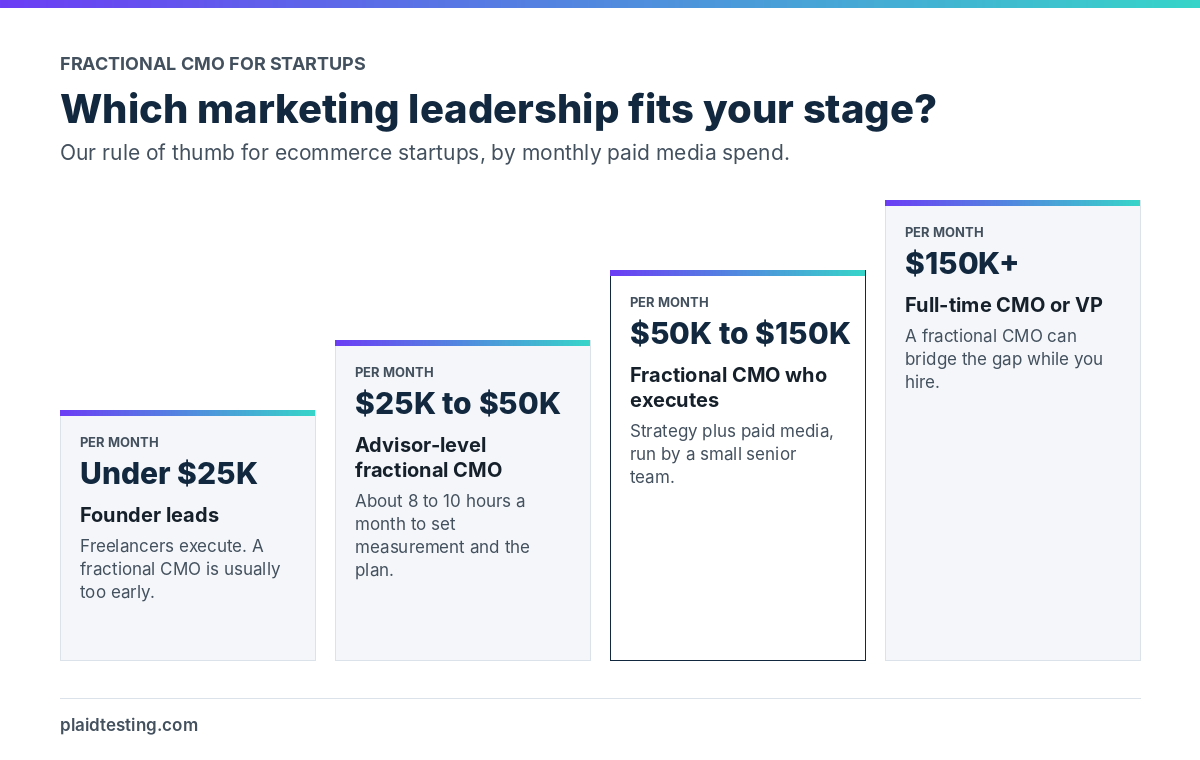
The thresholds come from the cost of mistakes. At $20,000 a month, a channel that wastes a third of its budget costs about $6,700 a month, which sits inside the market range for a fractional CMO retainer. Paying a senior leader to find it is roughly a wash. At $100,000 a month, the same mistake costs about $33,000 every month, and senior judgment pays for itself quickly.
In the $50K to $150K band, leadership without execution tends to stall, because the plan changes faster than a separate agency absorbs it, so we pair the two. Brands in this band that want a channel-level check first can start with a free paid media audit of their Google, Meta and TikTok accounts.
Spend is not the only test. A founder at $40,000 a month with clean tracking may need less help than one at $30,000 with three dashboards that disagree. The seven signals that an ecommerce brand is ready for a fractional CMO cover the rest.
What does a fractional CMO for startups cost?
Market data puts fractional CMO hourly rates at $150 to $500, with an average of $325, and monthly retainers at $4,000 to $20,000, with an average of $12,000 (Go Fractional, August 2026). Stage-based guidance from MarketerHire runs lower for early companies: $3,000 to $6,000 a month at seed or pre-Series A ($500,000 to $2 million in revenue), $6,000 to $12,000 at Series A and $12,000 to $20,000 at Series B and beyond (MarketerHire, June 2026).
Hourly billing suits the advisor tier. Eight to ten hours a month at $150 to $500 an hour comes to about $1,200 to $5,000, which makes the advisor tier the most affordable fractional CMO for startups that need senior input on measurement and planning. If that is all you need, a part time CMO with a fixed monthly hour block is the closer match. Retainers suit the execution tier, where the work is weekly and the hours are hard to predict.
| Option | Typical cost | What it buys | Basis |
|---|---|---|---|
| Advisor-level, billed hourly | About $1,200 to $5,000 a month | Measurement setup, margin targets, a quarterly plan | 8 to 10 hours at Go Fractional’s $150 to $500 hourly band |
| Fractional CMO retainer | $4,000 to $20,000 a month, $12,000 average | Ongoing leadership, weekly reviews, vendor management | Go Fractional, August 2026 |
| Full-time CMO | $374,414 median base salary, before bonus, equity and benefits | Full-time ownership of a marketing team | Salary.com, November 2026 |
Salary.com puts the median base salary for a U.S. chief marketing officer at $374,414 (Salary.com, November 2026). Benefits sit on top of that: for private-industry management and professional workers, benefits made up 31.5% of total compensation in June 2026 (BLS, September 2026). A $12,000 monthly retainer is $144,000 a year, under half the base salary alone.
There is a tenure risk too. Spencer Stuart found that CMOs at consumer companies last 3.5 years on average, the shortest of any industry it analyzed, against 4.1 years across the S&P 500 (Spencer Stuart, January 2026). A startup that hires a full-time CMO before it has a plan for them is making a bigger bet than the salary suggests.
The break-even test we use is simple: the fee has to come back as spend efficiency or margin. At $20,000 a month of ad spend, a $4,000 retainer means the budget must work 20% harder just to cover it. At $100,000, a $12,000 retainer needs a 12% gain, which is a realistic bar when tracking is broken or a campaign is plainly wasting money. We work through the math line by line in our fractional CMO pricing guide, and if you are shortlisting providers, our guide to comparing fractional CMO companies covers provider types and how to vet them.
Why a startup’s plan should include repeat purchase, not only acquisition
Most startup marketing plans run on one number, the cost to win a first order. It is the right first number and the wrong only number. Ecommerce brands that outgrow the startup stage tend to do it on repeat customers, so the plan should account for them from day one.
One brand we work with, an athletic apparel brand, compared the first half of 2026 with the first half of 2025. Units sold rose 63.8%, returning-customer revenue rose 52.0%, and sales reached $9.27M, up 35.7%. Revenue from returning customers grew faster than revenue overall, so repeat buyers carried more than their share of the growth.
Read those figures with care. They are store-wide Triple Whale numbers that blend every channel, not a clean measure of paid media. There was no holdout test, so we cannot say how much of the lift marketing caused. Product and merchandising changes also moved the results. And this brand is well past the startup stage.
What the numbers do show is the shape a startup should plan toward: acquisition priced against what a customer is worth over time, not only on the first order. In practice, that means setting a new-customer CPA target in month one and tracking repeat rate by monthly cohort from the start, even while the repeat numbers are small. Watch only blended ROAS and you overpay for customers who never return.
What happens in a fractional CMO’s first 90 days?
A useful first quarter at an ecommerce startup follows one order: measure, then rebuild, then scale. Skipping straight to scale is the most expensive mistake a new marketing leader can make, because every budget increase built on broken tracking multiplies the error.
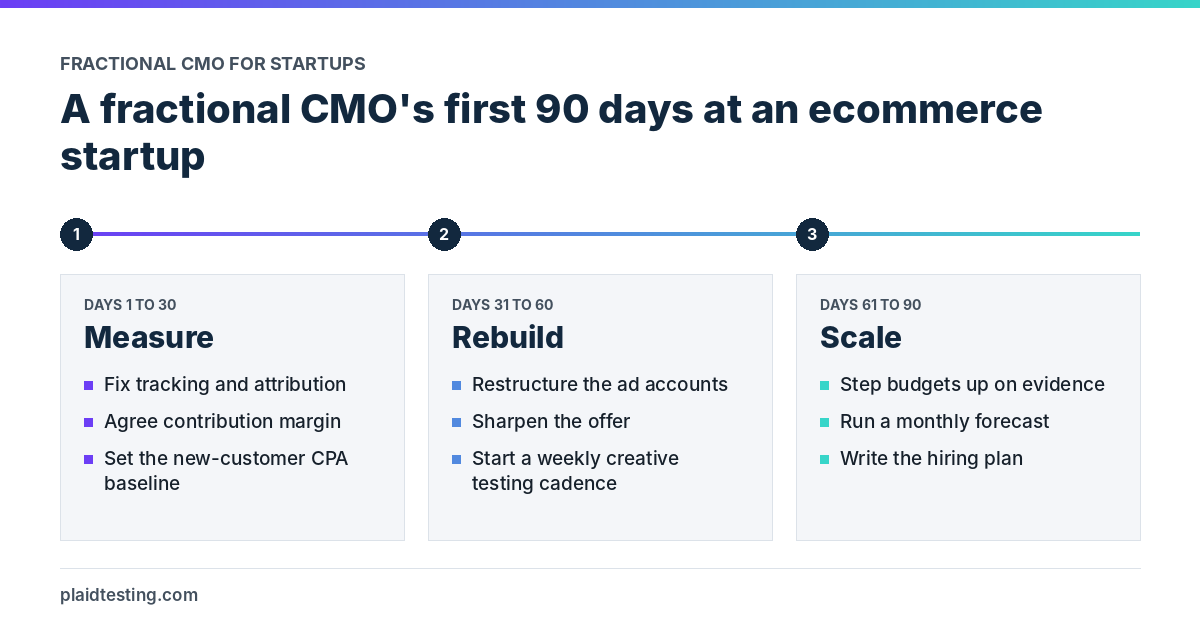
Days 1 to 30: Measure
Fix tracking first: check pixel and server-side events on every ad platform, reconciling platform-reported revenue against Shopify and the bank account, and agreeing one source of truth the founder and the team will both use. When the rebuild is the bottleneck, it can run as a dedicated tracking and attribution project alongside the strategy work.
Then calculate contribution margin per order: revenue minus product cost, shipping, payment fees, discounts and returns. Finally, set a baseline new-customer CPA by channel. By day 30, the founder should have three numbers everyone trusts.
Days 31 to 60: Rebuild
Rebuild the account structure so each campaign gets enough conversions to learn, with prospecting split from retargeting so new-customer CPA is visible. Rework the offer (bundles, first-order incentives, price points), testing each against contribution margin, not conversion rate alone. Set a creative testing cadence, with a fixed number of new concepts each week and a written log of what each test taught.
Days 61 to 90: Scale
Raise budgets in fixed steps, and only after new-customer CPA has held at target for a full week. Introduce a monthly forecast covering spend, new customers, contribution margin and cash, so the founder can see two months ahead. Close the quarter with a hiring plan: which roles go in house, which stay with an agency or freelancer, and when each one is needed.
If your startup already spends $50,000 or more a month and wants this plan run by the same people who write it, see how our fractional CMO engagement for ecommerce brands works.
Which contract terms should a startup insist on?
Startup engagements usually go wrong on four points, none of them the headline fee. Get each in writing before the first invoice.
| Term | What to ask for | Why it matters at a startup |
|---|---|---|
| Notice period | 30 days, month to month after any initial term | Cash and priorities change fast; long lock-ins outlive the plan |
| Hours | Monthly hours stated, plus what happens to unused hours | Lets you divide fee by hours and compare offers fairly |
| Equity or deferred fees | Cash first; any equity on a vesting schedule with a cliff | Equity is expensive at startup valuations; deferred fees become a liability |
| Accounts and data | Ad accounts, pixels, analytics and Shopify in the company’s name | You keep the history and the learning if the engagement ends |
Notice period. Thirty days is common. MarketerHire runs engagements month to month with 30 days’ notice and a two-week trial (MarketerHire, November 2026), and Chief Outsiders lets clients scale an engagement up or down with 30 days’ notice (Chief Outsiders, November 2026). Avoid six months of committed fees.
Hours in writing. The same Go Fractional guide recommends at least 10 hours a week for a full fractional CMO engagement. Our advisor tier is far smaller, about 8 to 10 hours a month, so it should be scoped and priced as advice, not leadership. The contract should say which one you are buying.
Equity or deferred fees. Some fractional CMOs offer to work for equity or a deferred fee. Treat both with caution. The Founder Institute’s FAST advisor template, last revised in August 2020, suggests 0.25% for a standard advisor at seed stage and 0.75% for an expert one, with a three-month cliff (Founder Institute, August 2020). A request well above that, with no cash at risk, is a request to be treated as a cofounder. A deferred fee is debt your next investor will see.
Who owns accounts and data. Every ad account, pixel, analytics property, email platform and attribution tool should sit in the company’s name, with the fractional CMO added as a user or partner. If the engagement ends, you keep the history and the audiences.
When should a startup not hire a fractional CMO?
There are four situations where a fractional CMO for startups is money badly spent, however good the person is.
Before product-market fit. If customers rarely buy without a discount and almost nobody reorders, marketing leadership will optimize a product that is not ready. Spend the money on product instead.
Under about $25,000 a month in ad spend. The fee becomes too large a share of the budget. A $4,000 retainer on $15,000 of spend is more than a quarter of the media budget, and no strategy recovers that reliably. Let the founder lead with freelancers, and revisit when spend grows.
No real budget authority. If the founder or investors will overrule every budget call, the fractional CMO becomes an expensive commentator. The role only works when it can move money within agreed limits.
You need hands, not decisions. If the plan is clear, the metrics are agreed and the gap is execution capacity, a fractional CMO for startups is the wrong purchase. In that case, hiring a DTC marketing agency to run the channels is usually the better use of the same money.
Common Questions
How much does a fractional CMO cost for a startup?
Market retainers run about $4,000 to $20,000 a month, with hourly rates of $150 to $500. Early startups usually sit at the low end: MarketerHire’s stage guide suggests $3,000 to $6,000 a month at seed. An advisor-level arrangement of 8 to 10 hours a month costs roughly $1,200 to $5,000. Always get the hours in writing and divide the fee by them.
When is an ecommerce startup ready for a fractional CMO?
Our rule of thumb is monthly paid media spend of $25,000 or more, product-market fit shown by real repeat purchase, and a founder willing to hand over budget decisions. Below $25,000, the fee is too large a share of spend. Between $25,000 and $50,000, an advisor-level engagement of about 8 to 10 hours a month is usually enough.
Should a startup pay a fractional CMO in equity?
Pay cash first. If equity is part of the deal, put it on a vesting schedule with a cliff and keep it near advisor norms: the Founder Institute’s FAST template suggests 0.25% to 0.75% at seed, depending on involvement. Treat any deferred fee as debt, because your next investor will read it that way.
Should a startup hire a fractional CMO or a growth marketer first?
If nobody has written the plan, hire the fractional CMO first. A growth marketer executes a strategy and rarely has time to create one while running campaigns. Once metrics, margin targets and a test plan exist, a growth marketer or agency can run them, and the fractional CMO can step back to fewer hours.
How many hours a month does a fractional CMO work for a startup?
It depends on the tier. An advisor-level engagement is about 8 to 10 hours a month. A fractional CMO who also runs paid media is involved every week, and Go Fractional recommends at least 10 hours a week for a full leadership role. Whatever the number, write it into the contract along with the rule for unused hours.
Book a free 30 minute growth audit and we will tell you which stage your startup is at, what your tracking is missing and the three fixes worth making first, whether or not we work together.
Related Reading
- How Much Does a Fractional CMO Cost in 2026?: the full break-even math behind the price ranges
- When to Hire a Fractional CMO: 7 Signals Your Ecommerce Brand Is Ready: the signals beyond ad spend that say it is time
- What Does a Fractional CMO Actually Do? Scope and 90 Days: the deliverables to expect at each stage
- How to Hire a Fractional CMO: Questions and Terms: interview questions and contract terms in more depth
- Fractional CMO vs Full Time CMO: when the full-time hire becomes the better deal