
In-house marketing gives an ecommerce brand control, speed and deep product context; an agency gives specialist skills and scale without the cost of hiring. For most brands spending $50K or more a month on ads, the answer to in-house vs agency marketing is a hybrid: own strategy and data internally or through a fractional leader, and buy specialist execution.
The question usually comes up at a predictable moment. The founder is still approving every campaign, the agency’s report and the Shopify dashboard disagree, and someone suggests hiring a head of marketing instead. Large advertisers have been running the same experiment for years, and their answer is rarely all one way. In the ANA’s 2023 survey of 162 members, 82% had an in-house agency, yet 92% of those still used external agencies as well (ANA, May 2023). This guide puts real 2026 costs on each option and shows how to choose for your spend level.
What Does An In-House Marketing Team Really Cost?
Salaries are the visible part. The US Bureau of Labor Statistics puts the median annual wage for marketing managers at $166,790 and for advertising and promotions managers at $133,660, both as of May 2025 (BLS Occupational Outlook Handbook). For the specialists an ecommerce brand needs, Glassdoor reports average total pay of $108,309 for a performance marketing manager and $101,355 for a paid media manager in the US (Glassdoor; Glassdoor).
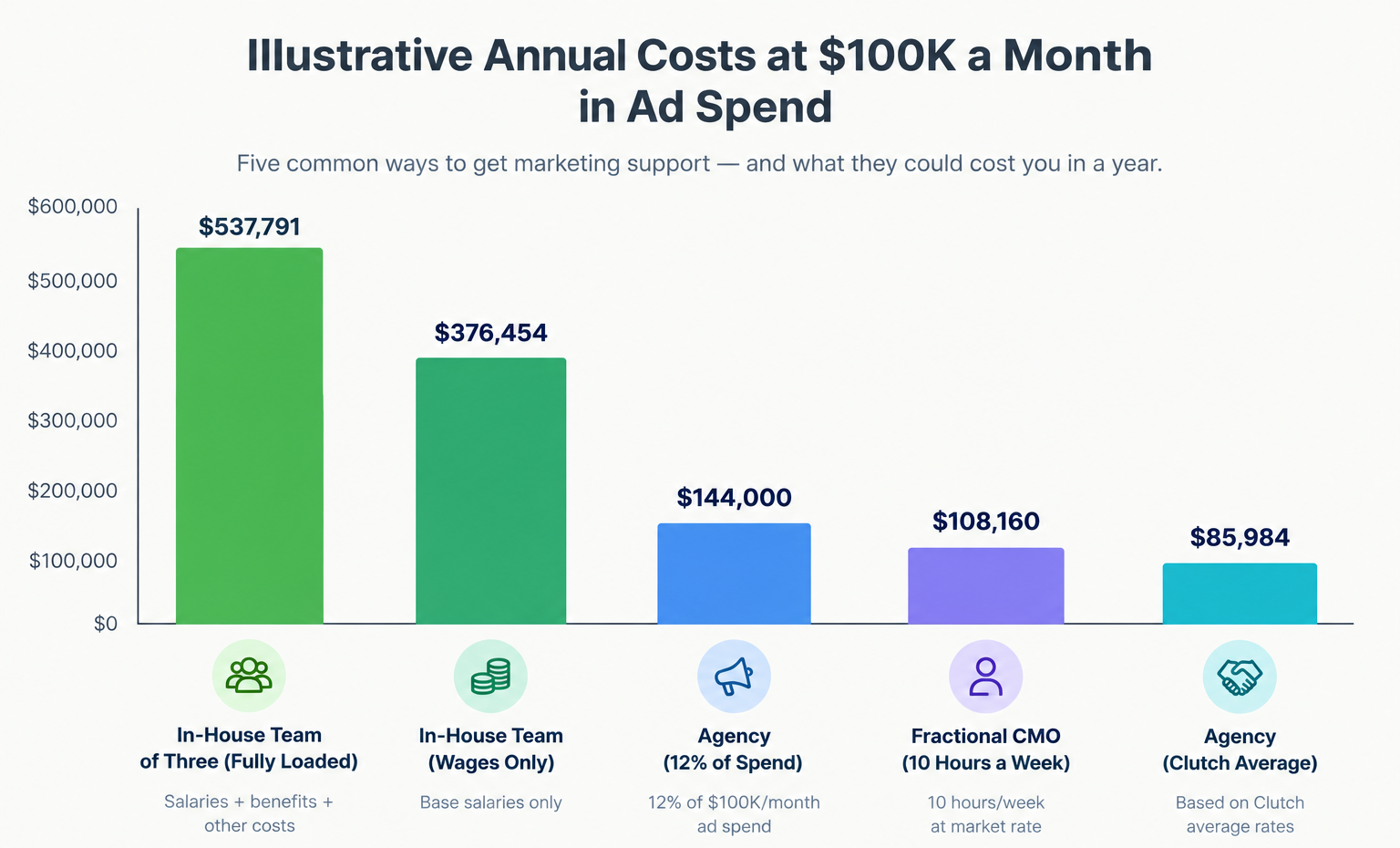
Wages are not the whole bill. Benefits made up 30.0% of employer compensation costs in private industry in June 2026, $14.07 of every $46.89 an hour (BLS, 9 September 2026). Put a three-person team together, a marketing lead plus a performance marketer and a paid media manager, and wages alone come to about $376,454 a year. Grossed up so benefits are 30% of compensation, the same team costs roughly $537,791, before tools, recruiting fees, training, and the months it takes a new hire to understand your customers.
The comparison is illustrative: salaries vary by city and seniority, and agency quotes vary by scope. It still makes the shape of the decision clear. A full in-house team is a large fixed cost that pays off when the work is constant, the knowledge compounds, and you can keep the people. An outside partner is a variable cost that pays off when you need skills you could not hire one at a time.
What Do In-House Teams Do Better?
Context is the advantage that is hardest to buy. An in-house marketer sits in the product meetings, hears the customer service complaints, knows which supplier is late and which launch has slipped. That context changes decisions an outside team often hears about later: whether to push a product that is about to go out of stock, which offer protects margin in a heavy discount week, or why returns spiked in one category.
Speed is the second advantage. Approvals happen in a hallway rather than a ticket queue, and creative can be briefed the same day a trend appears. The third is that knowledge stays in the building. Every test an employee runs builds a record that remains when vendors change.
The large-advertiser data shows the motivation has shifted from cost to capability. In the ANA’s 2026 State of In-Housing report, 53% of respondents agreed the primary role of in-house agencies is that of a strategic partner (ANA, 22 June 2026), and Adweek’s coverage of the same data reported that just 9% view in-housing as a cost-saving alternative to external agencies (Adweek, 15 July 2026). For an ecommerce brand the lesson travels well: bring in-house the work where context is the edge, not the work that looks cheapest on a spreadsheet.
What Do Agencies Do Better?
Breadth of pattern recognition is the main thing an outside team brings. A specialist who runs a dozen Meta accounts sees the effect of a platform change across all of them in a week. An in-house hire sees it in one account, sometimes a month later. That matters more in 2026 than it did a few years ago, because the platforms change faster: Meta replaced Advantage+ shopping campaigns with Advantage+ sales campaigns (Jon Loomer Digital, March 2025), Google keeps reshaping Performance Max reporting, and Meta’s attribution settings changed twice in 2026 alone.
Agencies also offer depth on demand. One retainer can cover a media buyer, a creative strategist, an analyst and a feed specialist, roles that would each be a separate hire. Tooling comes bundled too, from creative testing platforms to attribution software, which can be expensive for one brand to license alone.
Budgets are under pressure on both sides of the choice. In Gartner’s 2025 CMO Spend Survey, 39% of CMOs said they planned to cut agency budgets and 22% said generative AI had reduced their reliance on agencies (Gartner, 12 May 2025), while Forrester expects 85% of US B2C marketing executives to review their media agencies in 2026 (Forrester). Reviews are healthy. They work best when you know which layer of the work you want to keep.
In-House Vs Agency Vs Hybrid: A Side-By-Side Comparison
| Factor | In-house team | Agency | Hybrid with a fractional leader |
|---|---|---|---|
| Annual cost at $100K a month in spend | About $376K in wages for three people, more fully loaded | About $86K (the Clutch average engagement, at any spend) to $144K (12% of spend), plus creative and tools | A senior leader part time plus specialist execution |
| Time to start | Two to four months to hire, then ramp-up | Weeks | Weeks |
| Product and customer context | Highest | Lowest, improves with tenure | High at the strategy level |
| Specialist depth | Limited to the people you hire | Broad | Broad, directed by one owner |
| Who owns the strategy | Your marketing lead | Depends on the scope; agree it in writing | The fractional leader, accountable to you |
| Risk when someone leaves | Knowledge walks out with the hire | Account knowledge leaves with the agency | Lower if accounts and data stay in your name |
The cost rows use the inputs in the chart above: the agency range runs from the Clutch average monthly PPC project cost of $7,165.33, an average across engagements of every size, (Clutch, September 2026) to a 12% fee on $100K a month in spend. At WebFX’s typical 10% to 20% range, the same spend would cost $120,000 to $240,000 a year (WebFX). The fractional option depends on hours: at GoFractional’s average ecommerce asking rate of $208 an hour (GoFractional, October 2026), ten hours a week is about $108,000 a year. Our fractional CMO cost guide covers retainer structures in more detail.
Read the table by row rather than by column. No model wins every row, which is why the choice is really about which weaknesses you can manage. A full in-house team loses on cost and time to start but wins on context. An agency wins on speed and depth but needs someone on your side to own the plan and check the numbers. The hybrid only works if that owner exists and has authority, because otherwise it becomes an agency relationship with an extra invoice. The ownership row is the one founders most often skip and most often regret, because it decides what you keep when any arrangement ends: the ad accounts, the creative library, the customer data and the record of what was tested.
Why Most Ecommerce Brands End Up With A Hybrid
The hybrid is not a compromise; it splits the work along the line where context and scale trade places. Strategy, measurement and the customer data stay with the brand, because they compound and they are the most expensive things to lose. Channel execution and specialist skills are bought, because they are the cheapest things to replace and the hardest to hire one person at a time.
Making the split work takes three rules. The first is ownership: ad accounts, the Pixel, analytics, creative files and customer lists live in the brand’s name, never the vendor’s. Google’s guidance for advertisers working with third parties says you are entitled to know the clicks, impressions and total cost of your ads (Google Ads policy help), and the same principle should apply to every platform. The second is one source of truth: store-side numbers such as blended ROAS and new customer CPA decide budget, and each platform’s own reporting is used to compare campaigns inside it. The third is a single owner for the plan, whether that is an employee or a fractional CMO. When nobody owns the plan, every vendor optimizes its own channel and the totals drift.
That owner does not need to be full time, and the test for whether the seat is filled is simple: if the founder is still the person reconciling the agency report with the bank account every month, the strategy seat is empty. Filling it part time is often the cheapest fix with the largest effect, because every channel decision downstream improves at once. Our guide to the fractional marketing team model shows how the pieces fit.
How To Decide At Your Spend Level
Spend level is the most practical guide, because it decides how much specialist work there is to do and how much a mistake costs. These are starting points rather than rules.
| Monthly ad spend | Typical best fit | Why |
|---|---|---|
| Under $25K | Founder-led, with a freelancer or a small agency | Senior management costs more than the savings it can find; offer and creative volume matter most |
| $25K to $50K | Agency or senior freelancer, founder owns strategy | Enough spend for specialist skills, not yet enough for a full team |
| $50K to $150K | Hybrid: fractional leader plus specialist execution | Mistakes in budget allocation now cost more than the leader |
| $150K to $500K | Hybrid, with one or two key in-house hires | Context and speed start to pay for full-time roles |
| Over $500K | In-house leadership and core team, specialists bought in | Volume justifies a permanent team; vendors fill skill gaps |
One real example of why the strategy seat matters at scale. An athletic apparel brand we work with grew sales 35.7% to $9.27M in the first half of 2026 while paid media investment rose 42%, and blended ROAS finished the half at 3.36, about 4.5% below the prior year, per its Triple Whale account. Accepting that dip was a deliberate call: the margin still cleared the floor, so extra volume was worth more than a better ratio. That is a strategy decision, not a channel tactic. The figures are blended across all paid channels, no incrementality test was run, and product and merchandising moved them as well; the athletic apparel case study has the detail.
Not sure which seat is empty in your setup? Book a free 30 minute growth audit. We review your tracking, account structure and budget split, and give you three fixes ranked by impact, including whether the strategy seat in your setup is filled. For a closer look at what an outside growth partner should own, read our ecommerce growth agency guide.
Common Questions
Is it cheaper to hire in-house or an agency?
For most ecommerce brands under about $150K a month in ad spend, an agency or fractional setup costs less than a full in-house team. Three marketing hires cost roughly $376,000 a year in wages (a BLS median and two Glassdoor averages) before benefits, which BLS data puts at 30% of compensation. Agency fees at 10% to 20% of $100K a month in spend come to $120,000 to $240,000 a year.
When should an ecommerce brand bring marketing in-house?
Bring a role in-house when the work is constant, depends on product and customer context, and the knowledge compounds, such as marketing leadership, retention and creative direction. Spend level is a useful guide: above roughly $150K a month in ads, one or two key full-time hires usually pay for themselves.
Can you use an agency and an in-house team together?
Yes, and most larger advertisers do. In the ANA’s 2023 survey, 92% of members with an in-house agency also used external agencies. The arrangement works when one person owns the plan, accounts and data stay in the brand’s name, and store-side numbers decide budget.
What does a fractional CMO cost compared with an agency?
Fractional CMOs in ecommerce ask an average of $208 an hour on GoFractional, so ten hours a week comes to about $108,000 a year. That is similar to many agency retainers at $100K a month in spend, but it buys strategy and accountability rather than channel execution, so the two are often combined.
Related Reading
- Ecommerce Growth Agency: What It Does, What It Costs and How to Choose One: what an outside growth partner should own
- How Much Do Marketing Agencies Charge? 2026 Pricing for Ecommerce Brands: fee models with worked numbers
- How Much Does a Fractional CMO Cost in 2026?: retainer and hourly structures
- Fractional Marketing Team: Roles, Cost and Setup: senior leadership without a full-time hire
- Fractional CMO vs Full Time CMO: Which Does Your Ecommerce Brand Need?: when the full-time hire makes sense