
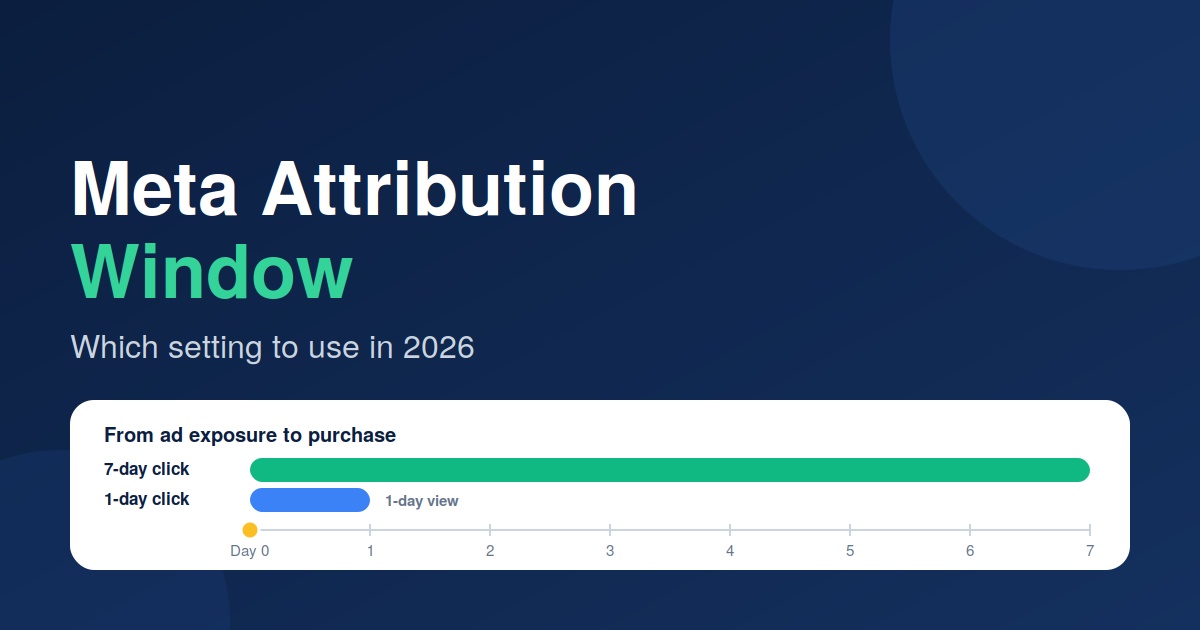
Meta’s attribution window is the period after someone clicks, engages with or views an ad during which a purchase is credited to that ad. The 2026 default for sales campaigns is 7-day click-through, 1-day engage-through and 1-day view-through. The window changes what Meta reports and optimizes toward, not the sales your store makes.
The settings changed twice in quick succession. From 12 January 2026, Meta’s Ads Insights API stopped returning the 7-day view and 28-day view windows (Meta for Developers, 16 October 2025). Then, in a rollout that began in March 2026, Meta narrowed click-through to link clicks and moved likes, shares, saves and other clicks into a new engage-through window (Search Engine Land). Any ROAS comparison that spans those dates mixes two definitions of a conversion.
What are Meta’s attribution settings in 2026?
An attribution setting has two parts: which kinds of interaction can earn credit, and how many days after each one a purchase still counts. Meta now recognizes three kinds. Click-through covers clicks on the ad’s link. Engage-through covers interactions that are not link clicks, such as a like, share or save, and video views that pass an engagement threshold, which Meta lowered from 10 seconds to 5 seconds in the March update. View-through covers people who saw the ad and did neither.
| Setting | What counts | Options for sales campaigns | Default |
|---|---|---|---|
| Click-through | Purchases after a click on the ad’s link | 1 day or 7 days | 7 days |
| Engage-through | Purchases after a like, share, save, other non-link click or engaged video view | 1 day or off | 1 day |
| View-through | Purchases after an impression with no click or engagement | 1 day or off | 1 day |
| Attribution model | How credit is assigned | Standard or incremental | Standard |
Source: Jon Loomer Digital, 10 March 2026, describing a website sales campaign optimized for conversions.
The 28-day click window is no longer something a campaign can be set to, but it can still be read in reporting by comparing attribution settings. That comparison view is the safest place to test a different window, because it changes what you read without changing what the campaign is told to find. Read it side by side for a few weeks: if most of a campaign’s purchases arrive inside one day of the click, a shorter window will barely move the numbers, and if a large share arrives on days two to seven, the default is doing real work for a considered product.
What changed in Meta attribution in 2025 and 2026?
Three changes matter for anyone reading Meta reports across the last year. The first was in the API. From 12 January 2026, the Ads Insights API no longer returns 7-day view or 28-day view results; the remaining windows are 1-day, 7-day and 28-day click, 1-day engaged view and 1-day view, a change Meta described as consistent with how Ads Manager already behaved. Dashboards and connectors that pulled the longer view windows lost them on that date.
The second was the March 2026 split between click-through and engage-through. Before it, a like or a save followed by a purchase within seven days could count as a click-through conversion. After it, that purchase counts only if it falls inside the 1-day engage-through window. Meta said billing was unaffected and rolled the change out in stages by account, so there is no single cut-over date. Accounts with a lot of social engagement on their ads saw click-through conversions fall and engage-through conversions appear, with reported ROAS moving even though nothing about sales changed.
The third was the incremental attribution model, which estimates the purchases the ads caused rather than crediting every purchase inside a window. It sits beside the standard model as an option and is covered below.
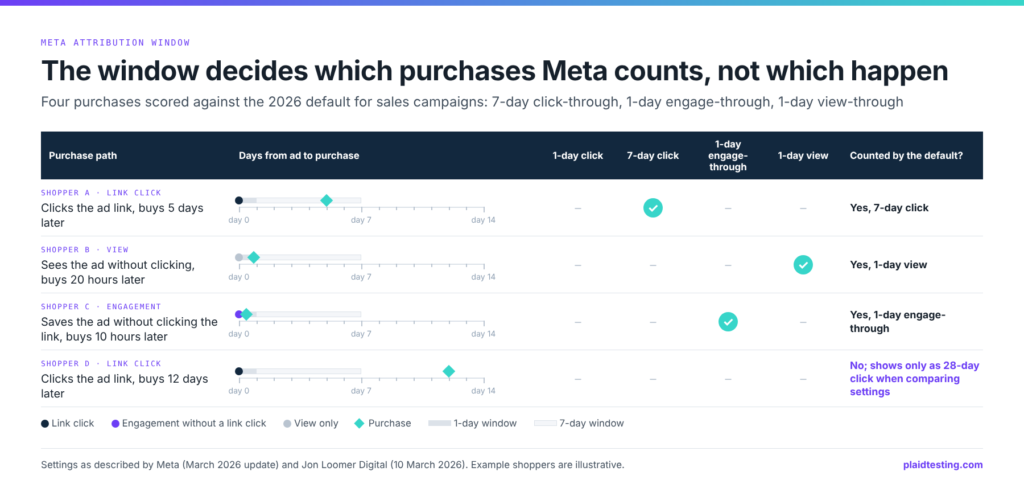
The practical rule: mark January and March 2026 on any trend chart of Meta ROAS, and read the weeks around each date with care. A drop or a jump at those points is as likely to be definitional as real.
Does the attribution window change optimization or only reporting?
Both, which is why it deserves more care than a reporting preference. The attribution setting on an ad set tells Meta’s delivery system which purchases count as successes it should find more of. Meta’s API reference describes the ad set’s attribution spec as the one used for attributing conversions for optimization (Meta for Developers), and for a sales campaign the choice is 1 or 7 days of click-through, with engage-through and view-through each set to 1 day or off.
A 1-day click setting trains delivery toward people who buy almost immediately, which suits impulse products, low prices and lead forms. A 7-day click setting lets delivery learn from people who think about it first, which suits higher prices and considered purchases. Jon Loomer’s guidance follows the same lines: keep the defaults for sales campaigns, use 1-day click for leads and free offers, and drop 1-day view for remarketing, where people who already know the brand would often have bought anyway (Jon Loomer Digital, 27 December 2025).
Because the setting shapes what an ad set optimizes for, choose it when the ad set is built and treat a change as a new test, not a reporting tweak. To see what a different window would have reported, use the comparison view in Ads Manager instead. It shows the same results under other windows without touching delivery.
Should you use standard or incremental attribution?
Incremental attribution tries to credit only the purchases the ads caused, using Meta’s own modeling rather than a fixed window, and it ignores the click, engage and view settings. Reported results tend to be lower than under standard attribution (Jon Loomer Digital, 2 June 2026). The question is whether optimizing toward it buys more real sales.
The independent evidence has moved. Haus compared the incremental return of campaigns run on each model in geo tests. Across July 2025 to June 2026, campaigns on incremental attribution returned 1.26 times the incremental ROAS of standard attribution on a pooled basis, after trailing at 0.80 times in the twelve months before; across the full period the figure was 1.11 times (Haus, 16 July 2026). Haus calls the sample modest, and Jon Loomer reported little difference in his own accounts. The fair reading is that incremental attribution has earned a test, not an automatic switch.
We run that test as a split: the same campaign structure, creative and budget on each model, judged on store-side new customer revenue rather than on either model’s reported results. Whichever moves new customers more keeps the budget.
How do Meta’s windows compare with Google, TikTok, Klaviyo and Shopify?
Every tool uses its own window and its own model, which is why the same order can appear in four reports. A shopper who clicks a Meta ad on Monday, clicks a Google Shopping ad on Thursday and opens a Klaviyo email on Friday before buying can be counted by all three platforms, while Shopify’s channel report gives the sale to whichever qualifying source came last.
| Tool | Default click window | View or engaged window | Default model |
|---|---|---|---|
| Meta (sales campaigns) | 7 days (1 day optional) | 1-day engage-through and 1-day view-through, each can be off | Standard, incremental optional |
| Google Ads | 30 days (1 to 90) | 3-day engaged view, 1-day view-through | Data-driven for most conversion actions |
| TikTok | 7 days (1, 7, 14 or 28) | 1-day view (off, 1 or 7) | Not stated |
| Klaviyo | 5 days for email and SMS, 24 hours for push | Opens count as well as clicks | Last touch |
| Shopify marketing report | Not applicable | Not applicable | Last non-direct click |
Sources: Google Ads Help; TikTok Ads Help and TikTok for Business; Klaviyo Help Center, for accounts created after 9 October 2024; Shopify Help Center.
Two conclusions follow. Adding platform-reported revenue across tools will almost always exceed what the store took. And a longer window is not automatically more generous than the truth: across 640 Haus experiments, Meta’s 7-day click reporting under-counted measured incrementality by 15% on average for brands that sell only on their own site, and for brands with a quarter or more of sales elsewhere, roughly 32% of Meta’s measured effect landed outside their own site (Haus, 28 July 2025). The window decides how a platform tells the story; only store data and tests decide whether it is true. That reconciliation is the core of our tracking and attribution work.
Which attribution window should an ecommerce brand use?
Choose by how your customers buy, then prove the choice against the store. For impulse products and low prices, a short window reads most honestly, because a longer one credits Meta with purchases that email, search or habit would have produced. For considered purchases with a longer path, the 7-day click default with 1-day view fits the way people decide. For remarketing campaigns, turning off view-through stops Meta from claiming purchases by people who were already on their way.
The proof is a correlation, not a dashboard. It is the method we walked through in Triple Whale’s Moby Deep Dives session: pick the window that fits the product, then check over several weeks whether Meta’s reported ROAS rises and falls with new customer acquisition in the store data. If it tracks, the window is close enough to steer by. If reported ROAS climbs while new customers stay flat, the window is giving Meta credit it did not earn.
The store-side line has to be watched on its own, because customer mix moves. At a womens fashion brand we work with, first-time customers’ share of revenue rose from about 52% in January to August 2025 to about 78% in the same months of 2026, derived from its new customer ROAS divided by blended ROAS in its Triple Whale account. A shift that large changes what any window is measuring. The figure is blended across all channels rather than a Meta result, and no incrementality test isolated Meta’s part.
Whatever you choose, keep it fixed and write down when it changed. A window altered mid-quarter makes every comparison across that date unreliable. Not sure your Meta reporting matches what the store sees? Book a free 30 minute growth audit and we will check your attribution settings against Shopify orders and new customer revenue.
Common questions
What is the default attribution window on Meta ads?
For a website sales campaign optimized for conversions, the default in 2026 is 7-day click-through, 1-day engage-through and 1-day view-through, under the standard attribution model. Click-through can be shortened to 1 day, and engage-through and view-through can each be turned off. The 28-day click window can still be viewed in reporting comparisons but cannot be set on a campaign.
Should I turn off 1-day view attribution?
For remarketing and campaigns aimed at existing customers, usually yes, because people who already know the brand often buy without the ad’s help, and view-through credits the ad anyway. For prospecting, keep it while you test, then check whether reported ROAS tracks new customer acquisition in the store. If it does not, a click-only setting reads more honestly.
Why did my Meta click-through conversions drop in March 2026?
Meta narrowed click-through attribution to link clicks in an update that rolled out from March 2026. Purchases that followed a like, share, save or other non-link click moved into the new engage-through window, which lasts one day. Click-through conversions fell in accounts with high social engagement, though sales were unchanged. Compare periods on the same definition before drawing conclusions.
Why doesn’t Meta ROAS match Shopify or GA4?
Each tool counts differently. Meta credits purchases within its click, engage and view windows; Shopify’s channel report uses last non-direct click; GA4 uses its own lookback and model. One order can be claimed by several platforms, or by none. Judge Meta on blended store revenue and new customer revenue, and use its own ROAS to compare campaigns within the account.
Related reading
- Ecommerce Attribution: Models, Tools and What to Trust: models, surveys and tests beyond Meta’s window
- Facebook Ads for Shopify: Setup, Tracking and Scale in 2026: data sharing levels and deduplication behind Meta’s numbers
- NC-ROAS: How to Calculate New Customer ROAS and Set a Floor: the store-side number to test a window against
- What Is a Good ROAS? 2026 Benchmarks and the Break-Even Test for Ecommerce: setting Meta targets from margin
- Meta Ads for Black Friday: Structure and Budget Pacing: reading Meta results through peak season