
Facebook ads for Shopify run best on three foundations: the Facebook & Instagram app connected at the Enhanced or Maximum data sharing level, so each purchase reaches Meta from the server as well as the browser; few enough ad sets that each one can finish learning; and a scorecard read from Shopify orders rather than from Ads Manager.
Each of those foundations shifted in 2026: Meta stopped API creation of separate Advantage+ shopping campaigns, and its reporting lost two view windows. The auction got pricier too, with Meta’s ad impressions up 14% year over year and the average price per ad up 12% in the second quarter of 2026 (Meta, 29 July 2026). Most advice on Facebook ads for Shopify store owners ends at the install; at $50,000 or more a month, the decisions after it are what move results.
Meta ads for Shopify: which connection should you use?
The first decision in how to run Facebook ads for Shopify is which connection carries the data, because Shopify offers two and they do different jobs. The Facebook and Instagram by Meta sales channel syncs products to a Meta catalog for Facebook Shop and Instagram Shopping, connects the Meta pixel and holds the store’s data sharing setting. It is free on all Shopify plans, subject to store eligibility (Shopify Help Center). Meta publishes the app behind it, which launched on 4 October 2018 and holds a 3.8 rating from more than 5,700 ratings (Shopify App Store), a middling score that is reason enough to verify the connection after installing it.
The second is Campaign Autopilot, which connects to a Meta ad account, syncs products to a catalog and runs optimized campaigns, recommending Meta Advantage+ campaigns. Three lines in its documentation matter to a brand at scale: Autopilot-managed campaigns use a separate product catalog, edits made to an Autopilot campaign directly in Meta might be overwritten, and the monthly budget is a target rather than a hard limit (Shopify Help Center).
At $50,000 or more a month, we connect through the sales channel and build every campaign in Ads Manager. A media buyer whose edits can be reverted does not really control the campaign, and two catalogs mean two sets of product data to keep accurate. Autopilot suits a store with nobody to run Ads Manager; once a team or partner owns the account, it adds a second decision maker to the same budget. That split, the app for the connection and Ads Manager for the decisions, is how we run Meta ads for ecommerce brands. The table compares the two routes using the Shopify Help Center’s descriptions.
| Question | Facebook & Instagram sales channel | Campaign Autopilot |
|---|---|---|
| What it does | Syncs a catalog, connects the Meta pixel, sets data sharing, powers Facebook Shop and Instagram Shopping | Connects an ad account, syncs a catalog and runs campaigns for the store |
| Who builds campaigns | Your team or partner, in Ads Manager | Autopilot, which recommends Advantage+ campaigns |
| Catalog | One catalog shared by every campaign you build | A separate product catalog for Autopilot campaigns |
| Edits made in Meta | Stay as made | Might be overwritten by Autopilot |
| Budget control | Set per campaign or ad set in Ads Manager | A monthly target, not a hard limit |
| Conversions API | On at the Enhanced or Maximum data sharing level | Set up by Autopilot |
| Best fit | A brand with someone accountable for Meta inside a cross-channel plan | A store with no one to run Ads Manager |
Which data sharing level should a Shopify store choose?
The sales channel’s settings offer three customer data sharing levels: Standard, Enhanced and Maximum (Shopify Help Center). Standard relies on the Meta pixel alone, running in the shopper’s browser, and Shopify notes that a browser-based ad blocker can stop that pixel from sharing data. Enhanced adds Meta’s Conversions API, which passes the purchase event directly between Shopify’s servers and Meta’s, out of reach of browser ad blockers. Maximum runs both and, in Shopify’s description, “is updated with Facebook’s latest advertising technology”, without listing what that covers. Enhanced and Maximum both share the customer’s name, location, email address and phone number with Meta, along with browsing behavior, so the store’s privacy policy should say so.
Meta’s developer guidance points the same way: use the Conversions API alongside the Meta Pixel and send identical events through both, since the server connection can deliver events the pixel drops when a connection fails or a page does not finish loading (Meta for Developers). On Standard, Meta optimizes toward an incomplete count of purchases, and Advantage+ can only find more buyers like the ones it is told about.
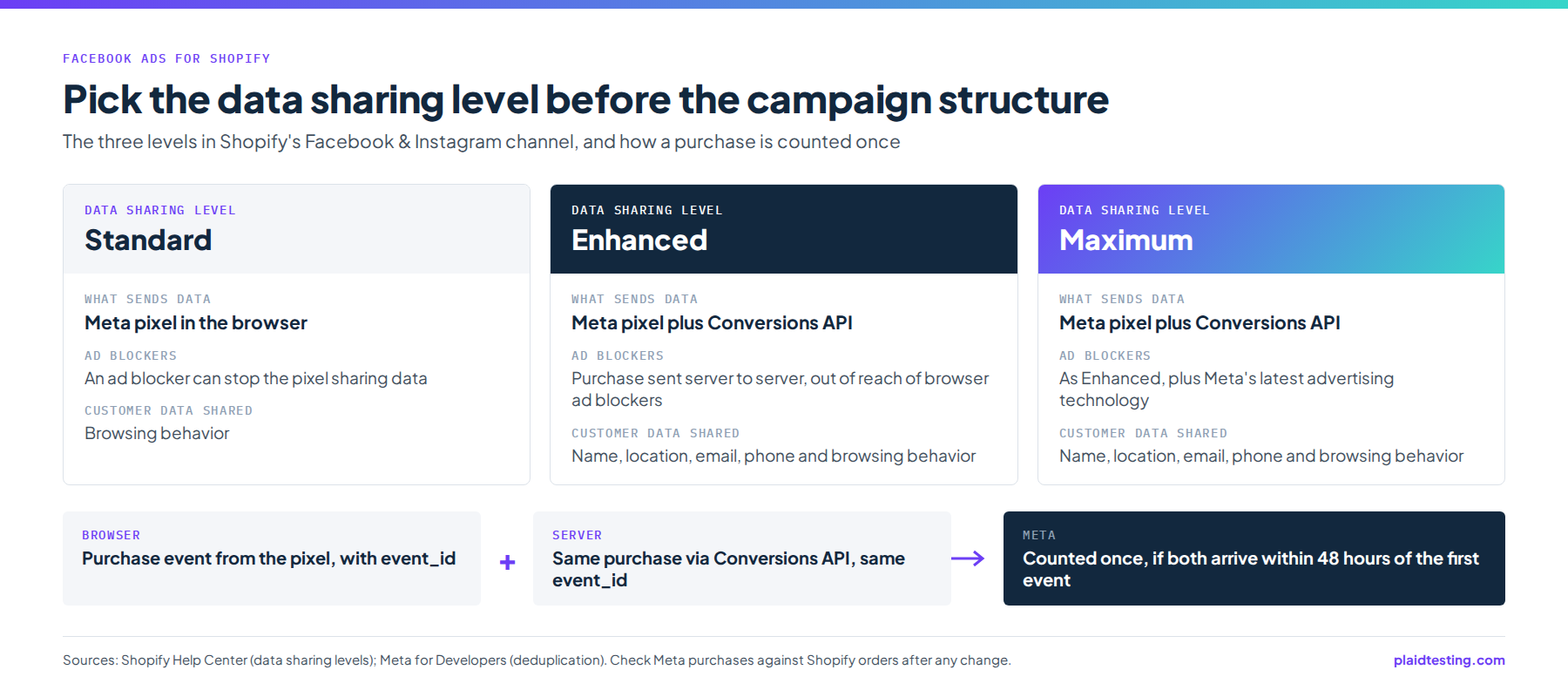
Sending each purchase twice creates a second job: making sure Meta counts it once. Meta pairs a browser event with its server twin through an event_id, “an identifier that can uniquely distinguish between similar events”, and deduplicates the pair only if both arrive within 48 hours of the first event carrying that ID (Meta for Developers). In the Shopify stores we audit, double counting usually traces to a purchase source added on top of the app: a pixel pasted into the theme, a tag manager container, or a server-side tool sending purchases without a matching ID. Our first check, and the opening step of every tracking and attribution setup we run, sets a week of purchase events in Meta’s Events Manager beside the Shopify order count for the same days; any gap gets fixed before budget moves. The table summarizes the three levels from Shopify’s documentation, with our recommendation in the last row.
| Attribute | Standard | Enhanced | Maximum |
|---|---|---|---|
| What sends data | Meta pixel in the shopper’s browser | Meta pixel plus the Conversions API | Meta pixel plus the Conversions API, “updated with Facebook’s latest advertising technology” |
| Purchase event route | Browser only | Also sent server to server between Shopify and Meta | Also sent server to server between Shopify and Meta |
| Ad blocker exposure | A browser-based ad blocker can stop the pixel sharing data | Server events can’t be blocked by browser-based ad blockers | Server events can’t be blocked by browser-based ad blockers |
| Customer data shared | Browsing behavior | Name, location, email address, phone number and browsing behavior | Name, location, email address, phone number and browsing behavior |
| Pixel events tracked | PageView, ViewContent, Search, AddToCart, InitiateCheckout, AddPaymentInfo, Purchase | The same seven browser events | The same seven browser events |
| When we use it | Only where the brand has decided not to share customer data with Meta | The minimum for a store spending $50K+ a month | Our default, with Meta event counts checked against Shopify orders after the switch |
How should you structure Facebook ads for Shopify in 2026?
Meta is replacing the separate creation workflows for manual campaigns, Advantage+ shopping campaigns (ASC) and Advantage+ app campaigns with one streamlined campaign creation process (Meta for Developers). Its developer documentation sets the timetable by API version: from version 25.0, released 18 February 2026, ASC campaigns cannot be created and the existing-customer budget percentage field is deprecated; from version 26.0, released 29 July 2026, legacy ASC campaigns are blocked from edits (Meta for Developers changelog).
Two consequences follow for a Shopify account. A legacy ASC campaign still carrying a large share of spend should be rebuilt in the unified flow on a planned date ahead of peak season, because a rebuilt campaign starts learning from scratch; our plan for pacing Meta budgets through Black Friday assumes the campaign map is settled well before November. And with the existing-customer budget field gone, the share of orders from first-time buyers has to be read in Shopify every week rather than trusted to a setting.
On its earnings call for the second quarter of 2026, the company said Advantage+ end-to-end solutions were “reaching over $75 billion in annual revenue run-rate” (Meta’s earnings call, 29 July 2026). Inside an Advantage+ campaign, the system chooses audiences, placements and much of the budget split. The brand still controls the purchase signal, the number of ad sets, the creative, and who should be kept out of prospecting. In the Shopify accounts we run at $50,000 a month or more, that leaves a short list of campaigns, each with one job:
- A prospecting campaign in the unified flow, optimized for purchases, holding most of the budget and creative range.
- A creative testing campaign on a fixed budget, where new concepts have to beat the control before they move into prospecting.
- A catalog campaign on the sales channel’s catalog, showing viewed and related products to recent site visitors.
- No Autopilot campaigns in the same ad account, so every change has one owner.
With targeting automated, creative volume decides how far prospecting can reach: each distinct concept finds a different group of buyers, and a campaign fed the same few ads keeps finding the same people. That is why our performance creative testing system runs a steady pipeline of concepts produced through the brand’s own creators, and why BFCM creative testing starts in October. Reels placements need vertical edits of their own, covered in our notes on Instagram Reels ads.
Running Meta on a mix of legacy shopping campaigns, Autopilot and manual ad sets? See how we rebuild and run Meta ads for Shopify brands spending $50K+ a month inside a single cross-channel plan.
How much budget does each ad set need to learn?
Enough to buy about 50 optimized events a week. Jon Loomer Digital, a trade publisher, reported that Meta’s learning phase guidance reflects about 50 optimized events in seven days, and noted that Meta had briefly tested a lower bar of 10 events in three days (Jon Loomer Digital, July 2024). We plan on that figure. For a store optimizing for purchases, each optimized event is a purchase, so an ad set’s weekly budget needs to be roughly its target cost per purchase multiplied by 50.
The table applies that formula at five cost levels. Two are Triple Whale’s 2026 Meta medians: $36.98 per purchase for apparel and accessories and $38.99 across all industries (Triple Whale, updated 17 August 2026). The other three, $25, $50 and $75, are round targets for comparison. The last column takes a $50,000 budget spread across four weeks, which is $12,500 a week ($50,000 divided by 4), and divides it by each weekly figure to show how many ad sets that budget can keep fed.
| Target cost per purchase | Weekly budget per ad set (cost × 50) | Daily budget per ad set (weekly ÷ 7) | Ad sets a $12,500 week can fund |
|---|---|---|---|
| $25 (round target) | $1,250 | $179 | 10 |
| $36.98 (Apparel and Accessories median) | $1,849 | $264 | 6 |
| $38.99 (all industries median) | $1,949.50 | $279 | 6 |
| $50 (round target) | $2,500 | $357 | 5 |
| $75 (round target) | $3,750 | $536 | 3 |
Sources: Jon Loomer Digital for the 50-event figure and Triple Whale’s 2026 Meta benchmarks for the two medians, with daily figures rounded to the nearest dollar and ad set counts rounded down.
The pattern matters more than any single row. At a $25 target, $12,500 a week keeps ten ad sets learning; at $75, only three. A higher-priced brand that splits the same budget across ten audiences or product lines leaves most ad sets short of 50 purchases a week, so their results swing on noise rather than on the creative. Let the cost per purchase set the number of ad sets: when the math allows three, run three and test creative inside them.
Treat the table as a floor. A first-time buyer usually costs more than a blended purchase, so an ad set judged on new customers needs more than the table shows. We raise budgets in measured steps and give each step a full week before reading it. For the whole chain from CPM to cost per purchase, the Facebook ads cost calculator runs the same arithmetic on your own rates.
What do 2026 benchmarks say about Facebook ads for Shopify?
One large public reference is Triple Whale’s Meta benchmark report, covering Facebook and Instagram spend for more than 40,000 brands across the twelve months ending 31 July 2026 (Triple Whale, updated 17 August 2026). Those brands put 66.88% of their ad budget on Meta, and with that share of spend, Meta is where a misread costs the most. The table sets Triple Whale’s 2026 medians beside the prior year, adds the apparel and accessories figures it publishes, and names the store number each one should be compared with.
| Metric | All industries, 2026 (prior year) | Apparel and Accessories, 2026 | Store number to compare it with |
|---|---|---|---|
| Cost per purchase | $38.99 ($37.80) | $36.98 | Blended cost per new customer: total ad spend divided by first-time buyers in Shopify |
| Click through rate | 2.39% (2.06%) | 2.44% | Your own rate by creative concept |
| Conversion rate | 1.53% (1.60%) | 1.47% | Shopify’s conversion rate for sessions from Meta |
| ROAS | 1.88 (1.86) | 2.24 | Store revenue divided by total ad spend, since Triple Whale leaves its ROAS attribution method unstated |
Read together, the figures describe a market where clicks got easier to win and harder to convert. In Triple Whale’s data, click through rate rose from 2.06% to 2.39% while conversion rate slipped from 1.60% to 1.53%, and CPM climbed 13.24% to $15.06 against a 3.14% rise in cost per purchase. Part of the CPM rise is the market itself: Meta’s management put its higher average price per ad down to better ad performance, stronger macro conditions than in the second quarter of 2025, and currency tailwinds (Meta’s earnings call, 29 July 2026), and no brand controls any of those.
For a Shopify store, each median is most useful set against a number the store already owns. If click through rate beats Triple Whale’s apparel median of 2.44% but Shopify shows Meta visitors converting well below that report’s 1.47%, the problem is more likely the product page, the offer or the price than the ad account. Treat ROAS with the most caution: Triple Whale leaves its attribution method unstated, so its 2.24 apparel median cannot be set against an account’s 7-day click ROAS as a like for like comparison. A ROAS median also ignores margin, and a brand discounting hard can beat it while losing money on each order.
How do you judge Meta without trusting Meta’s report?
Start by holding the window steady, because Meta’s reporting changed twice in 2026. From 12 January 2026, the Ads Insights API dropped its 7-day view and 28-day view windows, keeping 1-day, 7-day and 28-day click plus 1-day engaged view and 1-day view (Meta for Developers, 16 October 2025). Then, according to the trade publisher Jon Loomer Digital, Meta replaced engaged-view with engage-through in March 2026 and set the default to 1-day view-through, 1-day engage-through and 7-day click-through (Jon Loomer Digital, 10 March 2026). A comparison of reported ROAS that spans those dates mixes two definitions.
Platform numbers are not simply inflated, either. Haus, which sells incrementality testing, pooled 640 of its experiments and found that Meta added about 19% lift on average to a brand’s main KPI; for brands that sell solely through their own store, Meta’s 7-day click numbers came in 15% below measured incrementality on average, and for brands also selling elsewhere, 32% of Meta’s measured effect showed up in sales away from their own site (Haus, 28 July 2025). A Haus follow-up covering July 2025 to June 2026 found Meta’s incremental attribution option ahead of standard attribution on incremental ROAS at a pooled geo-mean of 1.26x, having trailed at 0.80x in the prior twelve months (Haus, 16 July 2026). A brand that also sells on Amazon or in stores should not cut Meta on Shopify revenue alone, and attribution settings deserve a retest every year.
The scorecard that cannot double count is blended: total ad spend against total store sales, read beside the number of new customers. Measured in its Triple Whale account, an athletic apparel brand we work with brought blended ad spend from about 31% of sales in June 2025 down to about 26% of sales in June 2026. The ratio spans every paid channel, so it is not a Meta result; no incrementality test isolated what Meta contributed, and product and merchandising decisions moved it as well. It is still the number the business runs on, and Meta’s own ROAS earns trust only as far as it agrees with it.
We choose Meta’s attribution window by what the brand sells: a considered, higher-priced purchase is read on a longer click window, and an impulse product on a short one, since a longer window would credit Meta with orders that email, search or habit produced. Then we test the choice: if Meta’s reported ROAS rises and falls with new customer acquisition in Shopify, the window is close enough to steer by, and if reported ROAS climbs while new customers stay flat, the window is giving Meta credit for orders it did not create. Our breakdown of ecommerce attribution models and tools places this read beside surveys and tests, and our paid media management treats Meta as one line in a single plan, shifting budget between channels once the read is in.
If Meta reports a stronger month than your Shopify orders do, book a free 30 minute growth audit. We reconcile Meta’s purchases with your store, check the data sharing level and deduplication, and show which ad sets can learn at your cost per purchase.
Common questions
Is the Facebook & Instagram app enough to run Facebook ads for a Shopify store?
It is enough to connect the store, not to run the account. The app handles the plumbing: catalog sync, the Meta pixel, and the data sharing level that switches on the Conversions API. Campaign structure, budget per ad set, creative testing and the weekly check against Shopify orders still need an owner in Ads Manager, and past $50,000 a month that owner decides the results.
How much should a Shopify store spend on Facebook ads?
Work backward from learning rather than picking a round daily figure. Each ad set needs enough budget to buy the weekly purchase volume Meta’s learning phase expects, so the total depends on your cost per purchase and your number of ad sets, and fewer well-funded ad sets beat many starved ones. To turn a target cost per purchase into a monthly plan, try our Facebook ads cost calculator for ecommerce.
Which attribution window should a Shopify brand use for Meta ads?
Pick it by how your customers buy: products people deliberate over suit a longer click window, while quick, low-priced purchases read more honestly on a short one. Keep the setting fixed so weeks compare cleanly. Then test it against Shopify: a sound window shows Meta’s reported ROAS tracking the number of first-time buyers in the store, and a misleading one shows reported ROAS drifting away from them.
Does the Conversions API double count purchases on Shopify?
It should not, as long as the browser and server copies of each purchase share one event ID. Meta merges matching events only when they arrive within 48 hours of the first one (Meta for Developers). When we find double counting in a Shopify store, the cause is usually an extra purchase source, such as a hard coded pixel, and a week of Meta purchase events compared with Shopify orders exposes it.
Related reading
- Facebook Ads Cost Calculator for Ecommerce: 2026 Benchmarks and Budget Math: turns a target cost per purchase into a monthly budget
- Meta Ads for Black Friday: Structure and Budget Pacing: how the same campaign map holds through peak season
- Ecommerce Attribution: Models, Tools and What to Trust: where Meta’s numbers sit beside store data and tests
- BFCM Creative Testing: What to Test in October: the creative pipeline the prospecting campaign depends on
- Google Ads for Shopify: Setup, Structure and Tracking for Brands at Scale: the Google side of the same Shopify setup