

Instagram Reels ads are full-screen vertical video ads that Meta places between organic Reels, bought and managed in Meta Ads Manager alongside Feed and Stories. For an ecommerce brand they pay off when each video is cut for Reels, made for sound on, keeps text clear of the on-screen buttons, and is judged on new customers rather than views.
More than half of Instagram’s advertising runs on Reels. Sensor Tower data reported by EMARKETER shows that 53% of all Instagram ads ran on Reels in the fourth quarter of 2025, up from 35% in the fourth quarter of 2024 (EMARKETER, 20 January 2026). For a brand spending $50K or more a month, the open questions are how much control to take over the placement, what to make for it, and which number decides its budget.
What are Instagram Reels ads, and where do they run?
A Reels ad is a sponsored video that plays in the same full-screen, swipeable feed as organic Reels. It has no dashboard of its own. Meta’s placement targeting reference lists reels as one Instagram position next to stream (the Feed), story, explore and profile_feed (Meta for Developers), and Meta’s Reels ads documentation lets you choose a manual placement covering Instagram and Facebook Reels together, or stay on automatic placements (Meta for Developers).
So Reels shares one auction and one budget with the rest of Meta, and choosing it is a question of control and creative rather than a different kind of media. What sets it apart is attention. Meta reported US Reels watch time more than 30% higher in the final quarter of 2025 than a year before (Meta, 28 January 2026), and Social Media Today relayed Meta’s own figure that Reels takes “50% of all user time spent on Instagram” (Social Media Today, 8 June 2026). Those are Meta’s measurements of its own product, but they match the ad load data: the customers a fashion or lifestyle brand wants spend much of their Instagram time in a vertical feed, and an ad not made for it gives itself away in the first second.
What are the Instagram Reels ads specs and safe zones in 2026?
Meta’s own Reels guidance is brief: build in 9:16 video, build in safe zones, build for sound on, and “keep the bottom 35% of your 9:16 creative free of text, logos, and other key elements” (Meta for Developers). Resolution, file size and character limits come from third-party tools, and the table marks which is which.
| Spec | Value | Source | Whose figure |
|---|---|---|---|
| Aspect ratio | 9:16 vertical, full screen | Meta for Developers | Meta’s own |
| Recommended resolution | 1440 x 2560 pixels | Moda | Third-party |
| File type and size | MP4 or MOV, up to 4GB | Moda | Third-party |
| Length | 0 seconds to 15 minutes for an ad; under 90 seconds to promote an existing organic reel | Moda; Meta for Developers | Split: the 90 second rule is Meta’s own |
| Bottom safe zone | 35% of the frame (672 pixels at 1080 x 1920) | Meta for Developers; pixels from Ads Uploader | Percentage is Meta’s own, pixels third-party |
| Top safe zone | About 14% (269 pixels at 1080 x 1920) | Moda; Ads Uploader | Third-party |
| Side margins | About 6% on each side (65 pixels at 1080 x 1920) | Moda; Ads Uploader | Third-party |
| Primary text and headline | 44 and 55 characters | Moda | Third-party |
| Audio | Build for sound on | Meta for Developers | Meta’s own |
| Catalog product video | At least one 9:16 video per product recommended, auto-selected for Reels | Meta for Developers | Meta’s own |
The Meta rows come from the Reels ads page on Meta for Developers, the remaining figures from Moda’s spec sheet, last verified 28 August 2026, and the pixel margins from Ads Uploader’s safe zone guide, updated 31 July 2026.
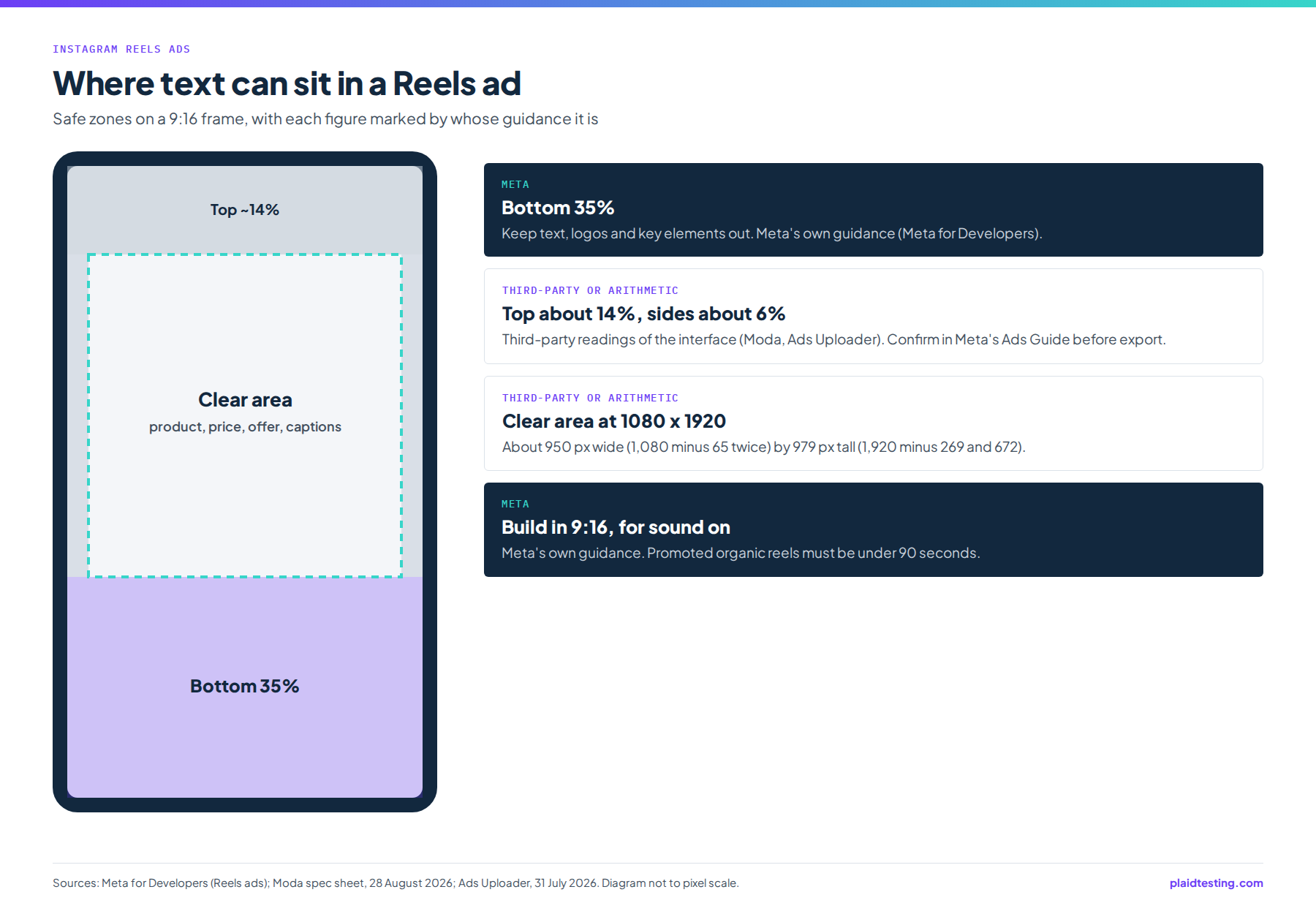
Three conflicts matter for a template. Moda recommends 1440 x 2560 while Ads Uploader’s pixels assume 1080 x 1920; at Moda’s size, 14% of the 2,560 pixel height is about 358 pixels, 35% is 896, and 6% of the 1,440 pixel width is about 86. Moda allows up to 15 minutes, while Meta limits promoted organic reels to under 90 seconds. And only the bottom margin is on Meta’s page; the top and side margins are the tools’ reading of the interface. Check every value against Meta’s Ads Guide in Ads Manager before final export.
The usable area is smaller than most teams design for. On Ads Uploader’s 1080 x 1920 frame the margins leave a clear box about 950 pixels wide (1,080 minus 65 twice) and 979 pixels tall (1,920 minus 269 and 672), and every price, offer line and caption belongs inside it. The spec problem we find most often is an offer line hidden under the caption and buttons, which a template with that box drawn on it prevents.
Should Reels ads run alone or inside Advantage+ placements?
For most ecommerce accounts, Reels belongs inside automatic (Advantage+) placements with a dedicated Reels cut attached. Automatic placements let Meta shift delivery toward whichever surface is converting most cheaply, while placement-only ad sets divide the same conversions across more ad sets, each learning more slowly. The default will not make creative decisions for you, though. A square Feed image still serves in Reels when nothing better is attached, so the setup work is asset customization: a 9:16 edit for Reels and Stories, and a separate cut for Feed.
Excluding placements is also less absolute than it looks. Meta’s placement targeting reference says that when you exclude placements, you can allow up to 5% of spend to each excluded placement “when it’s likely to improve performance” (Meta for Developers). A Reels-only ad set with that allowance on is Reels-weighted, not sealed. We use manual Reels placement for three narrow jobs: trying a concept made only for Reels, giving a creator edit a clean read, and checking whether Reels is buying first time customers or reaching existing followers. How we set up placements and creator permissions inside a brand’s own Meta account is on the Instagram ads management page.
| Placement setup | When it fits | What to watch |
|---|---|---|
| Automatic placements with asset customization | The default for prospecting campaigns with steady conversion volume | Placement breakdown every week, read against first time buyer share |
| Manual: Instagram and Facebook Reels only | Trying a Reels-native concept or a creator edit | Fewer conversions per ad set, so fix the read window in advance |
| Manual with exclusions, 5% allowance on | One placement is clearly wasting spend, but some flexibility is still useful | Each excluded placement can still take up to 5% of spend |
| Manual with exclusions, allowance off | A strict test cell that needs a clean placement read | Costs may rise without the flexibility, so keep the test short |
The 5% figure in the table is from the same Meta for Developers reference.
If your Reels delivery runs on automatic and nobody has checked which placement is bringing in first time buyers, that weekly read is built into how we run Instagram ads for ecommerce brands.
Which Reels ad formats matter for an ecommerce brand?
Reels inventory covers more than one ad type. Meta opened Reels trending ads to advertisers with a sales rep in September 2025 and widened post-view ads to all advertisers in June 2026, while partnership ads change whose name sits on the ad. These six matter for a brand selling physical products.
| Format | What it is | How it is bought | Who it suits |
|---|---|---|---|
| Standard Reels ad | A 9:16 video ad served between organic reels, on Instagram and on Facebook Reels if selected | Ads Manager, through automatic placements or a manual placement that includes Reels | Every brand with vertical video; the base of any Reels plan |
| Promoted organic reel | An existing reel from the brand’s own account run as an ad | Ads Manager, using the post; it must be under 90 seconds, full-screen 9:16, free of copyrighted music, GIFs, interactive stickers and third-party camera filters, and not shared to Facebook | Brands whose organic reels already hold attention |
| Partnership ad | An ad run with a creator or another business, with both accounts shown in the header | Ads Manager, once the creator grants account-level or post-level permission | Brands with a creator program and budget to test creators against brand-handle ads |
| Post-view ad | An ad shown after an eligible organic reel longer than 60 seconds, with a 5 second countdown and a skip button | Inside the existing Reels ad tools, rolling out to all advertisers globally as of June 2026 | Brands that want reach among people watching longer reels |
| Reels trending ad | An ad placed next to top trending Reels | Only through a Meta sales rep | Launches and seasonal awareness pushes, judged on brand lift rather than purchases |
| Catalog product video | A 9:16 video attached to each product in the catalog, auto-selected for Reels | Catalog ads; collection ads using catalog product video do not run on Reels placements | Brands with large catalogs and video for each product |
Sources: Meta for Developers’ Reels ads and partnership ads pages, Social Media Today (8 June 2026) for post-view ads, and Social Media Today (11 September 2025) for trending ads, with Meta’s own claim that they “can boost unaided awareness by +20%”, a brand lift figure, not sales.
Partnership ads, formerly branded content ads, show both accounts in the ad header (Meta for Developers). The creator grants permission for the whole account, or for one post through a partnership ad code or by approving the boost; without it, the ad sits in a pending delivery state, so approvals belong in the creator contract. According to Meta’s own data reported by EMARKETER, partnership ads deliver on average 19% lower CPAs and a 13% higher click through rate than standard formats (EMARKETER, 12 December 2025), and Meta said their revenue run-rate more than doubled year over year to $10 billion in the first quarter of 2026 (Meta, 29 April 2026). Both are the seller’s figures. The real test for your account is to run the creator version and a brand-handle cut of the same idea side by side.
TikTok meets the same need with Spark Ads, where the creator generates a video code with an authorization duration of 7, 30, 60 or 365 days (TikTok Ads Help), as our guide to TikTok Spark Ads codes and authorization explains. On Meta, account-level permission spares a brand a fresh approval for each post; a Spark code is tied to one video for a set term.
What do Instagram Reels ads cost?
Reels has no price list. It is priced in the same Meta auction as every other placement, and that auction has grown more expensive: Meta’s results for April to June 2026 showed ad impressions 14% higher than a year earlier and the average price per ad 12% higher (Meta, 29 July 2026). Public cost data for Reels alone is thin, and the two most quoted sources measure different things.
| Source | Scope | Figures | What it cannot tell you |
|---|---|---|---|
| Triple Whale, Meta benchmarks, all industries | 40,000+ brands, Facebook and Instagram combined, 1 August 2025 to 31 July 2026 | CPM $15.06 (up 13.24%), CTR 2.39% | Anything about Reels alone; there is no placement breakdown |
| Triple Whale, Apparel and Accessories | Same sample, category medians | CPA $36.98, CTR 2.44%, ROAS 2.24 | How ROAS was attributed, or the split by placement |
| Emplifi via Ads Uploader, Instagram Reels | Worldwide, all industries, April to June 2026 | CPM $4.00, CTR 0.25%, CPC $0.70 | US costs, ecommerce costs, sample size |
| Emplifi via Ads Uploader, Instagram Feed | Same as above | CPM $5.00, CTR 0.40% | The same limits |
| Emplifi via Ads Uploader, Instagram Stories | Same as above | CPM $4.50, CTR 0.40% | The same limits |
The Triple Whale rows are from its Facebook ads benchmarks, updated 17 August 2026, and the Emplifi rows are its second quarter 2026 medians as quoted by Ads Uploader on 10 August 2026; Emplifi does not disclose its sample size.
The Emplifi rows are worldwide medians across every kind of advertiser, not US ecommerce brands, one reason the Reels CPM sits far below Triple Whale’s Meta-wide $15.06. Their useful signal is relative: Reels shows a lower CPM and a lower click through rate than Feed or Stories. Medians also do not combine. A $4.00 CPM at a 0.25% click through rate implies $1.60 per click ($4.00 divided by 2.5 clicks per thousand impressions), yet Emplifi’s median Reels CPC is $0.70.
For a monthly budget split by placement, use the Instagram ads cost calculator; for Meta-wide budget math, the Facebook ads cost calculator. For Reels itself, a low CPM is only cheap if the people reached go on to buy, so read Reels cost as cost per new customer.
What makes a Reels ad work for an ecommerce brand?
Meta’s guidance sets the base: build in 9:16, keep key elements inside the safe zones, and build for sound on, because audio “is a key driver of engagement and entertainment on Reels” (Meta for Developers). In the accounts we run, results then come down to four habits.
- Show the product early. The opening frames decide whether a viewer stays, so lead with the product worn or in use.
- Write for sound and for silence. A voiceover or a creator speaking carries the ad with sound on; captions inside the clear box carry it without.
- Put one offer on screen. One price or offer line beats three messages, and our Black Friday ad copy examples by offer type supply short lines for November.
- Version every winner. Change the hook, opening shot and creator while the concept stays fixed.
Creative volume is the constraint most brands underestimate. Once vertical assets are supplied, Reels tends to take a large share of delivery in the accounts we manage, and one or two videos a month cannot carry it. We run Reels as a testing system, with briefs written from the last round’s data, several hooks per concept and the brand’s own creators producing; the method is on the performance creative testing system page, and the October plan for BFCM creative testing covers what to test before November. Recut, a Reels master also supplies most of what a trial on another full-screen channel needs, as our guide to Snapchat ads for business shows.
How should you judge Instagram Reels ads?
Not on the placement report alone. Ads Manager shows ROAS by placement, but that is Meta’s attribution of Meta’s own delivery, and Reels is where a cheap view is easiest to buy; Triple Whale’s Meta benchmarks (17 August 2026) have no placement-level breakdown either. The real question is whether Reels spend adds first time customers the store would not otherwise have had.
Independent testing shows why the platform’s view is incomplete. In 640 incrementality experiments, Haus measured an average lift of about 19% from Meta on each brand’s primary KPI, and where a brand sold through its own website alone, 7-day click attribution in Meta understated incrementality by 15% on average (Haus, 28 July 2025). Buyers lean the same way. EMARKETER covered a Haus poll in which 60% of 500 US senior decision makers named independent incrementality testing as the measure they trust most, while 37% said that of in-platform reporting (EMARKETER, 19 May 2026).
We read Reels weekly on new customer revenue in the store, cost per new customer by placement as a directional signal, and hook and hold rates; once spend is large enough to move the plan, a holdout or geo test answers what reports cannot. A women’s fashion brand we work with lifted new customer revenue by 205% over January to August 2026, compared with January to August 2025, as measured in its Triple Whale account. That figure is blended across every channel, not a Reels or Instagram result; no incrementality test was run, and product decisions moved it too. It is still the kind of number Reels has to answer to: if Reels spend climbs and new customer revenue stays flat, the placement report is wrong about something, which is why our paid media management runs every channel as one plan, scored on blended new customers and contribution margin.
Want a second opinion on whether your Reels budget is finding first time buyers or reclaiming customers you already had? Our free 30 minute growth audit walks through your Reels delivery, creative pipeline and new customer numbers with you.
Common questions
What size and length should Instagram Reels ads be?
Build every Reels ad as 9:16 vertical video, which is Meta’s own guidance. Moda’s spec sheet, last verified 28 August 2026, recommends 1440 x 2560 pixels in MP4 or MOV, up to 4GB, and allows up to 15 minutes, but an organic reel can only be promoted under 90 seconds. Confirm each value in Meta’s Ads Guide before export.
What is the safe zone for Instagram Reels ads?
Meta’s own rule keeps text, logos and other key elements out of the bottom 35% of a 9:16 frame. Ads Uploader, in a guide updated 31 July 2026, adds third-party margins: 269 pixels at the top, 672 at the bottom and 65 per side on a 1080 x 1920 frame. Keep prices, offers and captions in the clear middle area.
How much do Instagram Reels ads cost?
There is no fixed rate, because Reels is bought in Meta’s auction with every other placement. Emplifi’s worldwide medians for April to June 2026, quoted by Ads Uploader on 10 August 2026, put Reels at a $4.00 CPM and $0.70 per click across all industries and countries. A US brand should plan from its own account’s rates, using the Instagram ads budget planner.
Can you run an organic reel as an Instagram Reels ad?
Yes, if it qualifies. Meta for Developers sets the conditions: under 90 seconds, full-screen 9:16 vertical, no copyrighted music, GIFs, interactive stickers or third-party camera filters, and not shared to Facebook. A reel from a creator’s account runs as a partnership ad instead, and it will not deliver until the creator grants permission.
Related reading
- Instagram Ads Cost Calculator: Plan a Monthly Budget by Placement: budget by placement, worked back from the new customers you need
- BFCM Creative Testing: What to Test in October: what to test in Reels before the November peak
- Black Friday Ad Copy: 30 Examples by Offer Type: short offer lines that fit inside the safe area
- TikTok Spark Ads: How They Work, Codes and Costs: how TikTok’s creator ad format compares with partnership ads
- Facebook Ads for Shopify: Setup, Tracking and Scale in 2026: the Shopify setup behind every Meta placement