
A paid social agency plans, buys and improves ads on Meta, Instagram, TikTok, Snapchat and Pinterest. For an ecommerce brand, the useful ones also run the creative pipeline and the conversion tracking the algorithms learn from. Judge one on new customers and contribution margin, not on platform ROAS, follower counts or the length of its client list.
The category is large and still growing. In its H2 2025 forecast, eMarketer projected that advertisers would spend more than $121 billion on US social networks in 2026, close to 32% of all US digital ad spending (eMarketer, H2 2025). Buyers then raised their expectations during the year: the IAB’s September 2026 outlook lifted its forecast for total US ad spend growth in 2026 from 9.5% to 12.3%, with social named among the channels leading it (IAB, September 2026). This guide covers what a paid social partner should own on each channel, what the work costs, how to vet a shortlist and which numbers prove it is working.
What Does A Paid Social Agency Do For An eCommerce Brand In 2026?
A few years ago the job was mostly audience engineering: interest stacks, lookalikes and bid caps. Most of that now happens inside the platforms. Meta’s streamlined Advantage+ setup for sales campaigns hands budget distribution, audience finding and placement selection to the system, replacing the old choice between an Advantage+ shopping campaign and a manual one (Meta for Developers, June 2025). On TikTok Shop, GMV Max became the default and only supported campaign type for Shop ads from July 2025 (TikTok Ads Help Center, March 2026).
The work did not disappear. It moved to three inputs the algorithms read. The first is creative, which now does much of the targeting: each concept finds the people most likely to respond to it, so a wider spread of concepts reaches a wider spread of buyers. A Meta executive, quoted by Retail TouchPoints, said creative diversification had delivered a 32% improvement in CPA and 9% more reach (Retail TouchPoints, May 2024). The second is signal quality, meaning clean purchase events with values. When Meta launched a one-click Conversions API setup in April 2026, it cited a 17.8% lower cost for advertisers who implement it (Jon Loomer, April 2026). The third is allocation: how budget splits across channels and products, a call no single platform’s automation will make for you, since each one optimizes toward its own reported results.
So a strong scope in 2026 names a creative testing rhythm and who produces the assets, who owns the pixel, Conversions API and Shopify data sharing settings, how money moves between platforms, and which number everyone agrees to trust. Daily campaign hygiene still matters, but it is the baseline. That is also why our Meta ads management work starts with signal and creative before structure.
Which Paid Social Channels Matter For eCommerce, And What Is Each One For?
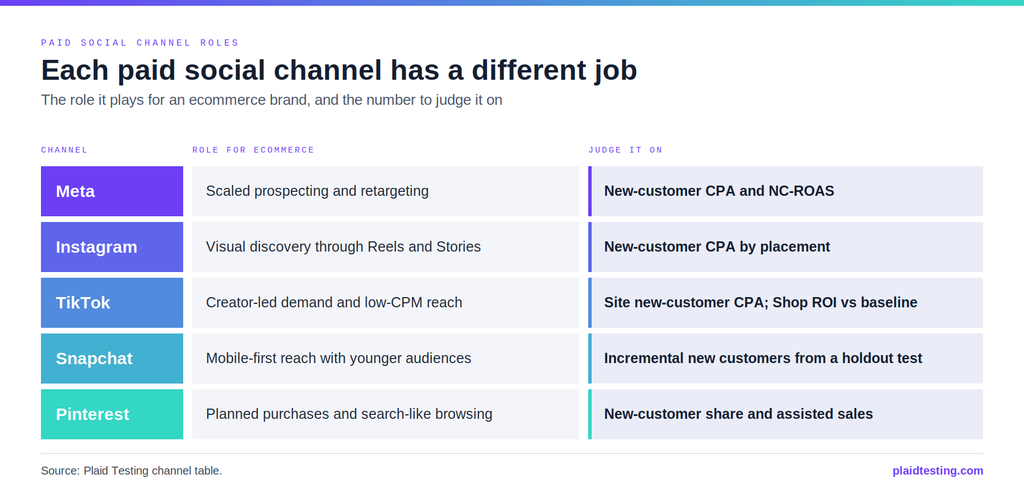
Each platform earns budget for a different job, and the price of reaching people varies widely between them. Across more than 40,000 brands tracked from August 2025 through July 2026, Triple Whale found Meta’s median CPM at $15.06 and its median ROAS at 1.88 (Triple Whale, August 2026). Its TikTok data for the same twelve months, from more than 5,900 brands, showed a $4.08 CPM, a $17.07 CPA and a 1.51 ROAS, with apparel and accessories at a 2.70 median ROAS (Triple Whale, August 2026). Cheap impressions are not the same as cheap customers, so the comparison that matters is new-customer cost on each channel, measured in your own store data.
Audience size shapes the role of the smaller channels. Snapchat reported 92 million daily active users in North America for the second quarter of 2026, down 7% on a year earlier (Snap Inc., August 2026). Pinterest counted 106 million monthly active users across the US and Canada in the same quarter (Pinterest, August 2026). Both are large, but a test should prove they add customers Meta would not have found anyway.
TikTok deserves its own creative plan. Spark Ads turn organic posts, from your account or a creator’s with their authorization, into ads while the engagement stays on the original post (TikTok Ads Help Center, June 2026). Our guide to running creator posts as Spark Ads covers codes and costs, and the TikTok ads service page sets out how we manage the channel as part of one paid social plan.
| Channel | What it is best at for ecommerce | Creative that tends to work | What to measure |
|---|---|---|---|
| Meta (Facebook) | Scaled prospecting and retargeting on deep conversion data | Many distinct concepts: static, video, creator content, catalog ads | New-customer CPA and NC-ROAS against total ad spend |
| Visual discovery through Reels, Stories and creator partnership ads | Vertical 9:16 video, partnership ads, carousels | New-customer CPA by placement, hold rate on Reels | |
| TikTok | Reaching new audiences at a low CPM, creator-led demand, TikTok Shop sales | Native creator video, Spark Ads, Shop videos under GMV Max | Site new-customer CPA; Shop ROI against a pre-launch baseline |
| Snapchat | Mobile-first reach, strongest with younger audiences | Full-screen vertical video, collection ads, AR lenses | Incremental new customers from a holdout test |
| Planned purchases and search-like browsing in fashion, home and gifting | Product pins and catalog-based shopping ads with lifestyle imagery | New-customer share and assisted sales over longer windows |
How Much Does A Paid Social Agency Cost?
Fees follow spend, the number of channels and whether creative production sits inside the scope. Clutch’s pricing page, built from verified client reviews, puts typical social media marketing agency rates at $25 to $49 an hour, the average monthly cost at $5,107.28 and the average project at $61,148.53 across 12 months (Clutch, September 2026). Treat those as a floor rather than a quote. Clutch’s category blends organic community management with paid work, and an account spending $50K or more a month across three platforms usually needs more senior hours than the average reviewed project.
The pricing models are the familiar four: a flat retainer, a percentage of ad spend, a fee tied to performance, or a hybrid of a minimum fee plus a percentage. Our breakdown of how each agency pricing model works out in dollars runs the numbers.
In paid social the larger hidden line is usually creative. Concept development, creator fees, usage rights and editing often sit outside the management fee. Ask for creative priced separately: how many new concepts per month, in which formats, who sources and pays the creators, and who owns the raw footage afterwards. Then project the total at the budget you expect to run two quarters from now, since percentage fees rise with spend. Media inflation belongs in the same model. Meta told investors that what it charged for the average ad from April to June 2026 was up 12% on the same months of 2025 (Meta, July 2026), so the same budget now buys fewer impressions and the creative has to carry more of the load.
How Do You Vet A Paid Social Agency? Where To Look And What To Ask
The platforms’ own directories make a sensible starting list. TikTok’s Marketing Partners directory groups partners into agency, creative, measurement and marketing technology. Snapchat lists ad agencies, technology providers and creative studios in its Snapchat Partners directory, and Pinterest’s approved partners directory filters by specialty, including advertising, creative and shopping. Clutch adds client reviews and published pricing. A badge shows a working relationship with a platform, not results in your category, so use directories to build the shortlist and questions to choose from it.
These are the questions we would put to any paid social partner, ourselves included:
- Who changes our campaigns each week, and can we meet that person before signing?
- How many genuinely new creative concepts will we see each month, and who makes them?
- If the relationship ends, do the ad accounts, pixel, Conversions API setup, catalogs and creative files remain ours?
- What metric do you want to be held to: platform ROAS, new-customer CPA or contribution margin?
- How do you decide the split between Meta, TikTok and the smaller channels, and what would make you move it?
- How will you show us that two platforms are not both claiming the same order?
Listen for specifics: names, cadences, examples from comparable accounts and what did not work. A vague answer on ownership or measurement is not proof of a problem, but it deserves a follow-up question before anything is signed. If you are also weighing a freelancer or an in-house hire, our guide to choosing between a media buying agency, a freelance buyer and an in-house team lays out that trade-off.
How Should You Measure A Paid Social Agency’s Results?
Start with new customers. Platform ROAS counts every attributed sale, including repeat buyers who would have ordered anyway, so it can rise while the customer base stalls. NC-ROAS (first-order revenue over total ad spend) and new-customer CPA (total ad spend over first orders) show whether paid social is adding buyers. Our explainer on calculating new customer ROAS from Shopify or Triple Whale covers the setup.
Next, check overlap between channels. Meta, TikTok, Snapchat and Pinterest each report the conversions they believe they drove, and a shopper who saw ads on two of them can be counted twice. Once a week, add up the purchases every platform claims and compare the total with actual Shopify orders for the same days. Some excess is normal when several channels run; a ratio that keeps widening means the platforms are crediting themselves for the same buyers. For newer channels, a regional holdout before scaling is the cleaner test of whether they add anything.
Attribution settings should match how the brand sells. In the accounts we run, considered purchases such as luxury goods get a longer, multi-touch view, while impulse products are read on a short last-click basis, and we test the choice by checking that Meta’s reported ROAS rises and falls with the count of new customers in the store’s own data. When the numbers stall despite all of this, our diagnosis for Facebook ads that stop converting walks through the checks in order.
What Does This Look Like In A Real Account? Hero Products Carry Paid Social
A women’s fashion brand we work with took 18,735 new-customer orders between January and August 2026, and 8,517 of them, about 45%, came from one product: a pair of track pants. That share is a store-wide count across every channel rather than a paid social result, no holdout test measured what the ads added on their own, and the product’s fit, price and stock depth earned those orders as much as any campaign did.
The lesson is about where creative and budget go. Paid social tends to find a handful of hero products and scale them, so a partner should plan around that instead of spreading spend thinly across the catalog: more concepts, angles and creators for the products already winning first orders, inventory confirmed before budget rises, and a smaller, separate test budget for everything else. Briefs built that way are what our performance creative team works from, with each new concept tied to a named product and a test it has to pass.
Whichever partner you choose, a second opinion before you sign costs little. Our free Meta ads audit reviews tracking, creative diversity and new-customer economics with a senior operator, and the findings are yours to keep.
Common Questions
What are the best paid social agencies for ecommerce?
There is no neutral ranking, and many lists of the best paid social agencies are published by agencies themselves. Build a shortlist from the TikTok, Snapchat and Pinterest partner directories plus Clutch reviews, then pick the partner that answers questions on account ownership, creative volume and new-customer measurement most specifically for a brand like yours.
What is the difference between a paid social agency and a social media agency?
A social media agency usually manages organic posting, community replies and content calendars. A paid social agency buys and manages ads, which for ecommerce includes creative testing, tracking and budget allocation across platforms. Many firms offer both, so ask what share of the team works on paid media and who runs the ad accounts day to day.
Is Meta or TikTok better for ecommerce advertising?
For most ecommerce brands Meta remains the base channel, because its conversion data and catalog ads scale reliably. TikTok is strongest for reaching new audiences cheaply and for creator-led products. Triple Whale’s 2026 benchmarks show TikTok’s CPM far below Meta’s but its ROAS lower too, so judge TikTok on new-customer CPA rather than platform ROAS.
How long does it take to see results from a paid social agency?
Expect the first month to go on tracking fixes, account structure and early creative tests, so the first numbers are noisy. Judge the partner on the trend in new-customer CPA and NC-ROAS over roughly a quarter, and on whether creative output and reporting arrive as promised from week one.
Related Reading
- TikTok Spark Ads: How They Work, Codes, Costs and Scaling: running creator posts as ads
- Instagram Reels Ads: Specs, Safe Zones and What Works for Ecommerce Brands: formats, specs and costs for Reels
- Snapchat Ads for Business: Formats, Targeting and Setup for Ecommerce Brands: testing Snapchat with a regional holdout
- GMV Max on TikTok Shop: How It Works, What It Hides and When to Use It: TikTok Shop’s automated campaigns