
An ecommerce growth agency is an outside team hired to grow an online store’s revenue and profit, usually by running paid media, creative, email and conversion work together. The good ones also own the strategy layer: margin targets, channel mix and one trusted set of numbers. Judge them on new customers and contribution, not on platform ROAS.
The label is loose, and that is the first problem a buyer runs into. Search for an ecommerce growth agency and the results mix full-service shops, paid media specialists, Shopify developers and consultancies that sell to other agencies. Meanwhile the stakes keep rising. US retail ecommerce reached $340.2 billion in the second quarter of 2026, 17.1% of all retail sales and up 12.2% on a year earlier (US Census Bureau, August 2026), and the cost of reaching each customer has climbed with it: Meta’s average price per ad rose 12% year over year in the same quarter (Meta, 29 July 2026). This guide covers what the work should include, what it costs, and how to tell a growth partner from an ad buyer before you sign.
What Does An Ecommerce Growth Agency Actually Do?
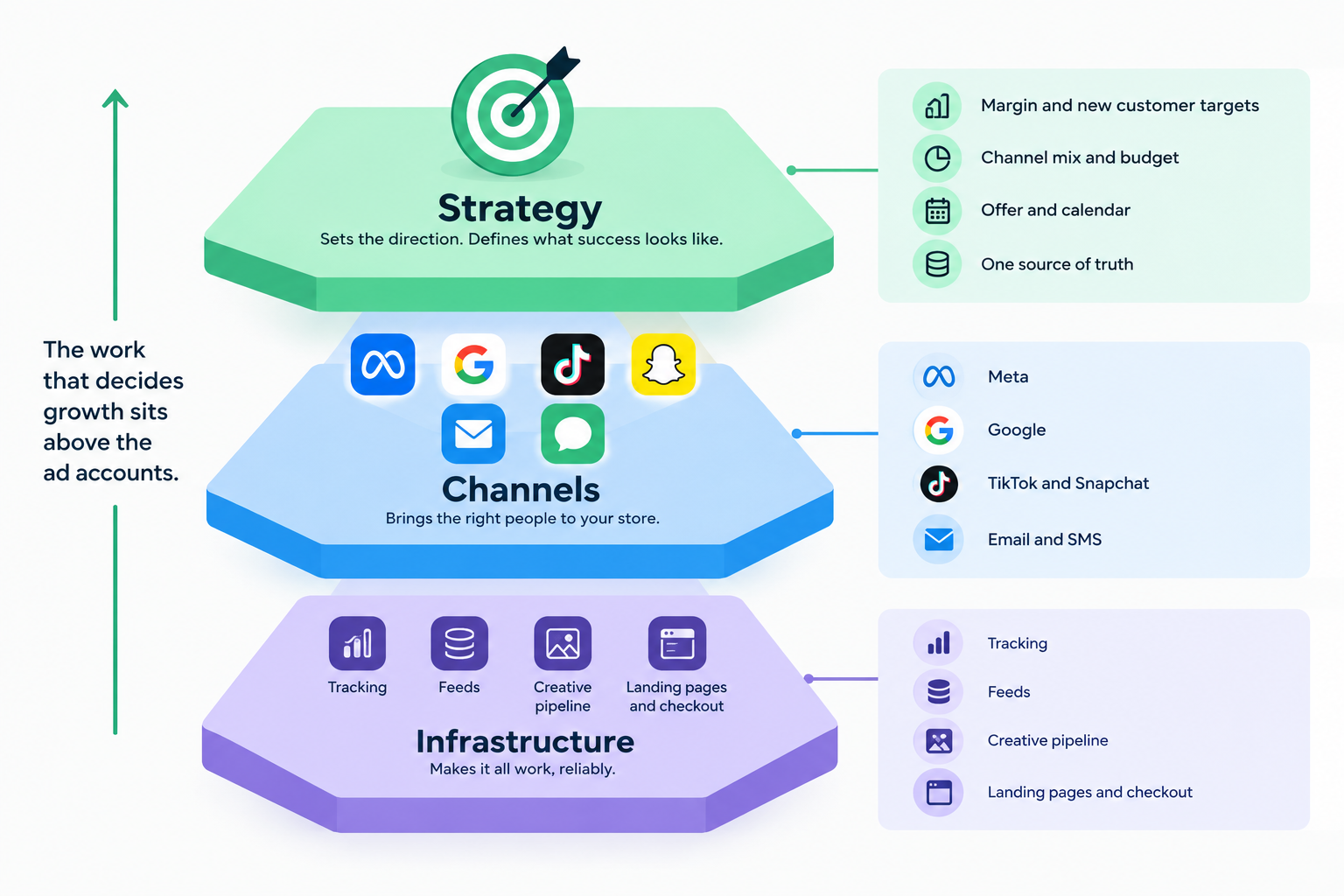
Strip away the branding and an ecommerce growth engine has three layers. At the bottom sits infrastructure: the Pixel and server-side events, product feeds and catalogs, landing pages, checkout, and the pipeline that produces creative. In the middle sit the channels: Meta and Instagram, Google Search and Shopping, TikTok, email and SMS. On top sits strategy: what margin and new customer targets the business must hit, how budget splits across channels, which offers run when, and which numbers everyone agrees to trust.
Many agency scopes are written around the middle layer, because channels are easy to price and easy to report on. Growth is usually decided above it. Paid media alone took 30.6% of the average marketing budget in Gartner’s 2025 CMO Spend Survey of 402 marketing leaders (Gartner, 12 May 2025), and a line that large needs an owner who decides where it goes, not only someone who spends it well. A true growth partner should be able to say, by name, who on their side owns each of the three layers, and which ones stay with you. If the answer for the strategy layer is “you do”, that can still work, as long as someone on your team has the time and the authority to own it.
Growth Agency, Performance Agency Or Fractional CMO: What Is The Difference?
The three are often sold against the same budget, so it helps to compare them on what they own rather than what they are called. A performance marketing agency buys media and is measured on platform results. A growth agency adds creative, retention and conversion work, and sometimes strategy. A fractional CMO is a senior leader, part time, who owns the plan and the numbers and directs whoever executes. Many brands end up combining two of them. The labels matter less than one practical test: when results dip for a month, who decides what changes, and on what evidence? Whoever answers that question owns the strategy layer, whatever the contract calls them.
| Model | Usually owns | Who is senior on your account | Typically paid by | Best fit |
|---|---|---|---|---|
| Performance marketing agency | Channel execution: campaigns, bids, budgets inside each platform | An account lead, with a senior sponsor at the start | Percentage of ad spend, retainer or hybrid | A brand with a clear strategy that needs execution capacity |
| Ecommerce growth agency | Channels plus creative, email, CRO and sometimes strategy | Varies widely; ask who runs the account in month four | Retainer, often with a percentage of spend on top | A brand that wants one partner across several channels |
| Fractional CMO | Strategy, budget allocation, measurement, hiring and vendor decisions | The fractional leader personally | Monthly retainer or hourly rate | A brand past the founder-as-marketer stage but not ready for a full-time CMO |
| Fractional CMO who executes | Strategy plus channel execution through a small senior team | The same person who sets the strategy | Scoped after an audit | A brand spending $50K or more a month that wants one accountable owner |
The last row is how we work, and it exists because the gap between the person who sells the strategy and the person who runs the account is where growth plans can leak. If you are weighing a leadership hire against outside help, our guide to a fractional marketing team goes deeper on that choice, and outsourced CMO vs fractional CMO covers the leadership options side by side.
How Much Does An Ecommerce Growth Agency Cost In 2026?
Pricing follows scope and spend. For paid media management, WebFX puts typical fees at 10% to 20% of ad spend, or around $1,000 to $3,000 a month for smaller budgets (WebFX, September 2026). Its own published tiers show the common hybrid in practice: a minimum fee or a percentage of spend, whichever is higher, with the percentage stepping down as budgets grow. Clutch’s verified client reviews put the average PPC engagement at $7,165.33 a month and $100 to $149 an hour (Clutch, September 2026), while social media marketing work averages $25 to $49 an hour (Clutch, September 2026).
A growth agency that bundles creative production, email and conversion work will sit above those figures, because it is several scopes priced as one. Two habits keep quotes comparable. First, convert every proposal into a monthly cost at the spend level you plan to reach in six months, not the one you have today, since percentage fees grow with the budget. Second, list what sits outside the fee: creative production, tools, landing page builds and setup charges are the usual extras. Our full breakdown of how much marketing agencies charge walks through each pricing model with worked numbers, and performance-based pricing covers fees tied to results.
How Do You Choose An Ecommerce Growth Agency?
The fastest filter is a short list of questions that a strong partner answers in specifics and a less suitable one answers in generalities. These are the eight we would ask in your position:
- Who will run our account day to day in month four, and can we meet them before signing?
- Which of strategy, channels and infrastructure do you own, and which stay with us?
- Which number will you be judged on: platform ROAS, blended ROAS, new customer CPA or contribution margin?
- Will the ad accounts, Pixel, data and creative stay in our name if we part ways?
- How will your fee change if our spend doubles?
- What reporting will we see daily, weekly and monthly, and in which tool?
- What did you change in a comparable account, and what did it not fix?
- What would make you tell us to spend less?
Credentials help, but read them for what they measure. A Google Partner badge requires an optimization score of at least 70%, $10,000 of ad spend across managed accounts over 90 days, and at least half of account strategists certified (Google Ads Help). That shows an active, certified Google practice, not results in your category. Shopify retired its Plus Partner program in December 2024 (Shopify Help Center), and its current partner tiers are based on referral revenue and merchants brought to Shopify (Shopify partner program guide). Ownership is the question that matters most later: Google’s own guidance says advertisers are entitled to know the clicks, impressions and total cost of their ads when a third party manages them (Google Ads policy help).
What Separates A Growth Partner From An Ad Buyer?
Three signals show up early, usually in the first proposal. The first is measurement. A growth partner will ask about contribution margin, returns and new versus returning revenue before discussing campaigns, because those decide what a good ROAS is for you. If the proposal leads with platform ROAS targets, the strategy layer is probably missing. Our guide to what a good ROAS is shows why the same ROAS can be profitable for one store and loss-making for another.
The second is transparency about money. Only 28% of advertisers in ANA’s 2025 agency compensation research said they had adequate visibility into how their agencies make money, according to ANA Magazine’s October 2026 coverage (ANA Magazine, 6 October 2026). Asking for fees, markups and tool costs in writing is ordinary diligence, and under Google’s transparency requirements, third parties that manage Google Ads must disclose their fees and report ad costs separately from them (Google Ads policy help).
The third is reporting rhythm. In AgencyAnalytics’ 2025 benchmarks survey of more than 220 agency leaders, 70% said reporting is critical to keeping clients (AgencyAnalytics, 10 September 2025). A partner who shows you the same daily data they see, including the bad weeks, is easier to trust and easier to correct.
What Growth Looks Like When The Strategy Layer Is Owned
A fashion apparel and accessories brand we work with grew sales 249% year over year while net profit rose 205%, with media investment scaled more than fourfold, per its Triple Whale account. Net margin finished at 41% and MER, paid media as a share of revenue, at 29%. New customer CPA rose over the same period, and that was a managed trade rather than a surprise: new customer CPA and new customer ROAS were tracked throughout the scale-up, so the extra volume was bought knowingly. The detail is in the fashion apparel case study.
What this does not claim: the figures are blended across every paid channel rather than any single platform, no incrementality test isolated what the ads caused, and product and merchandising decisions moved the numbers alongside media. The point is narrower and more useful. Revenue and profit grew together because someone owned the question of how much acquisition cost the margin could carry, and changed spend when the answer changed. That decision sits in the strategy layer. It is the strategy work that is hardest to see in a proposal and easiest to test in an audit, which is why we start every engagement with one.
When Is A Fractional CMO A Better Hire Than A Growth Agency?
An agency is the right call when the strategy is settled and the gap is execution capacity across several channels. A fractional CMO is the better first hire when the gap is the plan itself: nobody owns the margin targets, channel budgets are set by habit, and the agency, the email freelancer and the founder each report a different number for the same week. Bringing in more execution before that is fixed tends to spend money faster in the same direction.
Cost is closer than many founders expect. On GoFractional, the average asking rate for fractional CMOs in ecommerce is $208 an hour, with the middle 50% between $150 and $244, across 56 observations from July to October 2026 (GoFractional, October 2026). Those are asking rates, not retainers, but they show a senior strategist is within reach of the same budget an agency retainer uses. Our fractional CMO service is built for brands spending $50K or more a month on ads, and the in-house vs agency comparison covers the hybrid most of them end up running.
If you are comparing proposals now, a second opinion on your current setup costs nothing. Book a free 30 minute growth audit and we will review your tracking, account structure and budget split, then give you three fixes ranked by impact, whichever partner you choose.
Common Questions
What does an ecommerce growth agency do?
It runs the work that grows an online store’s revenue and profit: usually paid media, creative, email and SMS, and conversion rate work, sometimes with strategy on top. The strongest ones own margin targets, channel mix and measurement as well as execution, and report on new customers and contribution rather than platform ROAS alone.
How much does an ecommerce growth agency cost?
Paid media management typically runs 10% to 20% of ad spend or about $1,000 to $3,000 a month for small budgets, according to WebFX, and Clutch reviews put the average PPC engagement at about $7,165 a month. Full growth scopes that add creative, email and conversion work cost more, so compare quotes at your planned spend level.
What is the difference between a growth agency and a marketing agency?
A marketing agency may cover brand, content, social or PR as well as paid channels. A growth agency focuses on measurable revenue growth, usually through paid acquisition, creative testing, retention and conversion work, and is judged on sales and customer numbers. The label varies, so compare scopes and the metric each one is accountable for.
How long before a growth agency shows results?
In our experience, measurement and account structure fixes often show within the first 30 days as steadier delivery and cleaner reporting, while creative testing and channel expansion take 60 to 90 days to compound. Treat any promise of a specific ROAS in the first weeks with caution, because it depends on margins and data the agency has not yet checked.
Related Reading
- In-House vs Agency Marketing for Ecommerce Brands: Costs, Trade-Offs and the Fractional Option: what each model costs in a year
- How Much Do Marketing Agencies Charge? 2026 Pricing for Ecommerce Brands: retainers, percentages and hybrids compared
- Performance-Based Marketing Agency: How Pay-for-Performance Pricing Works for Ecommerce: fees tied to results, and the metric that decides them
- Fractional Marketing Team: Roles, Cost and Setup: senior leadership without a full-time hire
- Outsourced CMO vs Fractional CMO: Which Fits an Ecommerce Brand Spending $50K+ a Month?: the leadership options side by side