
INDUSTRIES · SUPPLEMENTS
Supplement marketing agency for ecommerce brands
Plaid Testing is a supplement marketing agency for ecommerce brands spending $50K or more a month on ads. We run paid media, creative testing and tracking under a fractional CMO, built around the two things that now decide supplement profitability: Meta’s health and wellness restrictions, and subscription lifetime value. Supplements are our second vertical after apparel.
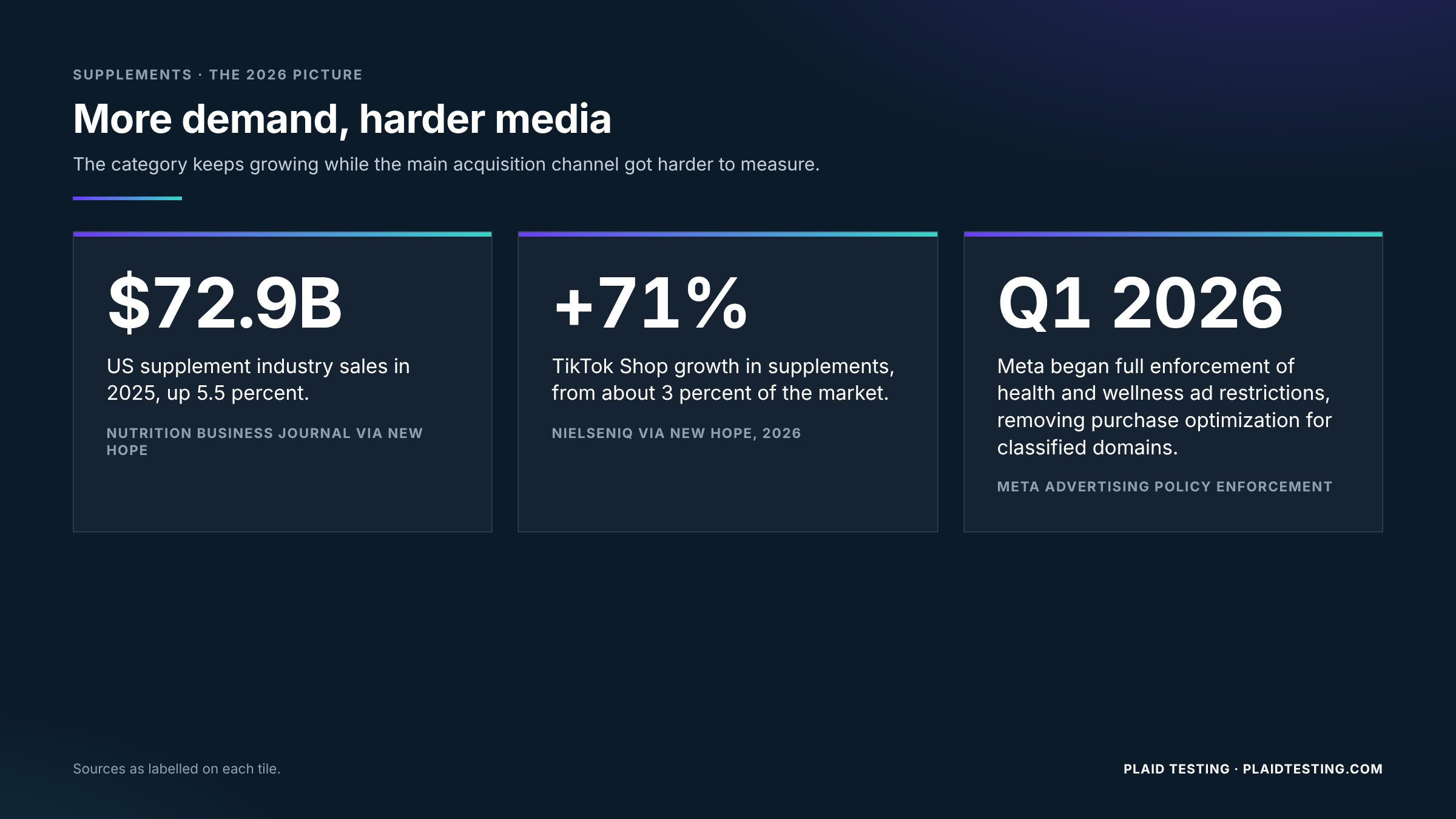
$72.9B
US supplement industry sales in 2025, up 5.5 percent
Nutrition Business Journal
71%
TikTok Shop growth in supplements, from about 3 percent of the market
NielsenIQ via New Hope
Q1 2026
Meta began full enforcement of health and wellness ad restrictions
Meta policy
Supplements in 2026: more demand, harder media
The category is growing. US supplement sales reached $72.9 billion in 2025, up 5.5 percent, and most of that volume now moves online, with TikTok Shop at about 3 percent of the market and growing 71 percent a year, according to Nutrition Business Journal and NielsenIQ figures reported by New Hope in 2026. The media that used to carry a supplement brand got harder at the same time. Since the first quarter of 2026, Meta enforces its health and wellness policy with automated classification of advertisers, and a domain classified as health-related loses Purchase and Add to Cart optimization and is limited to landing page views or engagement. A supplement brand that was buying purchases in 2025 is buying landing page views in 2026 unless its tracking is rebuilt.
That is the whole job: keep the growth and get the signal back.
What a supplement marketing agency should run
| Channel | The supplement-specific constraint | What we run |
|---|---|---|
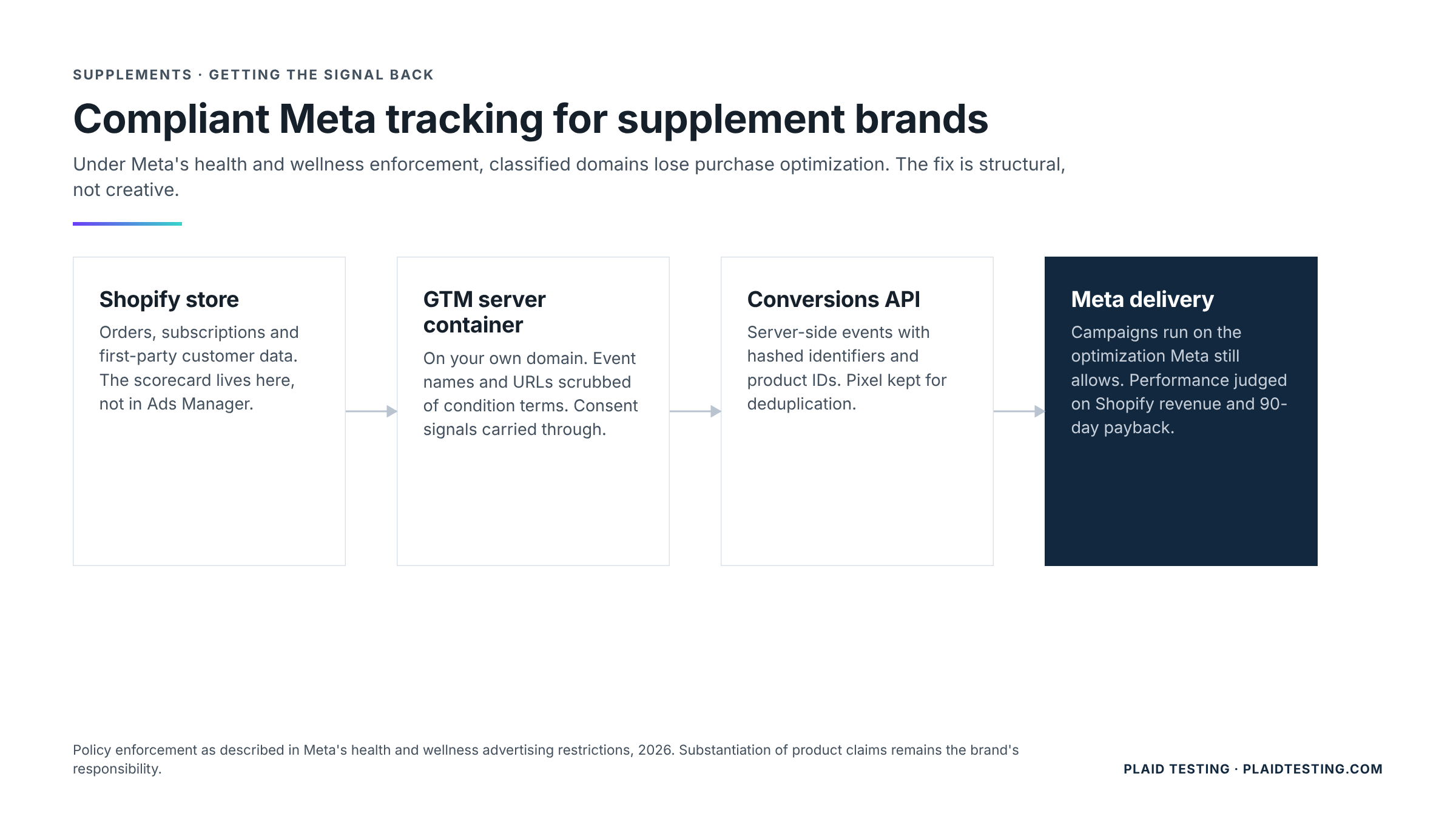
| Meta and Instagram | Health classification removes purchase optimization. Before and after imagery and condition claims get rejected or classified. | Server-side tracking through a GTM server container and the Conversions API, event names and URLs scrubbed of condition terms, landing page view optimization with Shopify revenue as the scorecard, and creative built on education and lifestyle rather than transformation. Meta Ads for ecommerce. |
| Google Search, Shopping and Performance Max | Non-brand search is where supplement intent lives, and Google’s healthcare policies apply to claims in ad copy. | Brand carved out, non-brand built by ingredient and use case, Shopping feeds with compliant titles, and Performance Max budgeted from contribution margin, not platform ROAS. Google Ads for ecommerce. |
| TikTok and TikTok Shop | The fastest growing supplement channel and the hardest to attribute to the Shopify store. | Spark Ads on creator content, GMV Max where the brand sells on TikTok Shop, post-purchase surveys to capture what the pixel misses. GMV Max on TikTok Shop. |
| Subscription economics | Most supplement brands lose money on the first order and make it on the third. | Bidding targets set from 90-day and 180-day LTV by product, first-order offers that recruit subscribers rather than one-time buyers, and churn tracked next to CPA. CAC, payback and LTV to CAC. |
| Creative testing | Claims substantiation and platform review slow the cycle. | A weekly test slot with a compliance pass before launch: hooks and formats tested in small sandbox campaigns before budget scales. Performance creative. |
| Tracking and attribution | Restricted events plus subscription renewals make platform reporting unusable on its own. | Triple Whale pixel and CAPI, blended and new-customer ROAS daily, subscription revenue separated from first orders. Tracking and attribution. |
Three things that break supplement paid media
1. The account is still optimizing for purchases that Meta no longer sees
The most common finding in a supplement audit this year is a campaign set to Purchase optimization on a domain Meta has classified as health-related. Spend keeps running, delivery narrows, and the account looks like creative fatigue when it is a signal problem. The fix is structural: server-side events, sanitized parameters, consent passed to the Conversions API, and campaigns moved to the optimization Meta still allows while Shopify, not Ads Manager, becomes the scorecard. Our post on Facebook ads that stopped converting walks through the diagnosis.
2. Claims that sell on the landing page get the ad account flagged
Supplement creative lives inside two rulebooks: the platform’s health policy and the FTC’s substantiation standard for health claims. Ads that imply a condition is treated, or that show a transformation, are the ones that get rejected and the ones that classify the domain. We write the creative brief from what can be substantiated and tested, which also happens to be what builds a brand customers reorder from.
3. CPA is judged on the first order
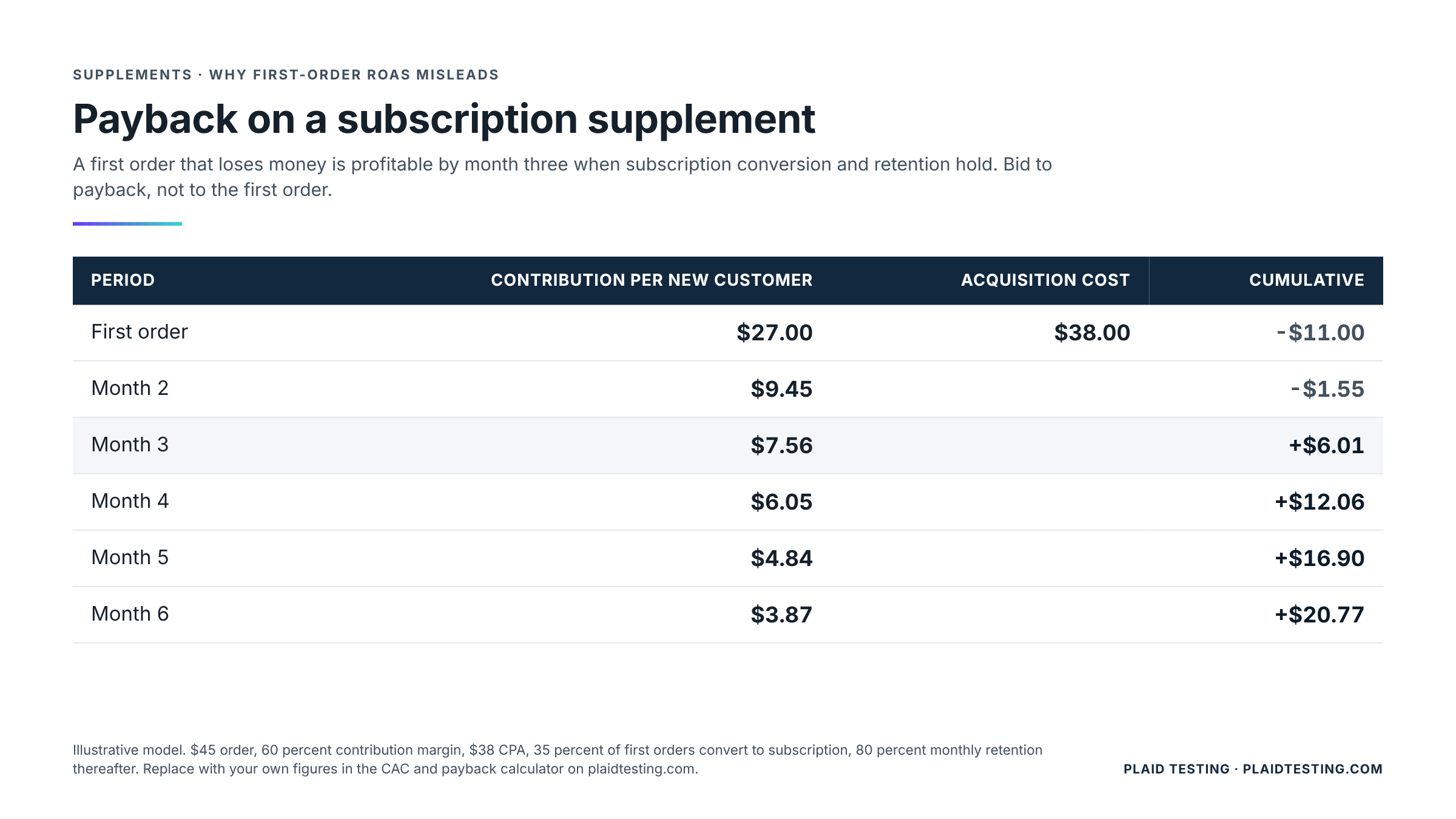
A $45 first order with a $38 CPA is a loss on day one and a profit by day 90 if the product converts to subscription at the rate most quality supplements do. Brands that cut spend when first-order ROAS dips are cutting the orders that fund next quarter. We set targets on payback, report subscription revenue separately, and move budget toward the products whose 90-day LTV earns it.
How we run supplement accounts
- Audit (free, 30 minutes). Is the domain classified as health-related by Meta, and what did that do to delivery? Does attribution agree with the bank account? Where does the structure leak budget? Three fixes, whether or not we work together.
- Rebuild (first 30 days). Server-side tracking and Conversions API with sanitized events, Triple Whale live, campaign structure split by new and subscribing customers, creative pipeline with a compliance pass, daily reporting from day one.
- Scale. Daily snapshot, weekly tests, monthly strategy. Budget follows 90-day payback by product, not platform ROAS.
Want to know whether your Meta account is classified and what it is costing you? Book a free 30 minute growth audit and we will check it on the call.
Proof from the work
We publish client figures only with written permission and only when they trace to a platform export we hold. Supplement brands rarely grant that, so supplement results are walked through on the audit call rather than printed here. What we can publish is the operating system itself, verified in Triple Whale on three apparel accounts: sales to $9.27M in the first half of 2026 on one, net margin from 32.8 percent to 48.3 percent on another while ad spend rose 419 percent, and new-customer CPA from $86 to $67 on a third. See the case studies. The tracking rebuild, the new versus returning split and the payback-based budgeting are the same work; the supplement version adds the compliance layer. What this does not claim: no incrementality test was run, blended figures come from Triple Whale, and product and merchandising moved these numbers alongside media.
Who this is for
- Shopify supplement, vitamin and sports nutrition brands at $50K or more a month in ad spend.
- Brands with a subscription product and a founder who wants LTV, not first-order ROAS, to drive the budget.
- Brands that have been classified by Meta and need the account rebuilt rather than the creative blamed.
Not for brands under $25K a month, Amazon-only sellers, or products that cannot substantiate the claims they want to advertise. We will say so on the audit call.
What it costs
No retainer is required to start. Pricing depends on monthly spend and on done for you versus done with your team. Our guide to how much marketing agencies charge in 2026 explains the models.
Questions supplement founders ask us
Can you still run Meta ads for a supplement brand in 2026?
Yes. What changed is optimization and tracking, not eligibility. A compliant supplement brand can advertise on Meta; it cannot optimize for Purchase if its domain is classified as health-related, so the tracking has to be rebuilt server-side and the account judged on Shopify revenue.
What is a good CPA for a supplement brand?
One below your 90-day payback. For a subscription product, a CPA above the first-order margin is normal and profitable if conversion to subscription holds. For a one-time product, CPA has to clear the first-order contribution margin. Our CAC calculator gives you the number.
Do you handle compliance?
We run a compliance pass on every creative brief and landing page before launch and we structure tracking to stay inside Meta’s health policy. We are not your regulatory counsel; claims substantiation for the product itself is yours and your lawyer’s.
Do you run Amazon or TikTok Shop?
TikTok Shop, yes, as part of paid media. Amazon advertising, no; we focus on the Shopify store and refer Amazon work out.
Get your free 30 minute growth audit
A senior review of your ad accounts, tracking and creative, with three fixes you can act on whether or not we work together. No retainer required to start.