
A Shopify marketing agency should run your paid media and also work the store: tracking through Shopify’s checkout and customer events, the Meta and Google channel apps, offers, shipping and repeat purchase. Most charge a retainer, a share of ad spend or both. Vet one on new-customer cost and contribution margin, not platform ROAS.
The stakes are large because the platform is. Merchants on Shopify processed $115.6 billion in gross merchandise volume in the second quarter of 2026, up 32% on a year earlier (Shopify, August 2026), and many of those stores bid in the same Meta and Google auctions. Those auctions keep getting dearer: Meta told investors that the average price it charged per ad climbed 12% from a year before in that quarter (Meta, July 2026). Shopify has also changed what Shopify expertise means, retiring its Plus Partner program and rebuilding checkout tracking within two years. This guide covers what the work should include on a Shopify store, what it costs, where to look and how to vet a partner.
What Should A Shopify Marketing Agency Do For Your Store?
Think of the work in three layers. The first is the store itself: the offer, free shipping thresholds, product pages, the returns policy and the email and SMS flows that bring a first-time buyer back. The second is the channels: Meta and Instagram through the Facebook & Instagram app, Google Search, Shopping and Performance Max through the Google & YouTube app, TikTok, and Shopify’s own Shop Campaigns. The third is measurement: the pixels running in Shopify’s customer events, the data sharing level sent to Meta, the conversion actions in Google Ads, and one agreed source for new versus returning customers.
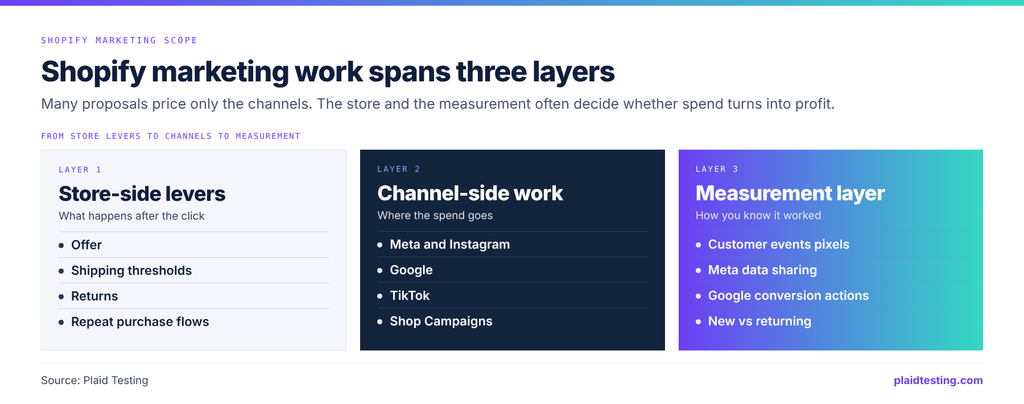
Many proposals price only the channel layer, since campaigns are simple to scope and simple to report on. On Shopify, the outer layers often decide whether spend turns into profit. One brand we worked with was converting under 1%; it cut its shipping charge from $20 to $9 and its conversion rate roughly doubled the next day. No bid adjustment does that. A partner who reads the store as closely as the ad accounts will find levers like that one; a partner whose scope stops at Ads Manager may never be asked to look. If channel execution is the gap in your team, this is how we run paid media for ecommerce brands across Meta, Google and TikTok.
Why Did Ad Tracking Break On Some Shopify Stores?
Shopify’s checkout upgrade is a common reason a store’s ad numbers drifted away from its orders. The additional scripts box in checkout settings became view-only on 28 August 2025, and stores outside Shopify Plus had until 26 August 2026 to move their Thank you and Order status pages to the new checkout (Shopify Help Center, 2026). Any conversion tag pasted into that box years ago had to be recreated. Shopify’s replacement is pixels managed under Customer events in the admin: app pixels supplied by marketing apps, or custom pixels a developer adds when no app covers the need (Shopify Help Center). A store that skipped the rebuild could lose purchase events silently.
The next check is how the store feeds Meta. The Facebook & Instagram app offers three data sharing levels: Standard depends on the browser pixel, while Enhanced and Maximum add the Conversions API, a server connection that browser ad blockers cannot stop (Shopify Help Center). Meta has put the payoff from server events at a 17.8% lower average cost per result (Jon Loomer Digital, April 2026). On Google, the Google & YouTube app should own purchase tracking, with old theme tags removed so orders are not counted twice, and enhanced conversions switched on; Google reports an average of 11% more Search conversions from them versus standard conversion imports (Google, September 2026). Our guides to Facebook ads on Shopify and Google Ads on Shopify walk through each setting.
Shopify Audiences, Shop Campaigns And Collabs: Which Are Worth Using?
Shopify sells three marketing tools of its own, and a partner who claims Shopify depth should know who qualifies for each and where it fits. Shopify Audiences generates lists of US and Canadian shoppers likely to buy from your store and exports them straight into your ad accounts. It is limited to eligible Shopify Plus stores that use Shopify Payments, are based in the United States or Canada, and have Shopify Network Intelligence turned on (Shopify Help Center).
Shop Campaigns is Shopify’s own ad buy. Ads run across the Shop app, shop.com, the Shopify Product Network and optional third-party placements; you set the average acquisition cost you are willing to pay and are charged only when a customer converts (Shopify Help Center). Read the reporting rules before comparing it with Meta. Orders within 7 days of a paid click count toward the campaign, and Shopify notes that returning customers can show up even in a campaign aimed at new ones (Shopify Help Center). Check its buyers against your new-customer report before you scale it.
Shopify Collabs handles affiliates and creators, from commission links to payouts, but its help page currently says the app is not accepting new creator signups (Shopify Help Center). For now it suits programs built on creators you already know.
What Should A Shopify Marketing Partner Own, And What Stays In-House?
Clear ownership prevents the most common disappointment: a partner judged on results it could not control. The table splits the work the way we see it in practice. Ad accounts, creative testing and tracking sit naturally with the partner. Merchandising, inventory and fulfillment usually stay with your team, because they depend on supplier terms, stock and cash. The middle ground, meaning offers, shipping thresholds and email, needs a named owner on both sides, since a discount agreed on Monday changes what the ads should say on Tuesday.
| Area | What a partner should own | What usually stays in-house | Check before signing |
|---|---|---|---|
| Paid media (Meta, Google, TikTok, Shop Campaigns) | Campaign structure, bidding, weekly budget moves within agreed limits | Total monthly budget and margin targets | Accounts sit in your name; how the fee moves as spend grows |
| Tracking and measurement | Pixels in customer events, Meta data sharing level, Google conversion actions, weekly reconciliation to Shopify orders | Choice of attribution tool and its subscription | Which report settles disagreements; how new and returning customers are defined |
| Creative | Concepts, testing plan, ad variations | Brand guidelines, product photography, final approval | Who keeps raw files; how many new concepts a month |
| Offers and shipping | Test proposals and landing pages | Final pricing, discount and shipping policy | How an offer test will be measured |
| Email and SMS (often Klaviyo) | Flows and campaigns, if in scope | Customer service messages | Account ownership and list access |
| Merchandising and inventory | Flagging sold-out products in live ads | Buying, stock levels, fulfillment, returns processing | Alerts when an advertised product runs out |
| Theme and apps | Recommendations | Development and app approvals | Who may install apps or edit the theme |
Two Shopify details belong in the contract. First, the store, ad accounts, pixels and Klaviyo account should stay in your name. Shopify lets you add collaborator accounts for partners and set permissions on what each can reach (Shopify Help Center), so nobody needs the owner login. Second, agree in writing which report wins when Meta, Google and Shopify disagree, before the first monthly review rather than during it. Shopify’s own analytics separates first-time from returning customers, and its New vs returning customers report is a sensible neutral referee (Shopify Help Center). Platform dashboards each credit themselves, so a store-side count keeps every party honest.
How Much Does A Shopify Marketing Agency Cost?
Pricing follows scope and ad spend more than the platform. WebFX’s published pricing puts paid media management at 10% to 20% of what you spend on ads, or roughly $1,000 to $3,000 monthly when budgets are small (WebFX, September 2026). Clutch’s review data places PPC firms at $100 to $149 per hour (Clutch, September 2026). Keep store builds separate in your head. Clutch’s Shopify listing says the average reviewed Shopify development project costs under $10,000, with ecommerce development firms averaging $25 to $49 an hour (Clutch, October 2026). A theme project and an ongoing growth engagement are different purchases, even when one firm sells both.
Shopify adds a few costs that sit outside any fee. Apps such as Klaviyo, Triple Whale or a reviews tool bill the store directly. Shop Campaigns charges per converted customer on top of whatever you pay a partner. Creative production, video especially, is often quoted on its own line. Ask every bidder to show total monthly cost at the spend you expect six months from now, with apps and production listed, so proposals line up item by item. Our breakdown of what marketing agencies charge in 2026 covers each pricing model with worked numbers.
Where Do You Find The Best Shopify Marketing Agency For Your Store?
Begin with directories that list evidence a buyer can verify, then read each badge for what it actually measures. Shopify’s Partner Directory filters by services, price and location, and lets you browse Select, Plus, Premier and Platinum partners; Shopify says the tiers weigh factors such as experience and proven success on Shopify (Shopify Partner Directory). Note that Plus is now a tier name, separate from the old Plus Partner program that Shopify sunset in December 2024 (Shopify Help Center). Ask which tier a firm holds today.
Clutch lists 10,415 firms under its Shopify filter, with reviews and filters for budget, hourly rate and industry (Clutch, October 2026); that list sits in Clutch’s design and development category, so narrow it to firms that offer marketing services. Google’s Partners Directory covers Google Ads specialists (Google Partners Directory). Its Partner badge asks for a 70% optimization score, $10,000 in managed spend over 90 days and half of account strategists certified, and Premier status goes to the top 3% in each country (Google Ads Help). Klaviyo’s Agency Partner Directory filters by ecommerce platform, brand size and tier (Klaviyo). Upwork is useful for defined freelance jobs, such as a pixel rebuild, where you manage the scope yourself.
| Where to look | What it shows | What it does not show |
|---|---|---|
| Shopify Partner Directory | Services, price, location, partner tier | Paid media results, or who will run your account |
| Clutch | Client reviews, budget and hourly rate filters | Whether reviewers match your category and spend |
| Google Partners Directory | Partner or Premier status in Google Ads | Results on Meta, TikTok or the store itself |
| Klaviyo Agency Partner Directory | Email and SMS expertise, brand size served, tier | Paid acquisition skill |
| Upwork | Individual specialists for defined tasks | Ongoing strategy and accountability |
How do you vet a Shopify marketing agency before you sign?
Strong partners answer these with specifics about your store.
- Which Shopify partner tier do you hold now, and which current clients sell on Shopify at our spend?
- Which pixels will run in our customer events, and which Meta data sharing level do you recommend?
- How will you reconcile Meta and Google conversions with Shopify orders each week?
- Will you report new-customer CPA and new versus returning revenue from Shopify, beside platform ROAS?
- Which store changes, such as shipping, offers or returns, would you expect to propose in the first 90 days?
- If we end the engagement, do the accounts, pixels and creative files remain ours?
The fifth question matters more than it looks. An athletic apparel brand we work with saw returns fall 10.2% to $17.7K in June 2026 against June 2025, while returning customers produced $759.5K of the month’s $1.73M in sales, about 44%. Those are store-wide Triple Whale numbers, so they blend every channel; no holdout test separated what the ads did, and the product range and merchandising choices shaped both figures alongside media. The lesson is that on Shopify, returns and repeat purchase move profit as much as the ad accounts do, so a partner should read the store, not only the ad platforms.
Whichever partner you choose, get a second opinion before you sign. Our free paid media audit for ecommerce brands checks your tracking, channel apps and store levers against your Shopify data.
Common Questions
What does a Shopify marketing agency do?
It runs paid acquisition for a Shopify store and should also handle the Shopify side: pixels in customer events, the Meta and Google channel apps, offers, shipping and repeat purchase. Strong partners report new-customer cost and contribution margin from Shopify data rather than leaning on platform ROAS.
How much does a Shopify marketing agency cost?
Paid media management is commonly priced at 10% to 20% of monthly ad spend, or as a fixed monthly fee, and Clutch reviews place PPC firms at $100 to $149 per hour. Store builds are priced separately. Add apps, creative production and any Shop Campaigns charges to compare the true monthly cost of each proposal.
Do I need a Shopify Plus Partner?
Not necessarily. Shopify sunset the Plus Partner program in December 2024 and now places partners in tiers from Registered up to Platinum based on performance. A tier reflects a firm’s standing with Shopify, not its paid media results, so ask for comparable accounts and meet the person who will run yours.
How do I find a Shopify marketing agency in the USA?
Filter Shopify’s Partner Directory and Clutch by United States and marketing services, then shortlist three firms with clients at your spend level. Ask each for a sample weekly report, the tracking setup they would build, and a named account lead. The best fit is the firm whose answers are specific to your store.
Related Reading
- Facebook Ads for Shopify: Setup, Tracking and Scale in 2026: Meta data sharing and deduplication
- Google Ads for Shopify: Setup, Structure and Tracking for Brands at Scale: tracking and structure in the Google & YouTube app
- Ecommerce Growth Agency: What It Does, What It Costs and How to Choose One: growth partners and fractional CMOs compared
- How Much Do Marketing Agencies Charge? 2026 Pricing for Ecommerce Brands: every pricing model with worked numbers
- Ecommerce Attribution: Models, Tools and What to Trust: matching platform claims to Shopify orders