
A performance-based marketing agency ties some or all of its fee to results, such as revenue, new customers or cost per acquisition, rather than charging only a flat retainer. It works when both sides agree on how results are measured. The ANA reports that use of performance incentives fell from 61% of advertisers in 2013 to 15% in 2025.
That decline is the most useful fact about the model, because it is not a sign that paying for results is a bad idea. It is a sign that agreeing on results is hard. In a June 2026 industry report cited by ANA Magazine, 81% of agencies said they saw the appeal of outcome-based models, and 69% named attribution as the blocker (ANA Magazine, 6 October 2026). For an ecommerce brand the measurement problem is solvable, and solving it is what makes a performance deal fair. This guide covers how the pricing works, which metric should decide the fee, why deals break, and what a sound agreement includes.
How does performance-based marketing pricing work?
Clutch describes performance-based pricing simply as pricing that depends on performance metrics, one of four common models alongside flat fees, percentage of spend and hybrids (Clutch, September 2026). In practice the structures fall into four families, and most real contracts mix two of them.
| Structure | How the agency is paid | Works best when | Main risk |
|---|---|---|---|
| Pay per acquisition | A fixed amount per order, lead or new customer | The unit is easy to count and its value is stable | Volume of cheap, low-value or returning customers |
| Revenue share | A percentage of the revenue attributed to the agency’s work | Attribution is agreed and audited | Paying for sales that would have happened anyway |
| Base plus bonus | A retainer, plus a bonus for hitting agreed targets | Targets are set from a clear baseline | Targets set too low, or too easy to game |
| Hybrid with spend | A base fee plus a percentage of spend, sometimes with a performance kicker | Work genuinely scales with budget | Incentive to spend rather than to earn |
Pure pay-for-performance deals are rare in paid media. A 2021 survey of 883 agencies and freelancers by Lunio found just 4% used performance-based pricing as their main model (Lunio, June 2021). In our experience, bonuses layered on a base fee are more common, because they keep the agency solvent in a bad month while still rewarding a good one. Our breakdown of how much marketing agencies charge covers the base fees these structures sit on.
The mix you choose changes behavior more than the headline rate does. A pay-per-acquisition deal pushes the agency toward the cheapest qualifying customers, so the definition of a qualifying customer has to be tight. A revenue share pushes toward whatever the attribution model credits most generously, so the model has to be agreed in advance. A base plus bonus is the easiest to keep fair, because the base covers the work and the bonus only pays for movement above a baseline both sides signed. Pick the structure whose failure mode you can live with.
Which metric should a performance fee pay on?
This is the decision that makes or breaks the deal, and the figure below shows why. It comes from a women’s fashion brand we work with, comparing January to August 2026 with the same months of 2025, per its Triple Whale account.
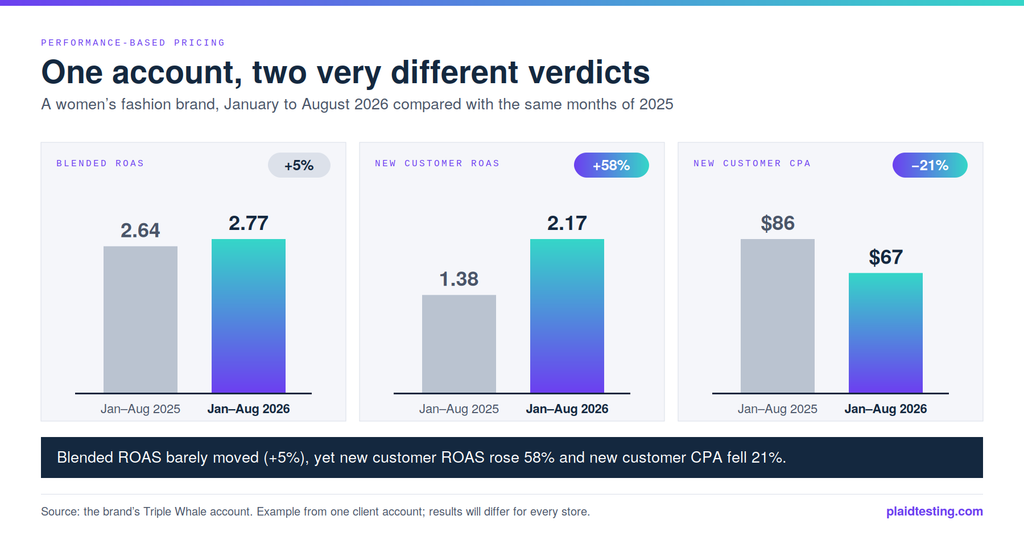
On blended ROAS, all store revenue divided by all ad spend, the year looks modest: about 2.64 to 2.77, up 5%. On new customer ROAS, revenue from first-time buyers divided by the same spend, it looks transformative: 1.38 to 2.17, up 58%, with new customer CPA down 21%, from $86 to $67. A bonus tied to blended ROAS would have paid for a 5% gain. A bonus tied to new customer numbers would have paid on the number that moved most. Both readings are true at once. The figures are blended across all paid channels, no incrementality test isolated what the ads caused, and product and merchandising moved them too.
For most ecommerce brands, the metric that best matches what the owner wants is new customer acquisition at a cost the margin can carry. That means new customer CPA or new customer ROAS from store data, checked against a floor set from contribution margin. Our guides to NC-ROAS and the break-even ROAS calculator show how to set both numbers before any contract is written.
Why do performance-based deals break down?
Most failures trace back to measurement. Each ad platform reports the revenue it believes it caused, inside its own attribution window, so the same order can be claimed twice. Northbeam, an attribution vendor, states plainly that its numbers may not line up with Meta Ads Manager by design (Northbeam pricing FAQ). And the gap does not always flatter the platform: across 640 incrementality experiments, Haus found Meta’s 7-day click reporting under-counted measured incrementality by 15% on average for brands selling only on their own site (Haus, 28 July 2025). A fee tied to any single platform’s report is a fee tied to a number neither side controls.
The second cause is baseline. Revenue rises in November whatever the agency does, and a strong product launch lifts every channel. If the contract pays on total revenue without a baseline, the agency is paid for the calendar. The third is the wrong customer. A revenue share that counts returning customers rewards retargeting people who would have bought anyway, and branded search is the classic example: it converts well and is cheap to claim.
Some analysts go further. Forrester has argued that performance-based agency compensation, as it is usually designed, does not produce better work from agencies (Forrester). That is a fair warning rather than a verdict. Solve the measurement first, then decide whether to pay on it. Our guide to ecommerce attribution covers which numbers to trust for which decision.
What should a fair performance agreement include?
A performance deal that survives a bad quarter has the same handful of clauses, written before the first campaign goes live:
- A metric defined from store data, such as new customer CPA, new customer revenue or contribution after ad spend, with the exact formula written down.
- A baseline period that matches the season, ideally the same months of the prior year, so the calendar is not paid as performance.
- Exclusions for branded search, existing customer retargeting and sales from product launches or press, or a separate, lower rate for them.
- A floor and a cap, so neither side is ruined by an outlier month.
- One measurement source both sides can see, such as the store’s own reporting or an agreed attribution tool, and a monthly reconciliation against the bank account.
- A review date after 90 days to adjust targets once the data is clean.
- Fee transparency: under Google’s transparency requirements, third parties that manage Google Ads must disclose their fees and report ad costs separately from them (Google Ads policy help), and the same standard should cover every platform.
Two more checks protect the brand. Make sure the ad accounts, Pixel and data stay in your name, so the measurement does not leave with the vendor. And write in what happens to the bonus if tracking breaks, because a broken Pixel can make a good month look bad, or the reverse.
Is a performance-based marketing agency worth it for ecommerce?
It can be, at the right stage and with the right metric. Paying for results suits a brand with clean tracking, a stable offer and a clear margin floor, where the agency can be judged on new customers at an agreed cost. It suits a brand less well in its first months with a new partner, when tracking is still being fixed and nobody yet knows what normal looks like. In that period a modest base fee plus a review date is usually the fairer structure, with performance terms added once the baseline is real.
Satisfaction with traditional fees is high but visibility is low. ANA Magazine’s coverage of the 2025 compensation research reported that 84% of marketers were satisfied with how they pay agencies, yet only 28% had adequate visibility into how those agencies make money (ANA Magazine, 6 October 2026). A performance clause, whatever its size, forces both sides to agree on what good looks like and how it is measured. That conversation is valuable even if the clause never pays out.
Rising costs make the conversation urgent. Northbeam’s first-half 2026 review of Meta advertisers found median CAC up 10.3% while median spend rose 12.4% (Northbeam, 6 August 2026). When each new customer costs more every quarter, paying for the wrong metric gets expensive quickly. If you want to know which of your numbers can support a performance deal, book a free 30 minute growth audit, or see what our paid media audit checks first. The ecommerce growth agency guide covers the wider selection process.
Common questions
What is a performance-based marketing agency?
It is an agency that ties some or all of its fee to measurable results, such as revenue, orders, new customers or cost per acquisition, instead of charging only a fixed retainer or a percentage of ad spend. Most performance deals combine a base fee with a bonus for hitting agreed targets.
How do performance-based agencies charge?
The common structures are a fixed amount per acquisition, a share of attributed revenue, a base fee plus a bonus for hitting targets, or a base fee plus a percentage of spend with a performance kicker. Pure pay-for-performance is rare: a 2021 Lunio survey found 4% of paid media agencies used it as their main model.
Is pay-for-performance marketing a good idea for ecommerce?
It works when tracking is clean, the metric comes from store data rather than platform reports, and the contract sets a seasonal baseline and excludes branded search and existing customers. Without those, the agency can be paid for sales that would have happened anyway, or penalized for a broken Pixel.
What metric should performance pricing use?
For most ecommerce brands, new customer CPA or new customer ROAS measured in the store, checked against a floor set from contribution margin. Blended or platform ROAS can move very differently: one women’s fashion brand saw blended ROAS rise 5% in the same period its new customer ROAS rose 58% (blended store figures, with no incrementality test).
Related reading
- How Much Do Marketing Agencies Charge? 2026 Pricing for Ecommerce Brands: the base fees performance deals sit on
- NC-ROAS: How to Calculate New Customer ROAS and Set a Floor: the metric most performance deals should use
- What Is a Good ROAS? 2026 Benchmarks and the Break-Even Test for Ecommerce: targets set from margin
- Ecommerce Attribution: Models, Tools and What to Trust: which numbers to trust for which decision
- Ecommerce Growth Agency: What It Does, What It Costs and How to Choose One: choosing the partner, not just the price