
The best fractional CMO companies for ecommerce brands are those whose model fits your gap. If strategy is the only gap, a network firm or marketplace can supply a senior leader. If you also lack the people to run Meta, Google and creative, you need a team that executes. Below we compare 10 firms on what each publishes.
For a brand spending $50K or more a month on ads, the stakes are real. A full-time CMO’s median US salary is $374,414 (Salary.com, November 2026), and average CMO tenure at S&P 500 companies is 4.1 years (Spencer Stuart, January 2026), which is a long commitment to get wrong. And budgets are flat: marketing sits at 7.8% of company revenue across 401 leaders surveyed (Gartner, May 2026).
That pushes many brands toward fractional leadership. Marketing made up 20% of the fractional roles Go Fractional tracked over a 90-day window, and fractional CMOs in its data average $176 an hour for about 27 hours a week (Go Fractional, June 2026). The hard part is choosing, because most lists of top fractional CMO companies are written for B2B SaaS and rank firms without saying how.
This guide covers how we chose, the four types of provider, ten firms with what each publishes, a comparison table and six questions to ask before you sign.
How we chose these firms and how to read this list
We started with the firms that appear most often in searches for fractional CMO companies, then added firms with a stated ecommerce offer. For each we checked four things on its own website in November 2026: the services it publishes, whether ecommerce or DTC brands are a stated fit, whether pricing is published, and whether it executes channel work or only advises.
We have not worked with any of these firms, except Plaid Testing, which is us, so nothing here reviews client outcomes. Where a firm makes a claim, such as a vetting rate or client count, we report it as that firm’s claim. Where it publishes no price, we say so rather than guess.
The list is grouped by provider type, not ranked by score, and order within a group is not a verdict. We also left some well-known names out on purpose. Kalungi describes itself as a B2B SaaS marketing agency, Connectd is built for startups and is registered in England, and Mayple and Right Side Up do not list a fractional CMO service on their homepages. Each is a real option for someone, just not for this reader.
What are the four types of fractional CMO provider?
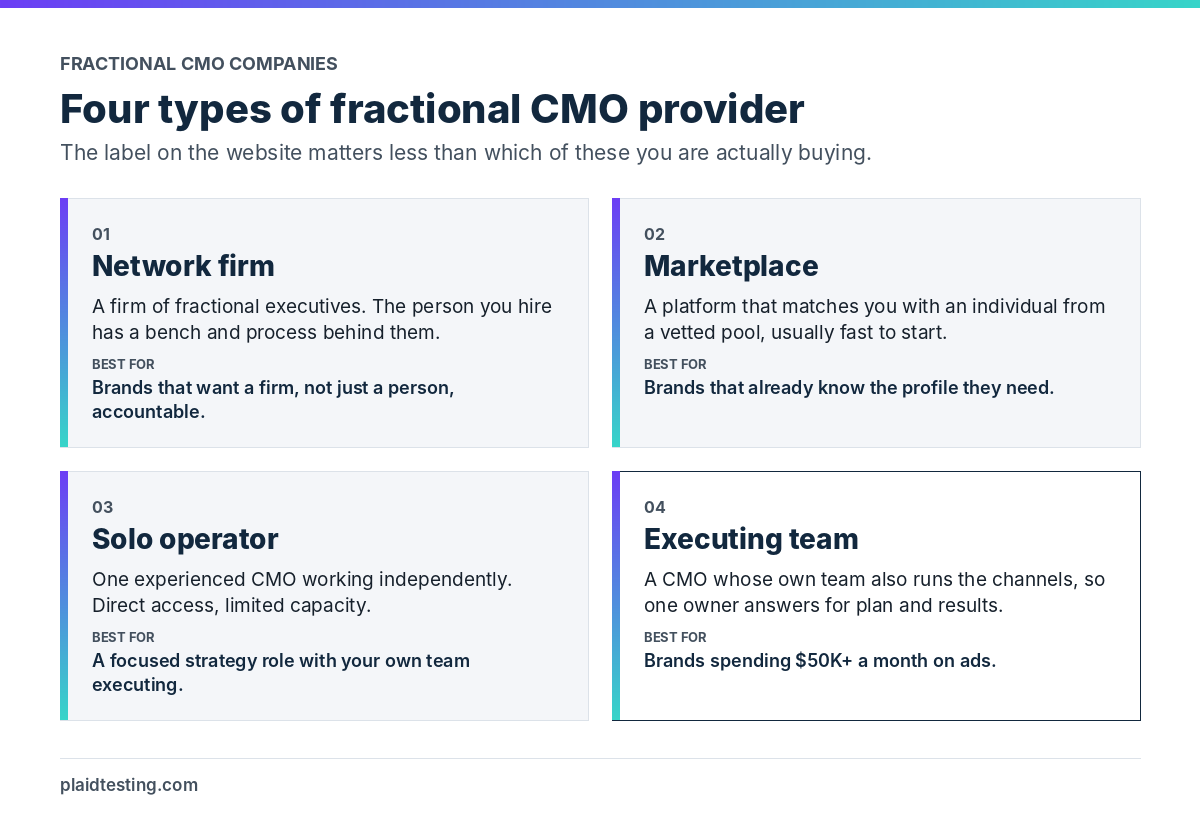
Most lists put four different products under one label, and each leaves a different gap. If you are still settling what the role covers, start with our guide to what a fractional CMO is and when ecommerce founders bring one in.
| Provider type | What you get | Works best when | Main risk |
|---|---|---|---|
| Network firm of fractional executives | A senior executive from the firm’s bench, with its methods and backup | You want a vetted leader with a firm behind them | Execution stays with your team; benches are often B2B-heavy |
| Marketplace that matches you with an individual | A shortlist of independent CMOs, fast matching, often a trial period | You know the profile you need and can manage the person | The platform’s job ends at the match; fit is on you |
| Solo operator | One independent CMO hired directly, usually by referral | You want a specific person and their network | No backup if they get busy, ill or leave; capacity is capped |
| Executing team | A CMO whose own team also runs paid media, creative and tracking | You need strategy and the people to carry it out | One firm grades its own work, so ask how the CMO reviews it |
The solo operator has no entry in our list, because it is a person, not a company. You usually find one by referral or through the marketplaces below.
At $50K or more a month in ad spend, the dividing line is execution. A CMO who sets the plan but cannot change the Meta account, the creative queue or the tracking depends entirely on whoever can. That works with a strong in-house team or agency. It fails if the CMO was hired to fix them.
The best fractional CMO companies for ecommerce brands in 2026
Ten firms, grouped by type: two network firms, four marketplaces, then four executing teams.
Chief Outsiders
Chief Outsiders is a network firm that says it has 100+ fractional CMOs and CSOs and 2,500+ clients, mainly small and mid-sized businesses and private equity portfolios. It can add a specialist execution team and scales engagements up or down on 30 days’ notice, but publishes no pricing. Watch-out: consumer products is on its industry list, but private equity, manufacturing and healthcare come first, so ask whether your executive has run paid social at your spend.
CMOx
CMOx matches business owners with fractional CMOs from its member network and trains marketers to build their own practices through the CMOx Accelerator. Its FAQ puts rates at $3,000 to $15,000 a month depending on hours, industry and scope, and DTC ecommerce appears as one use case among many. Watch-out: members run their own practices, so ask how long your match has practiced and for which ecommerce brands.
MarketerHire
MarketerHire is a managed marketplace that matches you with vetted marketers, including fractional CMOs, and says its acceptance rate is under 1%. It matches in 24 to 48 hours on average, includes a two-week trial, runs month-to-month and cites a typical $5,000 to $20,000+ a month. Watch-out: you are hiring one individual, and MarketerHire’s own ecommerce CMO ranking puts MarketerHire first, so treat every vendor list, ours included, as a starting point.
Toptal
Toptal is a talent marketplace that advertises “the top 3%” of fractional CMOs, a shortlist within 24 hours and up to two weeks to assess a hire with no obligation to pay. Its CMO profiles include ecommerce growth specialists, but it publishes no fractional CMO rates. Watch-out: the 3% figure is Toptal’s own and is not defined on the page, so judge the shortlist on DTC work at your spend.
Go Fractional
Go Fractional calls itself a members-only marketplace for fractional and interim executives, with a recruiter who checks each candidate before you meet. You can hire fractional, interim or contract-to-hire, with no deposit to start, free replacement matches and rates shown per role in its listings. Watch-out: it does not present itself as ecommerce-focused, so filter hard for operators who have run DTC paid media.
GrowTal
GrowTal is a remote marketplace of pre-vetted marketers that shortlists 2 to 4 candidates after a discovery call, with starts in as little as 48 hours. Interim CMOs sit alongside channel specialists such as Facebook media buyers, so you can hire a leader and an operator in one place. Watch-out: the only published price is a $300 Advanced Matching Service fee, and the CMO bench is one listing among many roles.
Hawke Media
Hawke Media is a full-service agency in Los Angeles, New York and Chicago that brands its model “Your Outsourced CMO.” The CMO layer comes with the agency’s own execution across paid search, paid social, Amazon, connected TV and creative, with no published pricing. Watch-out: an agency’s outsourced CMO is not the same as a named fractional executive, as our comparison of outsourced versus fractional CMO models explains, so ask who the senior person is and their hours.
Digital Authority Partners
Digital Authority Partners runs a dedicated ecommerce fractional CMO offer for mid-sized ecommerce businesses, covering a 12-month roadmap, paid media and SEO strategy, and vendor sourcing. It is one of the few firms that publishes a rate, $350 an hour, and the wider agency lists paid social, paid search, email and SEO services. Watch-out: the CMO page reads as strategy and team training, so confirm whether channel execution sits inside that rate.
Plaid Testing (Disclosure: this is us)
Plaid Testing pairs fractional CMO leadership with the paid media team that runs Meta, Google, TikTok and Snapchat, plus creative direction and tracking, for US ecommerce brands spending $50,000 or more a month on ads, mostly in fashion and apparel. We do not publish a rate: scope and price are set after a free 30-minute audit, with no retainer required to start. Watch-out: the fit is narrow, so pre-revenue, B2B and lower-spend brands are better served by others here.
Marketri
Marketri is a remote firm that pairs a senior strategist with an execution team for mid-market B2B companies. It is the most transparent firm here on price: engagements start at $7,500 a month, most run $10,000 to $20,000, and six months is the minimum. Watch-out: Marketri itself lists “you sell primarily to consumers” as a sign it is probably not a fit.
How do these fractional CMO firms compare?
| Company | Type | Best for | Pricing as published | Execution included? |
|---|---|---|---|---|
| Chief Outsiders | Network firm | Small, mid-sized and PE-backed companies | Not published | Optional specialist team |
| CMOx | Network firm | Startups, franchises and small to mid-sized businesses | FAQ range of $3,000 to $15,000 a month | Leadership and vendor management |
| MarketerHire | Marketplace | Fast, trial-first hiring of an individual | Typically $5,000 to $20,000+ a month | No, unless you hire specialists too |
| Toptal | Marketplace | A quick shortlist from a broad bench | Not published | No |
| Go Fractional | Marketplace | Fractional, interim or contract-to-hire leaders | Rates shown per listing; no deposit | No |
| GrowTal | Marketplace | Hiring a CMO and channel specialists in one place | $300 advanced matching fee; rates not published | Only through separate specialist hires |
| Hawke Media | Executing team | Brands wanting one agency across many channels | Not published | Yes, agency channel teams |
| Digital Authority Partners | Executing team | Mid-sized ecommerce brands | $350 an hour for the ecommerce fractional CMO | Agency services listed; confirm scope |
| Plaid Testing (us) | Executing team | Ecommerce brands at $50K+ a month in ad spend | Not published; set after the audit | Yes: paid media, creative and tracking |
| Marketri | Executing team | Mid-market B2B, not DTC | From $7,500 a month; most $10,000 to $20,000; six-month minimum | Yes |
Published prices are not comparable line for line, because scope and hours differ. At Go Fractional’s average of $176 an hour, its 27-hour average week works out to roughly $20,600 a month, which is why the hours behind a fee matter more than the headline number.
Our breakdown of what a fractional CMO costs in 2026 works through the math against a full-time hire, including break-even by ad spend.
If you are weighing the executing-team model, our page on fractional CMO leadership for ecommerce brands sets out scope, cadence and who it is not for.
How to vet a fractional CMO company before you sign
Every firm above will interview well. These six questions separate the firms that fit your brand from the ones that fit a sales deck. Ask them on the first call and get the answers into the proposal. Our guide to the questions and contract terms for hiring a fractional CMO goes deeper on each.
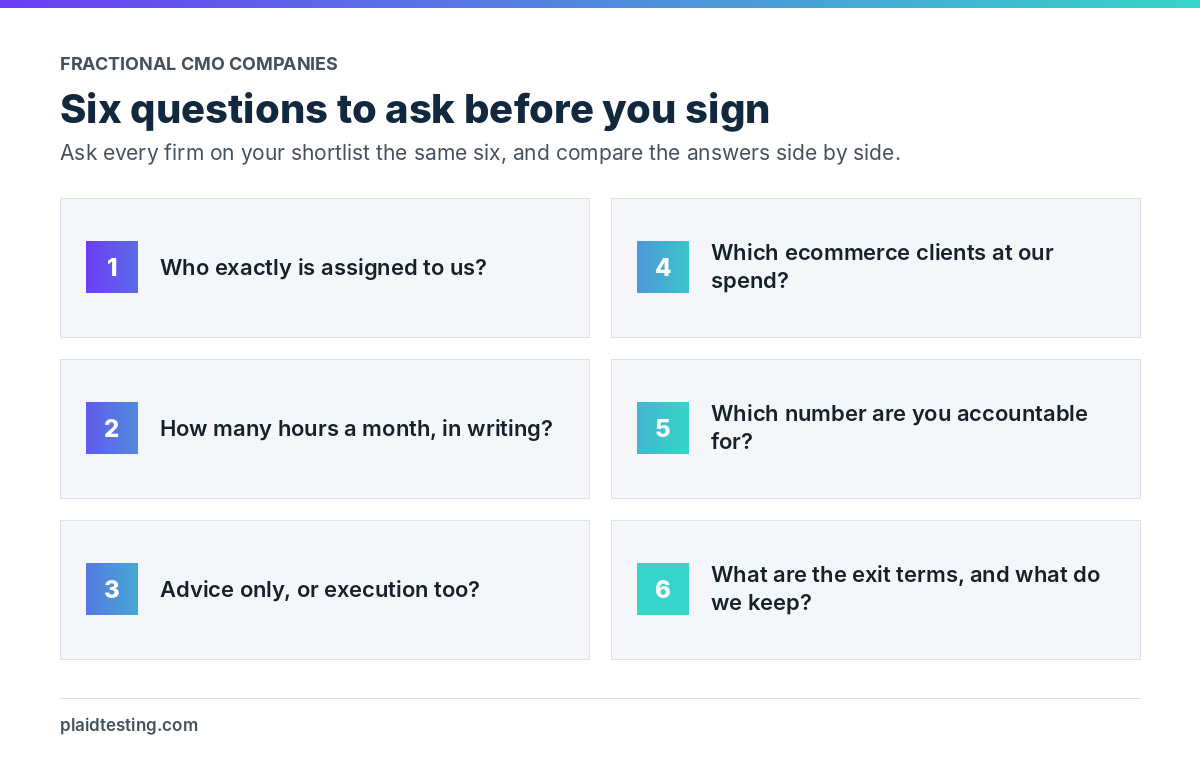
1. Who exactly is assigned to us?
Get a name and the brands that person has led, not a logo wall. Firms sometimes sell with a founder and deliver with someone else. Ask what happens if that person leaves, and whether you approve any replacement.
2. How many hours a month, in writing?
CMOx describes agreements of 5 to 25 hours a week (CMOx, November 2026), while Go Fractional’s report averages 27 hours a week for fractional CMOs. A monthly fee with no hours attached tells you little. Put hours, meeting cadence and response time in the contract, and ask how many other clients the person carries.
3. Is it advice only, or execution too?
Ask who will change the bid strategy, brief the next creative batch and fix the tracking when it breaks. If the answer is “your team” or “your agency”, you are buying advice. If the firm executes too, ask how the CMO challenges its own team’s work.
4. Which ecommerce clients have you run at our spend?
Spend level changes the job. Managing $10,000 a month on Meta is a different skill from managing $150,000 across Meta, Google and TikTok. Ask for two clients in your category and spend band, and permission to speak to one.
5. Which number are they accountable for?
Agree one business number before you sign, and make sure it is not in-platform ROAS. New-customer ROAS or new-customer CPA is usually closer to the truth, because it separates growth from revenue returning buyers would have brought anyway.
Here is what that looks like for a women’s fashion brand we work with. From January to August 2026, against the same period in 2025, new-customer ROAS rose to 2.17x from 1.38x, and new-customer orders rose to 18,735 from 7,625. What it does not prove: these are store-wide Triple Whale numbers that blend every channel, there was no holdout test, and product and merchandising changes also moved the results. Expect that level of caveat from any firm that quotes results to you.
6. What are the exit terms, and what do we keep?
Terms vary widely: MarketerHire runs month-to-month on 30 days’ notice (MarketerHire, November 2026), while Marketri sets a six-month minimum (Marketri, November 2026). Confirm that ad accounts, pixels, analytics, creative files and dashboards belong to your business from day one. If a firm builds everything inside its own business manager, leaving is slower and riskier.
Which type of fractional CMO company fits a brand at $50K+ a month?
If you already have a strong in-house team or a paid media agency you trust, a network firm or marketplace hire can work well. You need judgment, priorities and someone to hold the team to one number. Chief Outsiders, MarketerHire and GrowTal all fit that shape. The trial periods at the marketplaces also lower the cost of a wrong match.
If your ad accounts, creative pipeline and tracking are where the problem lives, an advisory CMO will spend most of the engagement writing recommendations nobody has time to carry out. That is where an executing team earns its fee, and where it makes sense to compare DTC marketing agencies alongside fractional CMO firms before you decide. Either way, hold the firm to the six questions above.
If you are earlier, pre-revenue or spending well under $50K a month, the economics change. A lighter marketplace engagement, or one of the options in our guide to fractional CMOs for startups, will usually give you more for the money than any firm built for scaled ecommerce.
Common Questions
What is the difference between a fractional CMO company and a fractional CMO agency?
A fractional CMO company usually supplies a senior leader, from its own bench or through a marketplace match, and leaves execution to your team. A fractional CMO agency pairs that leader with its own staff who run the channels. The label matters less than the answer to one question: who changes the ad account on Monday morning?
How much do fractional CMO companies charge?
Published prices vary widely. Digital Authority Partners lists $350 an hour for its ecommerce fractional CMO, MarketerHire cites $5,000 to $20,000+ a month, and Marketri starts at $7,500 a month with a six-month minimum. Go Fractional’s June 2026 report puts the average fractional CMO at $176 an hour. Many firms publish nothing, so compare on hours and scope.
Are fractional CMO marketplaces good for ecommerce brands?
They can be, if you know the profile you need and can manage the person. Marketplaces such as MarketerHire, Toptal and GrowTal match quickly and offer trials or free rematches. The risk is fit: most benches are broad, so screen hard for operators who have run paid social and search at your spend in a DTC category.
Can a fractional CMO run my Meta and Google ads?
Some can, most do not. A CMO from a network firm or marketplace usually sets strategy and manages whoever runs the accounts. Executing teams, including agencies with a CMO layer, also run the channels. Ask in writing who builds campaigns, launches creative and maintains tracking, and how many hours that person gives your account each month.
How long should a fractional CMO engagement last?
Plan for at least three months, which Go Fractional’s 2026 report links to the strongest fractional relationships, and six to twelve months to see a full planning cycle. Terms vary by firm: MarketerHire runs month-to-month on 30 days’ notice, while Marketri sets a six-month minimum. Avoid long lock-ins until you have seen the first 90 days.
Book a free 30 minute growth audit and we will tell you which of the four provider types fits your brand, even when the answer is not us.
Related Reading
- What Does a Fractional CMO Actually Do? Scope and 90 Days: what the first three months should produce, whichever firm you hire.
- Fractional CMO vs Full Time CMO: when a full-time hire makes more sense than any firm on this list.
- When to Hire a Fractional CMO: 7 Signals Your Ecommerce Brand Is Ready: check the timing before you start interviewing.
- Fractional Marketing Team: Roles, Cost and Setup: the roles around a CMO if you choose an advisory model.
- NC-ROAS: How to Calculate New Customer ROAS: the number to hold a fractional CMO accountable for.