
INDUSTRIES · JEWELRY
Jewelry marketing agency for ecommerce jewelry brands
Plaid Testing is a jewelry marketing agency for ecommerce brands spending $50K or more a month on ads. We run Meta, Google Shopping and creative testing for fine, demi-fine and lab-grown jewelry, and plan budgets around the gifting peaks that decide the year. Every decision is checked against contribution margin in Triple Whale, not platform ROAS.
$7B
Expected US jewelry spending for Valentine’s Day 2026, the largest gift category
NRF Valentine’s Day survey, January 2026
61%
Of engagement rings bought by couples married in 2025 had a lab-grown center stone
The Knot Jewelry and Engagement Study, February 2026
1 in 3
Engagement ring buyers bought online
The Knot Jewelry and Engagement Study, February 2026
What a jewelry marketing agency should run
Jewelry sells on trust, timing and how the price compares. The table shows what changes for jewelry in each channel and what we run there.
| Channel | What is different for jewelry | What we run |
|---|---|---|
| Meta (Facebook and Instagram) | Most purchases are gifts or considered buys, so the first click rarely converts. The ad has to show scale, sparkle and finish on a phone screen. | Prospecting by collection and price tier, catalog ads with clean variant data, and retargeting windows set to the brand’s real time to purchase. |
| Google Shopping and Performance Max | Shoppers search by metal, stone and style, such as “14k gold hoop earrings” or “lab grown diamond tennis bracelet”. The feed decides which searches you appear for. | Feed titles rebuilt around metal, stone, carat and style, with product groups split by margin. |
| Creative testing | Product photos that work on a website often fail as ads. On-body scale and close detail are where most jewelry tests start. | A weekly testing cadence across on-body, close-up, gifting and founder formats. |
| Tracking and attribution | Long consideration and gift purchases split credit across channels and devices. | Triple Whale pixel and Conversions API, with blended and new-customer ROAS reported daily. |
| Appointments for bridal and fine jewelry | For engagement rings and high-ticket pieces, the conversion is often a consultation, not a checkout. | A booked appointment tracked as a conversion and sent to Meta and Google, so campaigns learn from consultations as well as orders. |
Where jewelry paid media breaks
1. The calendar is uneven
Jewelry revenue gathers around a few dates. The NRF expects US consumers to spend $7 billion on jewelry for Valentine’s Day 2026, the largest category in a record $29.1 billion holiday, and 25% of shoppers plan to buy it. 38% say online is where they will shop most. Mother’s Day and the November to December gifting season follow the same pattern.
An account that holds a flat budget all year underspends in the weeks that matter and overspends in the weeks that don’t. We plan the year as a calendar: creative and stock ready weeks before each peak, budget raised step by step while cost per purchase holds, and a planned cooldown afterwards. Our BFCM paid media calendar shows how we lay out the November peak.
2. Lab-grown changed the price conversation
The Knot found that 61% of engagement rings bought by couples married in 2025 had a lab-grown center stone, and that average engagement ring spend fell to $4,600 from $5,200 a year earlier. Lab-grown brands now compete with each other on price, and natural diamond brands have to explain why they cost more. Both need ads that state plainly what the stone is.
The FTC’s jewelry advertising guidance says a lab-made diamond must carry a qualifier such as “laboratory-grown” or “laboratory-created”, placed immediately before the word diamond and shown as clearly as the word itself. We write every ad, product title and landing page headline to that rule, because a wrong description is a compliance problem, not a copy choice.
3. A third buy online, and nearly everyone researches online
The same study found that about a third of ring buyers bought online, while most still bought in a store after visiting two retailers and looking at around ten rings. For a jewelry brand selling online, that means two jobs: convert the shoppers who are ready to check out, and capture the ones who want to see a piece first through virtual or in-store appointments. We track both as conversions so Meta and Google optimize for both, instead of appointments living in a separate spreadsheet.
4. Sizes and one-off pieces sell through before the report shows it
A best-selling ring can sell out in a size or a metal while its ad keeps spending. On an apparel account Triple Whale documented, we built an automation that checks the product link behind every live ad and flags it the moment stock runs low or sells out. Jewelry has the same problem with ring sizes, metals and one-of-a-kind pieces, and we set up the same check on jewelry accounts.
How we run jewelry accounts
- Audit. We read the ad accounts, the product feed and the tracking against Shopify. You get a written list of what is costing money, ranked by size, including feed titles, attribution windows and any wording in your ads that could break the FTC guidance.
- Rebuild. Campaigns split by collection, price tier and gifting intent. The feed is rebuilt, creative testing runs weekly, and appointments and purchases are both tracked as conversions.
- Scale. Budget follows contribution margin and the gifting calendar. A twice-daily review of blended, platform and new-customer ROAS flags the accounts that need attention, so budget calls are made the same day.
Want us to look at your account first? Book a free 30 minute growth audit.
Proof: the operating system Triple Whale published
Triple Whale published how we use Moby, its AI teammate, across our apparel accounts. The checks carry straight over to jewelry.
| Check | What it found on one apparel account | Why it matters for jewelry |
|---|---|---|
| Meta and Shop Ads audience overlap, 90 days | 52% overlap. About $17,000 a week of Shop Ads spend moved to channels that were not double counting. | Gift buyers touch several channels before they buy, so two channels often claim the same customer. |
| Checkout funnel crawl | A $20 flat shipping fee caused a sharp drop between cart and checkout. At $9, conversion rose from 0.9% to 1.64% and Meta ROAS from 1.3x to 2.1x. | Shipping, insurance and sizing questions show up at the same step in jewelry checkouts. |
| Live ad stock check | Flags an ad the moment the product behind it runs low or sells out. | Ring sizes, metals and one-off pieces sell through quickly. |
Read the Triple Whale case study.
What this does not claim. These results come from apparel accounts, not jewelry. They show how the work is run, not what a jewelry brand will see. Each figure is from a single account, as published by Triple Whale.
Who this is for
- Jewelry brands selling online that spend $50K or more a month on paid media, or are ready to.
- Fine, demi-fine, lab-grown and bridal brands with their own store, usually on Shopify.
- Brands whose year depends on Valentine’s Day, Mother’s Day and the holidays, and who want those weeks planned rather than reacted to.
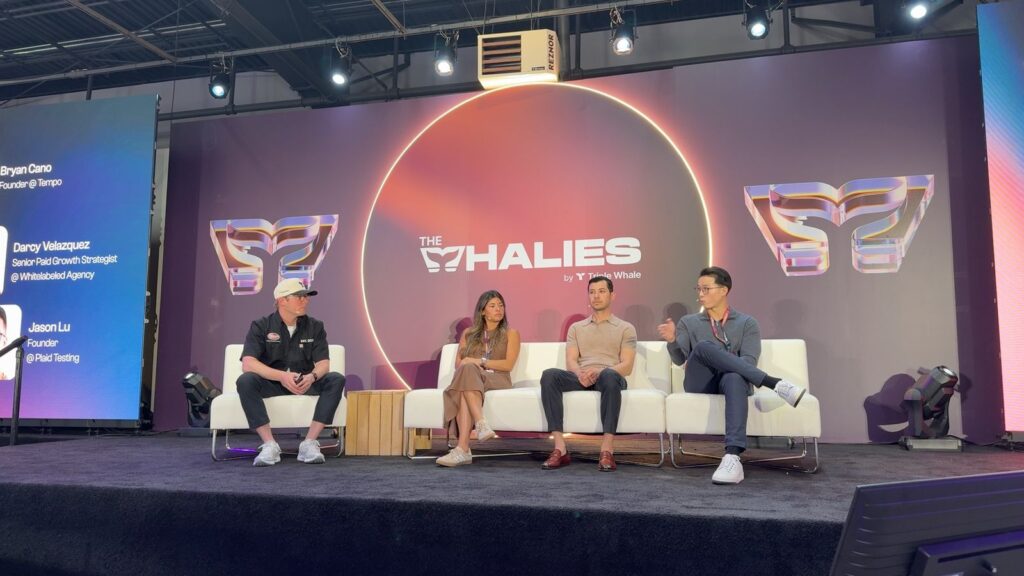
- Founders who want a senior operator accountable for the account. Jason Lu has run paid media for jewelry brands and leads every engagement.
Not a fit: local jewelers who need foot traffic to one store more than online sales, and brands not yet running paid media. For apparel brands, see our fashion marketing agency page.
What it costs
Pricing depends on ad spend, channels and whether you need fractional CMO leadership on top of media buying. Our guide to how much marketing agencies charge explains the common models. The growth audit is free.
Questions jewelry founders ask us
Do you work with lab-grown diamond brands?
Yes. Lab-grown is now a large share of online jewelry: The Knot found 61% of engagement rings bought by couples married in 2025 had a lab-grown center stone. We write ads and product titles to the FTC’s guidance, with “laboratory-grown” or “laboratory-created” placed directly before the word diamond.
Should a jewelry brand start with Meta or Google?
For most ecommerce brands, Meta finds new customers who were not searching yet, and Google Shopping captures people already searching for a metal, stone or style. We usually start with whichever channel has cleaner tracking, then add the other once its numbers agree with Shopify.
How do you plan Valentine’s Day and the holidays?
As a calendar. Creative, stock and offers are ready weeks before each peak, budget rises in steps while cost per purchase holds, and spend comes down on a plan afterwards, so the peak does not end with a week of expensive, unprofitable traffic.
Can you run ads that book engagement ring appointments?
Yes. For bridal and high-ticket pieces we track a booked consultation as a conversion and send it to Meta and Google, so campaigns learn from appointments as well as checkouts.
Get your free 30 minute growth audit
We’ll show you where your jewelry account is losing money before you sign anything.