
A Black Friday checklist for 2026 should run in deadline order: tracking by Friday 16 October, offers locked by Friday 30 October, paid media set by Friday 6 November, site, checkout and stock by Friday 13 November, then a change freeze from Friday 20 November. The 30 checks below each carry an owner and a test for done.
When should you start preparing for Black Friday 2026?
Start in September for anything that depends on data, and plan to finish building by Friday 13 November. The season does not begin on Thanksgiving. NRF counted 202.9 million people shopping between Thanksgiving and Cyber Monday 2025, 134.9 million of them online, and found that 84% had already begun their holiday shopping by that weekend, with 53% of it still left to do (NRF, 2 December 2025). A brand still changing its prices and pages in mid-November is changing them in front of shoppers who have already started comparing.
PwC’s 2026 Holiday Outlook found that about 40% of all planned gift spending falls in the five days from Thanksgiving to Cyber Monday (PwC, 8 September 2026). Peak load is concentrated too: Shopify merchants reached $5.1 million in sales per minute at 12:01pm EST on Black Friday 2025 (Shopify, 2 December 2025).
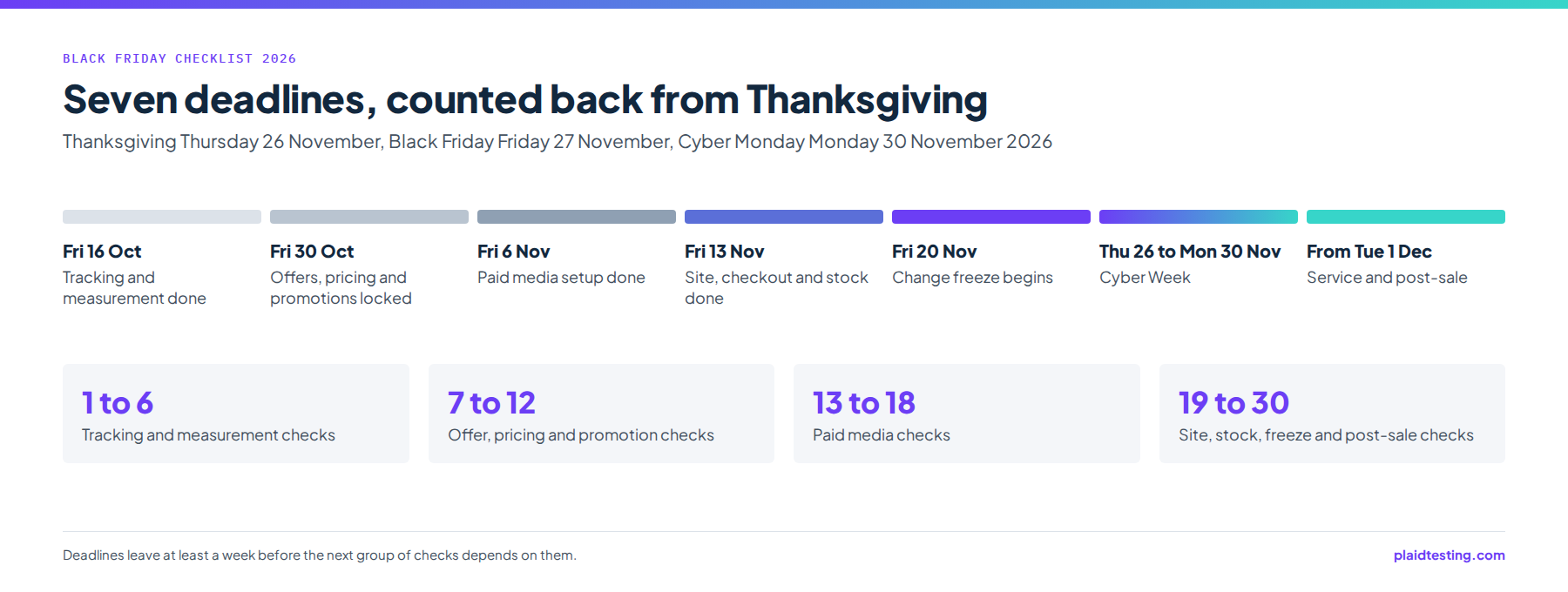
Every date works backward from Thanksgiving on Thursday 26 November, Black Friday on Friday 27 November and Cyber Monday on Monday 30 November, and each deadline leaves at least a week before the next group depends on it. The freeze on Friday 20 November leaves six days of stable running before Thanksgiving. Our BFCM 2026 paid media calendar sets out the media weeks inside these dates. Each check names one owner by role, so nobody is guessing who signs off; on a small team one person may own several.
Which tracking and measurement checks are due by 16 October?
Tracking is the one area where a mistake stays invisible until the money is spent. If the purchase event counts some orders twice, every Cyber Week report overstates results and budget follows the error. It opens the list because every later check, and every result you read in December, is judged on these numbers.
Friday 16 October is early by design. A fix to a purchase tag or a server connection needs several weeks of clean data behind it before November readings mean anything.
On Meta, the recommended setup pairs the Conversions API with the pixel, with identical events flowing through each, so purchases the browser drops to connectivity or loading errors still arrive (Meta for Developers). Check 2 tests that this works on test orders, not just that someone switched it on in the spring.
The blended report in check 4 matters most on the day itself: on 27 November you want one number that the founder, the media buyer and finance all read the same way. Our guides to ecommerce attribution and to running an ecommerce audit cover the reconciliation in full. When nobody in house owns this layer, it is the first thing our tracking and attribution service takes on.
Tracking and measurement, done by Friday 16 October
| # | Check | Owner | Done means |
|---|---|---|---|
| 1 | Purchase event reconciled against store orders | Tracking lead | For three recent days, store orders sit next to purchases in Meta, Google Ads and GA4; each gap has a written reason, and no platform shows more purchases than the store took |
| 2 | Meta Conversions API running alongside the pixel | Tracking lead | Purchase, add to cart and checkout events for the same test orders arrive from both the browser pixel and the server, with each order counted once |
| 3 | Google Ads conversion goals cleaned up | Paid media lead | One purchase action per account drives bidding and passes order value, every other action is kept out of bidding, and the value definition (with or without tax and shipping) matches the one finance uses |
| 4 | One blended daily report agreed | Founder or CMO, with finance | A single sheet or dashboard shows store revenue, total ad spend, new-customer orders and revenue per ad dollar, with written definitions finance has signed off |
| 5 | 2025 sale-period baseline pulled by day | Analyst or tracking lead | Orders, revenue, ad spend, conversion rate and returns for every day from two weeks before Thanksgiving 2025 to two weeks after Cyber Monday 2025 sit inside the check 4 report |
Unsure whether your purchase numbers would pass check 1? Our free 30 minute growth audit includes a tracking review, early enough to fix what it finds before 16 October.
Which offer, pricing and promotion checks lock by 30 October?
Offers lock on Friday 30 October because ad copy, feed prices, landing pages, email and service replies all repeat them, and a mid-November change means rewriting every one under deadline.
Start with a margin floor: for each product or category, the deepest discount that still leaves contribution after product cost, shipping, payment fees and expected returns. Returns deserve a real number in that sheet: retailers expect 17% of holiday sales to be returned, compared with an expected 15.8% of all US retail sales across 2025 (NRF and Happy Returns, 15 October 2025).
Then check every reference price against the FTC’s pricing guides. The guides count a “was” price as a fair reference only if the item was genuinely offered at it, openly and regularly, for a reasonably long stretch; a fictitious, inflated earlier price turns the claimed bargain into a false one (FTC, 16 CFR 233.1). Sale price annotations have their own gate: Google shows them only when the discount is more than 5% and under 90%, and in US Shopping ads only when the base price was charged on 5 of the past 30 days, or 15 of the past 200 (Google Merchant Center Help). The two tests are separate: a price can meet Google’s day count and still not be the regular price the FTC guides have in mind.
Google also wants the feed’s sale price lower than its regular price, the landing page to display both, and checkout to display the sale price alone (Google Merchant Center Help). Timezones cause the quietest errors. Leave the time off an effective date and the sale runs from 12 AM on its first day through 11:59 PM on its last; leave the timezone off and Google assumes UTC (Google Merchant Center Help). For a store selling on US Eastern time, that puts sale prices live the evening before the sale and ends them hours early. US Merchant promotions need a floor of 5% or $5 off and cannot be tied to a paid membership (Google Merchant Center Help).
Offers, pricing and promotions, locked by Friday 30 October
| # | Check | Owner | Done means |
|---|---|---|---|
| 6 | Margin floor set per product or category | Founder or CMO, with finance | A signed-off sheet lists the deepest allowed discount for each line after product cost, shipping, payment fees and expected returns, and every planned offer sits above it |
| 7 | Every “was” and compare-at price backed by history | Ecommerce manager | Each reference price has price or order history showing it was the price regularly offered to shoppers for a substantial period; any that fail are removed before launch |
| 8 | Merchant Center sale prices, dates and timezones loaded | Feed owner | A sample of sale SKUs shows a sale price below the regular price and an effective date with an explicit timezone offset, and diagnostics show no new disapprovals |
| 9 | Sale annotation and promotion eligibility confirmed | Paid media lead | Every discount sits above 5% and below 90%, base prices meet the charged-days rule, and each Merchant promotion is at least 5% or $5 off with no paid membership needed |
| 10 | Codes and automatic discounts tested together | Ecommerce manager | Every live code has been tried in a test cart with every other live discount, and stacking and exclusions behave exactly as the offer sheet says |
Which paid media checks are due by 6 November?
Paid media setup closes on Friday 6 November, three weeks before Black Friday, leaving room for ad review, feed diagnostics and budget sign-off.
The creative that runs during the sale should already have won something. We pick sale concepts from tests run in October at normal prices, the method laid out in our guide to what to test in October before BFCM. A concept that has never run is a guess, and Cyber Week is an expensive place to make one.
Write the daily budget plan down before the first sale ad runs: the amount per day and platform, the blended number that would trigger an increase or a cut, and the one person allowed to make the change. For how that plan behaves on Meta, see our piece on Meta ads structure and budget pacing for Black Friday.
On Google, settle the seasonality adjustment question in early November. Google’s guidance points to short events: it rates the adjustment ideal for 1 to 7 days and warns it may not work as well past 14 days. It is meant only for major expected conversion rate changes, because Smart Bidding already manages seasonal events, and it covers Search, Shopping and Display campaigns bidding on Target ROAS or Target CPA, plus Performance Max on any bid strategy (Google Ads Help). A written decision either way passes check 14. In the accounts our paid media service runs, that decision starts from how far conversion rate moved in the 2025 sale window.
Paid media setup, done by Friday 6 November
| # | Check | Owner | Done means |
|---|---|---|---|
| 11 | Sale campaigns built and ads approved | Paid media lead | Every sale ad shows approved and sits scheduled or paused ready to launch, and recent purchasers are excluded from prospecting where the plan says so |
| 12 | Sale creative chosen from October test winners | Creative strategist | Each concept in the sale set traces back to an October readout that picked it at normal prices |
| 13 | Daily budget plan written | Paid media lead, with founder or CMO | A dated plan shows budget per day and platform from Friday 20 November to Monday 30 November, the blended number that triggers a change, and the one person allowed to make it |
| 14 | Google seasonality adjustment decided | Paid media lead | Either an adjustment scheduled for Thursday 26 to Monday 30 November only and sized from the 2025 conversion rate change, or a written note saying none will be used |
Which site, checkout and stock checks are due by 13 November?
Site work closes on Friday 13 November, a week before the freeze, so anything shipped late can break, be noticed and be fixed while changes are still allowed.
Test speed on the pages paid traffic will land on, not the homepage. The pass marks for Core Web Vitals, judged at the 75th percentile, are LCP within 2.5 seconds, INP at or under 200 milliseconds and CLS at or under 0.1 (web.dev, 31 October 2024). Speed is worth the work: when Google and Deloitte studied 37 brand sites, a 0.1 second gain in mobile site speed lifted retail conversion rates by 8.4% (web.dev, 24 June 2020). Recheck layout shift after sale banners and pop-ups go in.
For checkout, the reasons shoppers leave are well documented. In Baymard’s survey of US shoppers who abandoned a checkout for reasons other than browsing, 40% left because extra costs were too high and 18% because the site wanted them to create an account (Baymard Institute, updated 22 September 2025).
Stock and fulfillment are where a successful sale turns into a service problem. A heritage fashion brand we work with sold 158,438 units in Q1 2026, up from 21,945 in Q1 2025, per its Triple Whale account: more than seven times the volume (158,438 divided by 21,945). Each unit had to be picked, shipped, supported and sometimes returned. It is a first-quarter figure and implies nothing about Black Friday; the point is that fulfillment, service and returns capacity has to be ready before the ads scale.
Site, checkout and stock, done by Friday 13 November
| # | Check | Owner | Done means |
|---|---|---|---|
| 15 | Core Web Vitals on paid landing pages | Developer | Every product and collection page that will take sale traffic passes LCP, INP and CLS in mobile field data, or has a named fix shipped before 13 November |
| 16 | Full checkout test on every payment method | Ecommerce manager | A completed real order on iOS and on Android for each payment option, with guest checkout on and shipping and tax shown before the payment step |
| 17 | Stock cover for hero SKUs and a sold-out rule | Operations lead | Units on hand for each hero SKU sit beside a forecast built from the 2025 baseline, and a written rule says at what stock level ads for that SKU pause |
| 18 | Fulfillment and service capacity confirmed | Operations lead, with customer service lead | The warehouse or 3PL has confirmed daily pick-and-pack capacity in writing against the forecast, service shifts are scheduled, and holiday shipping cutoffs are published on the site |
What should you not change in the final week?
From Friday 20 November, stop changing the theme, apps, checkout code, tags, campaign structure and offer terms. Two things still move: budgets, as written in the check 13 plan, and fixes to anything that stops people from paying.
The reason is diagnostic. During Cyber Week, traffic, conversion rate and ad costs all move at once. If the site also changed on the Tuesday before, nobody can say whether a dip on Friday came from the change or from the market. A frozen setup is what makes the readings in check 23 mean something.
In practice, in the days before Thanksgiving, do not install a new app, switch payment provider, add a tracking tag, restructure campaigns, launch a new campaign type, change the returns policy, or alter an offer after it has been announced. Each is reasonable in October and risky with six days to go.
Change freeze from Friday 20 November
| # | Check | Owner | Done means |
|---|---|---|---|
| 19 | Site, theme and app freeze | Developer | A dated freeze notice has gone out, one named person approves exceptions, and rolling back the last deploy has been tested |
| 20 | Tag and pixel freeze | Tracking lead | The live tag container version is published and recorded, with no new version going live before Tuesday 1 December |
| 21 | Campaign structure freeze | Paid media lead | Google campaign structure has not changed since 8 November, and after 20 November only budgets and pre-approved scheduled ads change on any platform, each logged with a time and a reason |
| 22 | Service briefing and on-call sheet | Customer service lead | Saved replies carry the final offer terms, returns policy and shipping cutoffs, and a one-page sheet names who to call for site, payments, ads and warehouse at every hour of the sale |
From Thursday 26 to Monday 30 November, the work is watching, not building, and the four checks below are the whole job. Keep watching through the weekend, because Cyber Monday was the bigger day for US online spend in 2025: Adobe counted $14.25 billion on Cyber Monday against $11.8 billion on Black Friday (Adobe, 2 December 2025).
Cyber Week, Thursday 26 to Monday 30 November
| # | Check | Owner | Done means |
|---|---|---|---|
| 23 | Morning and evening blended readout | Founder or CMO | Twice a day, orders, revenue, spend, new-customer orders and revenue per ad dollar are posted against the matching day of 2025 in one shared channel |
| 24 | Offers switch on and off on schedule | Ecommerce manager | At every start and end time someone loads the sale page and a test cart and confirms the price matches the offer sheet and Merchant Center |
| 25 | Stock watch on hero SKUs | Operations lead, with paid media lead | Ads for any SKU that crosses the sold-out rule from check 17 are paused within the same shift |
| 26 | Checkout and payment monitoring | Ecommerce manager | Payment failures and checkout errors are reviewed every few hours, and one live order a day is traced from ad click to confirmation email |
Which customer service and post-sale checks run from 1 December?
The sale ends on Monday 30 November; the work does not. From Tuesday 1 December the checklist moves to orders in transit, returns and the customers the sale has just acquired.
Returns arrive after the revenue is booked and after the ads that won those orders have been paid for. NRF and Happy Returns expected 19.3% of online sales to be returned in 2025, estimated that 9% of returns were fraudulent, and found free returns a major consideration for 82% of consumers (NRF, 15 October 2025). Read them weekly by SKU, reason and offer, so a problem with one product or promotion surfaces before January.
New customers are the most valuable thing Cyber Week produces, provided they buy a second time, and that second order should not depend on the next discount.
December is not a wind-down either. Think with Google, citing Ipsos, reports that shoppers say their holiday spending peaks after 25 December (Think with Google, 14 November 2025). A written Cyber Week readout, finished before 25 December, lets the team spend the post-Christmas period on what worked rather than on what people remember.
Service and post-sale, from Tuesday 1 December
| # | Check | Owner | Done means |
|---|---|---|---|
| 27 | Delivery and order-status tickets | Customer service lead | Ticket volume and first response time are reviewed daily for the first two weeks of December, and known carrier delays trigger an email before customers ask |
| 28 | Returns read by SKU, reason and offer | Operations lead | A weekly returns report runs through January, with any SKU or promotion returning well above its usual rate flagged for review |
| 29 | New-customer cohort follow-up | Retention or email lead | Customers whose first order fell between 26 and 30 November are tagged, excluded from prospecting, and enrolled in a second-order flow |
| 30 | Cyber Week readout and reconciliation | Founder or CMO, with finance | Before 25 December a written readout compares results with the 2025 baseline, reconciles platform-reported revenue with store revenue, and lists what changes for 2027 |
Want the tracking and media checks run by people who do them every season? Book your free growth audit in September and you will have three fixes in hand before the first deadline.
Common questions
What if we start preparing in November?
Put the checks that protect money first: purchase tracking (check 1), former prices (check 7), Merchant Center timezones (check 8) and a full checkout test (check 16). Skip anything that needs weeks of data, such as testing untried creative, and run ads that have already worked. Four checks done properly beat thirty done halfway, and the freeze on Friday 20 November still applies.
What is the most commonly missed Black Friday check?
There is no public data on which checks brands skip most, so this is a judgment call. Ours is the timezone on Merchant Center sale prices, because the failure is silent: nothing gets disapproved, the price simply changes at the wrong hour. It takes minutes to set in the feed, which is why it has its own row as check 8.
Should you change your website before Black Friday?
Yes, but finish by Friday 13 November. Speed fixes, checkout fixes and sale landing pages belong before that date, so they get a full week of live traffic ahead of the freeze. A redesign, a theme change or a platform migration does not belong in November at all. Move it to January, when a problem costs less to find and less to fix.
How do you check that checkout will hold up on Black Friday?
Place real orders rather than previews: every payment method, iOS and Android, guest and logged in, with a discount code applied. Confirm the total cost shows before the payment step. Then list every app or script that touches the cart or checkout and confirm each one has been tested under sale traffic, since one slow app can stall checkout on a healthy platform.
Related reading
- BFCM 2026 Paid Media Calendar for Ecommerce Brands: the media weeks that sit inside these deadlines
- Meta Ads for Black Friday: Structure and Budget Pacing: check 13 in detail for Meta
- BFCM Creative Testing: What to Test in October: how to find the winners check 12 asks for
- Ecommerce Audit: What a Growth Audit Should Check: the year-round version of the tracking and margin checks
- Cyber Monday Marketing Ideas That Protect Margin: offer structures and channel plays for the Monday after Black Friday that do not rely on deeper discounts