
TikTok Spark Ads are ads that run on an existing organic TikTok post, either the brand’s own or a creator’s shared through an authorization code. Views, likes, comments, shares and follows from the promotion count toward that original post. For an ecommerce brand, the real decisions are whose posts to run, for how long, and judged on what.
What are TikTok Spark Ads?
TikTok Ads Help (updated June 2026) defines Spark Ads as a native ad format that lets an advertiser use organic TikTok posts as ads. The post can come from the brand’s own account or from another creator’s account, provided that creator has authorized it. Everything the promotion earns, from views and comments to shares, likes and follows, is credited to the original post, and TikTok counts paid likes, shares and comments that happen within 1 day of someone seeing the paid ad.
Spark Ads are a creative format, not a campaign type. The same help page lists the auction objectives they run under: Reach, Traffic, Video Views, Community interaction, App promotion, Conversions, Lead generation and Sales. Videos up to 10 minutes long can be sparked, and one Ads Manager account supports up to 10,000 Spark Ads, so neither limit is what holds a brand back.
The format has run globally since July 2021, according to TikTok’s Spark Ads 101 post (TikTok For Business, updated 23 July 2025), and what it buys is identity: the ad carries the real account that posted the video, and a tap on its name or photo opens that profile rather than a product page. In the accounts we run, that is the case for it. A creator’s post with genuine comments under it reads like a recommendation; the same footage as a standard ad reads like an ad. Whether that becomes cheaper customers has to be measured, not assumed.
How do TikTok Spark Ads codes and authorization work?
Authorization is the step that lets a brand run someone else’s organic post as an ad. The creator turns on the Ad authorization toggle, generates a video code and selects “the authorization duration (7, 30, 60, or 365 days)”, and the brand applies that code in Ads Manager under Tools, Creative library, Spark ads posts, Apply for Authorization (TikTok Ads Help, updated October 2025). Duets and Stitches need codes from both creators, which is easy to miss when a reaction video is the one that took off.
Four details in TikTok’s Spark Ads creation guide (TikTok Ads Help, updated June 2026) shape how the process should run. Up to 20 video codes can be authorized in one batch. “You cannot edit a post’s caption after it’s been authorized as an ad,” so the caption, disclosure included, has to be final before authorization. “A private video will become public once it is used in a campaign,” so a test cut posted privately goes public the moment it runs. And a code can only be deleted once every ad using it has been deleted.
There is a second route. When a creator tags the brand as a partner in the content disclosure settings, TikTok provides ads and anchors “for Spark Ads usage by default for 60 days without waiting on authorizations” (TikTok Ads Help, updated April 2026). That saves a round of messages, but the window is a default rather than a term agreed in the creator deal.
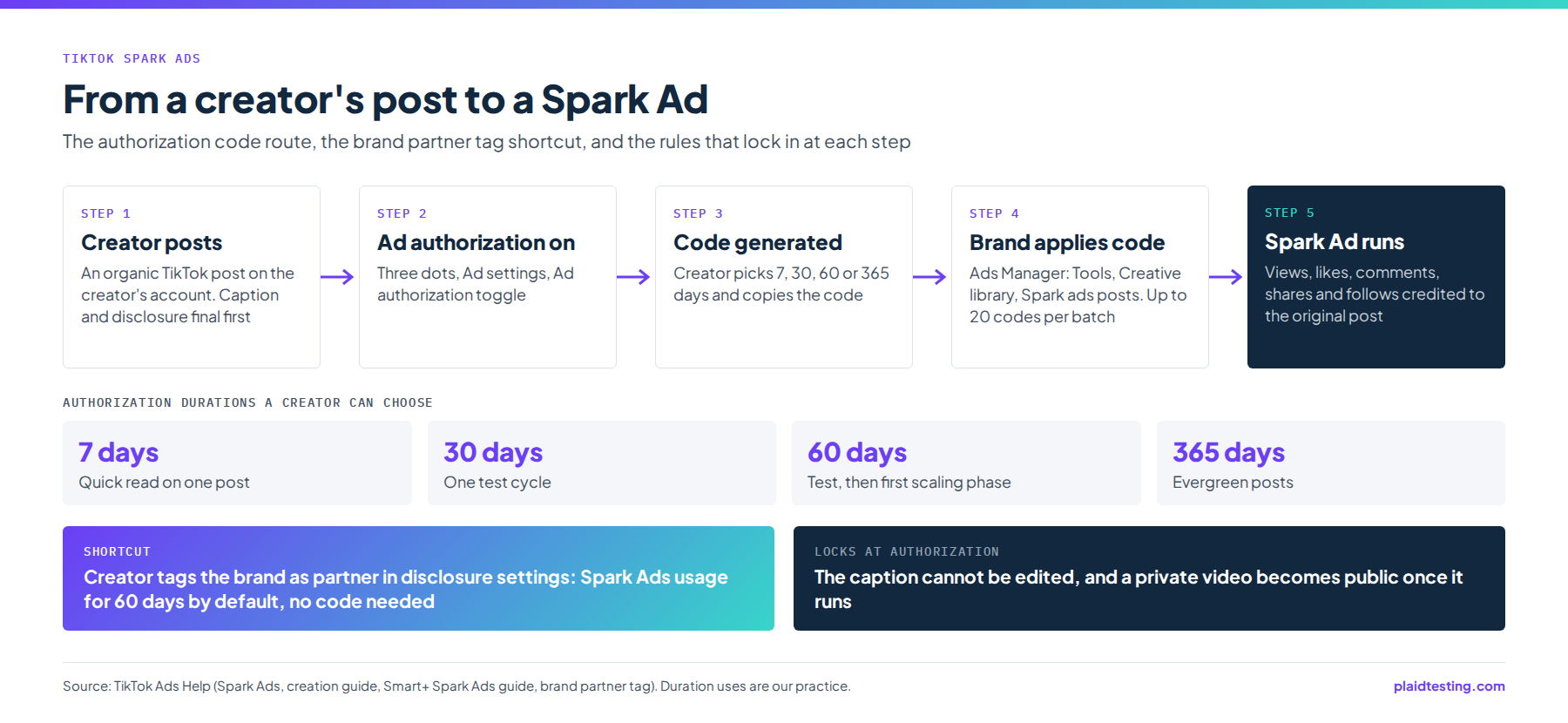
TikTok’s main Spark Ads help page says the period can be customized “to meet campaign needs and minimize costs”. The durations below are from TikTok Ads Help’s Smart+ Spark Ads guide and brand partner tag page; the last two columns are our practice.
| Authorization | How it is granted | What it suits | Main risk |
|---|---|---|---|
| 7 days | Video code, creator selects 7 days | A quick read on whether a creator’s post converts as an ad before agreeing longer usage | Ends before the ad shows whether it can hold spend |
| 30 days | Video code, creator selects 30 days | One monthly test cycle or a single promotion | A post that wins late in the window has to be renegotiated while it is still spending |
| 60 days, by code | Video code, creator selects 60 days | A test followed by a first scaling phase | Usage terms in the creator agreement have to match the code |
| 60 days, by brand partner tag | Default when the creator tags the brand as a partner, without waiting on an authorization | Gifted or paid creator posts where speed matters more than terms | The window is a default, not a negotiated term |
| 365 days | Video code, creator selects 365 days | Evergreen posts that keep converting across seasons | The creator’s post stays tied to the brand for a year with a locked caption |
Keep every code in one shared sheet with its creator, post link, duration and expiry date; an expired authorization takes a post out of the brand’s hands, sometimes while it is the best ad in the account. A 30-day authorization that starts on 1 October lapses before November, while a 60-day one lasts until about the end of November, so posts collected for November trading need the longer window.
Spark Ads vs normal ads: what actually changes?
The auction and the objectives stay the same. What changes is whose name is on the ad, where taps go and where the engagement ends up. The comparison below draws on TikTok Ads Help’s main Spark Ads page and creation guide (both updated June 2026) and its Smart+ Spark Ads guide (updated October 2025).
| Attribute | Spark Ad | Normal (non-Spark) in-feed ad |
|---|---|---|
| Source video | An existing organic post from the brand’s account, or a creator’s post with authorization | Footage uploaded to Ads Manager as an ad |
| Tap on profile photo or nickname | Opens the video owner’s TikTok profile | Opens the landing page |
| Tap on caption or call to action | Opens the landing page | Opens the landing page |
| Views, likes, comments, shares, follows | Credited to the organic post | Not added to any organic post |
| Caption | Locked once the post is authorized as an ad | Written in Ads Manager when the ad is built |
| Private posts | A private video becomes public once it runs in a campaign | No organic post involved |
| Creator dependency | Needs the creator’s code and chosen duration; Duets and Stitches need codes from both creators | No code; the brand runs footage it holds rights to |
| Smart+ campaigns | Can share an ad group with non-Spark ads | Can share an ad group with Spark Ads |
TikTok’s case for the format rests on its own numbers. Its Spark Ads creative playbook (TikTok Creative Center, 4 March 2024) reports internal data from the fourth quarter of 2020 to the second quarter of 2021 in which Spark Ads, against non-Spark in-feed ads, showed a 30% higher completion rate, a 142% higher engagement rate, a 43% higher conversion rate and a 4% lower CPM. Its Spark Ads 101 post cites 2022 A/B test data with a “157% higher 6-second view-through rate than standard In-Feed Ads”, and credits the profile landing page layout with “a 69% higher conversion rate and 37% lower CPA” (TikTok For Business, updated 23 July 2025).
These are TikTok’s figures about TikTok’s product, gathered between late 2020 and 2022, and none was measured in 2026. We read them as a reason to test Spark against non-Spark with the same footage, not as a forecast. A practical consequence of the table matters more than any percentage: a Spark Ad from the brand’s own account turns the brand profile into a second landing page, so it needs a clear bio link and pinned posts that sell.
Deciding which creator posts deserve paid spend, and for how long? See how we manage TikTok ads for ecommerce brands, from collecting codes to reading each test on new customers.
Should Spark Ads run on your own posts or on creator posts?
Both, for different jobs. Posts from the brand’s own account keep the caption, the comments and the post’s future with the brand, and no outside creator has to agree to anything. They suit product explainers, fit and sizing videos and anything meant to run for months. Their weakness is that they look like the brand talking about itself, the very signal a prospecting ad tries to avoid.
Creator posts carry the trust. TikTok’s own 2023 analysis, in the same Creative Center playbook, found that “87% of the top 200 high-spending Spark Ads have involved creators” (TikTok Creative Center, 4 March 2024). That describes what TikTok’s biggest spenders do rather than proving creators cause better results, but it matches what we see: the posts that hold spend longest are usually someone other than the brand explaining why they bought. The price is dependency, since every creator post brings a code, an expiry date, a locked caption and a disclosure obligation.
Finding creators is the easy half, and TikTok One (TikTok Ads Help, updated June 2026) exists to help brands “find creators”. The harder half is the brief, which should fix the product claim, the opening shot, the disclosure wording and the authorization length before anyone films. That work sits in our performance creative testing system, with production running through the brand’s own creators; for timing ahead of peak, see what to test in October before BFCM. Brands selling through TikTok Shop face different campaign rules, set out in our breakdown of GMV Max on TikTok Shop.
What do TikTok Spark Ads cost in 2026?
Spark Ads have no price of their own. They are bought in the same auction as every other TikTok ad, so the useful cost data covers TikTok as a whole. A large 2026 sample is Triple Whale’s 2026 TikTok benchmarks (updated 20 August 2026), covering more than 5,900 brands from 1 August 2025 to 31 July 2026.
| Median | All categories, Aug 2025 to Jul 2026 | All categories, prior year | Apparel and Accessories |
|---|---|---|---|
| Cost per purchase (CPA) | $17.07 | $24.86 | $20.64 |
| CPM | $4.08 | $5.71 | $4.16 |
| Conversion rate | 1.56% | 2.46% | 2.08% |
| Click-through rate | 0.61% | 0.70% | 0.74% |
| ROAS | 1.51 | 1.43 | 2.70 |
| Average order value | $50.32 | Not cited | $73.79 |
Treat the Triple Whale medians as channel context. Across all categories, cost per purchase fell from $24.86 to $17.07 and CPM from $5.71 to $4.08, while the conversion rate dropped from 2.46% to 1.56%: impressions got cheaper and each click converted less often. Apparel and accessories brands post a higher median ROAS, 2.70, on a $73.79 order value, though they pay more per purchase, at $20.64. None of these figures is reported for Spark Ads alone.
TikTok’s floor is low: a campaign’s daily budget must be more than $50 and an ad group’s more than $20 (TikTok Ads Help, updated July 2026). At that apparel median of $20.64 per purchase, an ad group at the $20 floor buys fewer than one purchase a day, so the minimum is a setting, not a test budget. One cost line never shows up in a benchmark: what creators are paid for usage rights. Authorization length is the lever there, since TikTok says durations can be set to minimize costs. For TikTok’s costs next to Meta and Snapchat, and how to size a test, see our Snapchat ads cost benchmarks for 2026.
What disclosure rules apply to creator Spark Ads?
Two sets of rules apply at once. On TikTok’s side, creators “must turn on the commercial content disclosure setting” when a post promotes a brand, product or service, and undisclosed commercial content “may not be eligible for distribution in the For You feed” (TikTok Ads Help, updated April 2026). TikTok’s Branded Content Policy, published 4 August 2026 and in effect from 31 August 2026, counts gifted products, paid posts, commission products such as affiliate links or promo codes, and brand ambassador relationships as branded content that needs the disclosure toggle.
Some brands resist the Paid partnership label on the assumption that it hurts delivery. The same TikTok help page reports a 2023 TikTok study of nearly 2 million videos that found the label made “no performance difference” in recommendation. It is TikTok’s own figure, but it removes the usual objection.
The FTC’s rules sit on top. Its Disclosures 101 for Social Media Influencers says “Don’t assume that a platform’s disclosure tool is good enough” and that on video “the disclosure should be in the video and not just in the description”, in plain words such as “ad” or “sponsored”. The Endorsement Guides at 16 CFR 255.5 (eCFR, revised 26 July 2023) say a material connection “must be disclosed clearly and conspicuously” and include “monetary payment or the provision of free or discounted products” among such connections. A gifted product counts.
We write disclosure into the creator brief: toggle on, brand tagged as partner, a spoken or on-screen “ad” in the video, and the caption final before the code is generated. Fixing a live ad with a locked caption means taking it down.
How should an ecommerce brand scale Spark Ads?
Scale comes from more authorized posts, a structure that lets the best ones take budget, and a scorecard that says when to stop. TikTok describes Smart+ as a way to “create a single campaign powered by AI for all of your performance objectives” (TikTok Ads Help, updated June 2025), and in Smart+ “You can combine Spark Ads and Non-Spark Ads within the same ad group” (TikTok Ads Help, updated October 2025). That suits delivery but blurs learning, because the automation then decides how spend splits, so a clean Spark versus non-Spark comparison needs separate ad groups. Automation chases whatever goal it is given, so the goal has to come from the business, not the platform.
TikTok’s budget rules set the pace: during learning, raise a budget by no more than 40% per adjustment, after learning by no more than 30%, and avoid adjusting more often than every two days (TikTok Ads Help, updated July 2026). Doubling an ad group that has left learning takes three 30% increases, two days apart (1.3 times 1.3 times 1.3 is about 2.2), so a November ramp starts in October with posts already authorized.
The scorecard is new customers, not TikTok’s reported results. A heritage fashion brand we work with drew 83.5% of its first-quarter 2025 revenue from new customers, and 84.2% of its first-quarter 2026 revenue, per its Triple Whale account (new customer revenue divided by sales). That share is blended across every channel and is not a TikTok result: it was never checked with an incrementality test, and the brand’s product and merchandising choices moved it as well. Even so, it sets the bar for a prospecting format like Spark Ads: more budget only while the new customer share holds as spend grows.
That is why Spark Ads sit inside our TikTok ads management rather than beside it, and why TikTok competes for budget within paid media management where every channel answers to one plan. Clean purchase data, with TikTok’s numbers reconciled against store orders, comes from tracking and attribution; without it, a Spark Ads test produces a dashboard, not a decision.
If Spark Ads are taking more of the TikTok budget and nobody can say what they add in new customers, start with a free 30 minute growth audit of your TikTok account, where the authorization setup, the creator pipeline and the new customer trend get reviewed side by side.
Common questions
What are TikTok Spark Ads used for?
Spark Ads turn an organic TikTok post, from a brand’s own account or an authorized creator’s, into a paid ad that keeps the post’s identity and engagement, as TikTok Ads Help describes them. For an ecommerce brand, their main job is prospecting with creator video that reads as a recommendation rather than a sales pitch.
How do you get a TikTok Spark Ads code from a creator?
In the post’s three-dot menu, under the Ad settings icon, the creator turns on ad authorization, generates a code with the Generate button and chooses how long it lasts, as TikTok Ads Help explains. The brand applies the code in the Creative library in Ads Manager. Ask for it only once the caption and disclosure are final, because the caption locks at authorization.
How long does Spark Ads authorization last?
The creator picks 7, 30, 60 or 365 days when generating the code, per TikTok Ads Help. TikTok also grants 60 days of Spark Ads usage by default when the creator tags the brand as a partner in the disclosure settings. Use a short window for a first test, and 60 or 365 days for posts that must carry spend through peak season.
Are TikTok Spark Ads better than normal ads?
TikTok’s own internal data from late 2020 to mid 2021 says so, with a 30% higher completion rate and a 43% higher conversion rate than non-Spark in-feed ads (TikTok Creative Center, 4 March 2024), but that is the platform grading its own product. The reliable answer is your own test: the same footage run both ways in separate ad groups, judged on new customers in the store.
Related reading
- GMV Max on TikTok Shop: How It Works, What It Hides and When to Use It: how Shop campaigns choose and credit creator content
- BFCM Creative Testing: What to Test in October: which creator posts to test before peak
- Snapchat Ads Cost in 2026: Benchmarks, Minimums and How to Size a Test: TikTok, Meta and Snapchat costs compared
- AI Runs the Ads Now. Who Runs the AI?: setting the business goal before the automation runs
- Snapchat Ads for Business: Formats, Targeting and Setup for Ecommerce Brands: the other full screen channel to test with the same video
- Instagram Reels Ads: Specs, Safe Zones and What Works for Ecommerce Brands: how Meta’s partnership ads compare with Spark Ads