
When Facebook ads stop converting, check five things in order: tracking, then the offer and landing page, then creative, then account structure, then budget and bidding. The early checks are the cheapest and fastest to fix. Triple Whale’s 2026 benchmark puts the median Meta conversion rate at 1.53%, so judge against your own history, not a guess.
The order matters because the symptoms look the same. A broken Pixel, a weak offer, tired creative and a starved ad set all show up as clicks without sales, and the instinct is to change the ads first because that is where the dashboard points. Costs make guessing expensive in 2026: Meta’s average price per ad rose 12% year over year in the second quarter (Meta, 29 July 2026), and across more than 40,000 brands Triple Whale found median CPM up 13.24% to $15.06 while the median conversion rate slipped 4.73% to 1.53% (Triple Whale, August 2026). This guide walks through each check, what to look at and what usually fixes it.
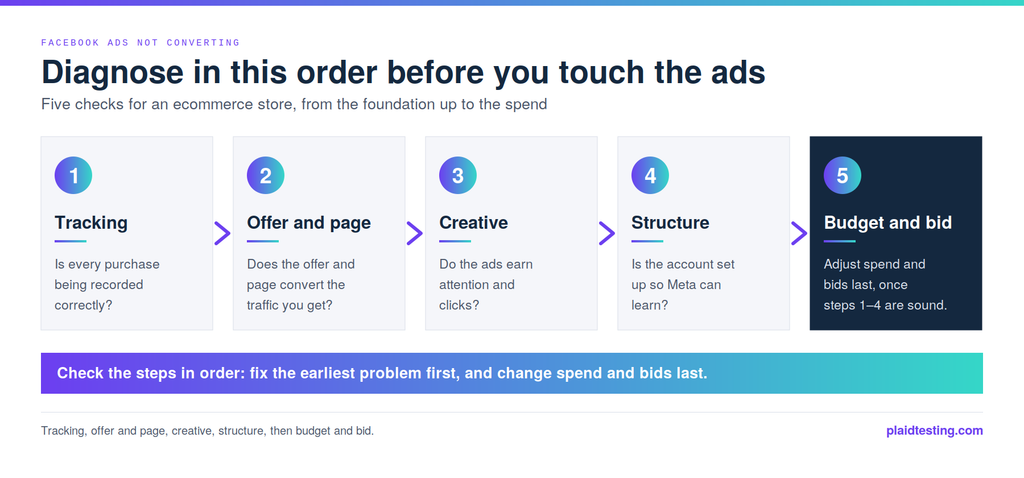
Step 1: Are Your Facebook Ads Really Not Converting, Or Is Tracking Broken?
Start by comparing Meta’s reported purchases with Shopify orders for the same days. If the store took orders that Meta did not see, the ads may be working and the signal is failing, which also means Meta’s delivery system is learning from incomplete data. Three causes come up most often in 2026.
The first is deduplication. Meta recommends running the Conversions API alongside the Pixel and matching events with a shared event ID so purchases are not counted twice or dropped (Meta for Developers). Meta has reported that advertisers using the Conversions API for web events see an average 17.8% lower cost per result (Jon Loomer Digital, 16 April 2026). On Shopify, the Facebook and Instagram channel’s data sharing level controls this: the Maximum setting combines the Conversions API with the Pixel, and server-to-server data cannot be blocked by browser ad blockers (Shopify Help Center).
The second is Shopify’s checkout upgrade. Tracking code that lived in the old additional scripts box on the thank you page does not carry over to the upgraded checkout; it has to be rebuilt as pixels or app integrations, and non-Plus stores reached their upgrade deadline in August 2026 (Shopify Help Center). The third is reporting itself: Meta changed its attribution settings twice in 2026, so a drop in reported conversions can be a change in counting rather than in buying. Our guide to the Meta attribution window explains both changes.
Step 2: Does The Offer And Landing Page Convert The Traffic It Gets?
If tracking checks out, look past the ad to the page it sends people to. Clicks without carts usually mean the page broke the promise the ad made. Check that the product, price and offer in the ad are the first things visible on the landing page, on a phone, without scrolling. Check load time on a mobile connection, because a slow page loses the impulse buyer the ad worked to attract. And check the reassurance details shoppers look for before they commit: shipping cost and speed, the returns policy and reviews.
Then check the economics. A product can convert and still lose money if contribution margin cannot carry the cost of acquiring each buyer. Meta’s median cost per acquisition across Triple Whale’s benchmark sample was $38.99 in 2026 (Triple Whale, August 2026). If your first order leaves less contribution than that after product cost, shipping, payment fees and returns, the problem is the offer, not the ads. Bundles, a free shipping threshold above your average order, or leading with a higher-margin product often fix more than a new campaign would. The break-even ROAS calculator shows the minimum return your costs require, and our Facebook ads cost calculator turns that into a budget.
Look for a change in the store, too. A price rise, a stockout on the hero product, a new theme or a broken discount code can all stop conversions on a day when nothing in Ads Manager changed.
Step 3: Is The Creative Fatigued Or Too Similar?
Creative now does most of the targeting on Meta. Its delivery system decides who sees an ad largely from what the ad is, so a set of ads that are all variations of one idea reaches the same narrow group of people again and again. In one Meta study, diversifying creative cut cost per acquisition by 32% and lifted reach by 9% (Retail TouchPoints, May 2024). Diversity here means different angles, formats and hooks, not the same video with five headlines.
Three numbers show fatigue before sales fall. Frequency rising week over week on the same audience means the same people are seeing the same ads. Hook rate, the share of viewers who watch the first three seconds of a video, falling means the opening no longer stops the scroll. Hold rate, the share who keep watching, falling means the middle of the ad no longer earns attention. When all three slide together, the fix is new concepts, not new budgets.
A testing rhythm prevents the cliff. Launch a small number of genuinely different concepts each week, give each a written kill and scale rule, and retire losers quickly. Our performance creative approach is built on that weekly cycle.
Step 4: Is The Account Structure Stopping Meta From Learning?
Meta’s delivery system needs volume to learn. An ad set generally needs about 50 optimization events within seven days of its last significant edit to exit the learning phase, per Meta’s guidance as summarized by PPC Land (PPC Land, 23 September 2026). Split a modest budget across many ad sets and none of them reaches that threshold, so delivery stays unstable and costs stay high. Every significant edit resets the clock, which is why frequent tinkering can cause the very problem it is trying to fix.
Consolidation is usually the answer: fewer campaigns and ad sets, each with enough budget and conversions to learn. Advantage+ sales campaigns, which replaced Advantage+ shopping campaigns, can work well here once the signal is clean (Jon Loomer Digital, March 2025). Check existing customer settings while you are in the structure. If prospecting campaigns are spending heavily on people who already buy from you, reported conversions can look healthy while new customer acquisition stalls, and the reverse can happen when exclusions are too aggressive.
Finally, check the optimization event. A campaign optimizing for add to cart or landing page views will find people who do those things, not buyers. For an ecommerce store with enough purchases, optimize for purchases.
Step 5: Did Budget, Bids Or Costs Change?
The last check is the one most people start with. Sudden budget jumps can push an ad set back into learning and into more expensive auctions; in our experience, raising budgets in steps of 15% to 25%, a few days apart, is gentler. Cost caps and bid caps set below what the auction now costs can choke delivery, so the ads spend little and convert less. And seasonality moves costs for everyone: CPMs climb into November as large retailers bid for the same audiences.
Diminishing returns are the quieter cause. The most likely buyers are reached first, so each extra dollar reaches people who are less likely to buy. If conversions fell after a budget increase while everything else held, the account may simply have passed the point where the next dollar pays. Our guide to marginal ROAS explains how to price each step of extra budget before committing to it.
Before you change anything here, write down what you changed and when. Budget, bid and audience edits made on the same day are impossible to untangle a week later, and most accounts that feel random are simply accounts where three things changed at once. One variable at a time, with a note in a shared log, turns the next drop into a quick diagnosis rather than another guess.
| Symptom | Most likely cause | First check |
|---|---|---|
| Store sales normal, Meta conversions down | Tracking or attribution change | Meta purchases vs Shopify orders, data sharing level |
| Clicks steady, carts low | Landing page or offer | Ad to page match, mobile speed, shipping and returns |
| Carts steady, purchases low | Checkout, payment or shipping cost | Checkout errors, discount codes, shipping rates |
| CPM and frequency rising, CTR falling | Creative fatigue | Hook rate, hold rate and concept diversity |
| Unstable daily results, many ad sets | Learning phase | Conversions per ad set per week |
| Conversions fell after a budget increase | Diminishing returns or a bid cap | Step-test history and bid settings |
What Does Fixing It Look Like In A Real Account?
A women’s fashion brand we work with raised Facebook spend 56% to $829K between January and August 2026, compared with the same months of 2025, while new customer orders rose 146%, from 7,625 to 18,735, per its Triple Whale account. Google spend rose sharply over the same months too, so combined Facebook and Google spend roughly doubled, about 92% higher. New customer orders still grew faster than the total budget, which is the pattern to look for: conversions rising faster than spend, not just alongside it.
What this does not claim: new customer orders are counted across the whole store, not attributed to Meta alone; no incrementality test isolated what the ads caused; and product and merchandising decisions moved the numbers alongside media. The transferable part is the method: check the data before the ads, and judge the result on new customers in the store rather than on Meta’s report alone.
If you have worked through the five checks and still cannot find the cause, a second pair of eyes is usually faster than another round of new ads. Our free Meta ads audit reviews your Pixel and Conversions API setup, account structure, creative and attribution in 30 minutes and ends with three fixes ranked by impact. Or book a free growth audit if Meta is one of several channels you want reviewed. Our Meta ads management page shows how we run accounts day to day.
Common Questions
Why are my Facebook ads getting clicks but no sales?
Clicks without sales usually point past the ad: a landing page that does not match the ad’s promise, slow mobile load times, surprise shipping costs, or a price the audience rejects. Check tracking first, though. If Shopify shows orders that Meta did not record, the ads may be converting and the Pixel or Conversions API is the problem.
Why did my Facebook ads suddenly stop converting?
Sudden drops usually follow a change: a tracking break after a checkout or theme update, an attribution setting change, a large budget jump that reset the learning phase, a stockout, or creative fatigue reaching a tipping point. Compare the date of the drop with recent changes in the store and the account before rebuilding campaigns.
How long should I wait before judging Facebook ads?
Give an ad set enough time to exit the learning phase, which Meta ties to about 50 optimization events within seven days of the last significant edit. For most ecommerce budgets that means at least a week without major edits, and judging on store-side results such as new customer orders rather than one day of reported ROAS.
What is a good conversion rate for Facebook ads?
Triple Whale’s 2026 benchmark across more than 40,000 brands puts the median Meta conversion rate at 1.53%, but category, price point and offer move it a lot. The more useful test is your own trend: a conversion rate falling while CPMs and frequency rise usually signals creative fatigue rather than a broken account.
Related Reading
- Meta Attribution Window: Which Setting to Use in 2026: why reported conversions can drop while sales hold
- Facebook Ads for Shopify: Setup, Tracking and Scale in 2026: data sharing levels and deduplication
- Facebook Ads Cost Calculator for Ecommerce: 2026 Benchmarks and Budget Math: from budget to purchases
- Break-Even ROAS Calculator: Find the ROAS Your Margins Need: whether the offer can carry the cost
- Facebook Ads Audit for Ecommerce Brands: what we check in a free Meta ads audit