
Most marketing agencies charge a monthly retainer, a percentage of ad spend, or a hybrid of the two. For paid media, WebFX puts typical fees at 10% to 20% of ad spend or about $1,000 to $3,000 a month, and Clutch reviews show an average PPC engagement of $7,165 a month. Scope and spend level move the number more than anything else.
That range is wide because the word “agency” covers very different jobs, from a freelancer managing one Google account to a team running media, creative and email across five channels. For an ecommerce brand spending $50K or more a month, the pricing model matters as much as the headline fee, because a percentage that looks small today can become the largest line on the invoice once the budget grows. This guide sets out the common models, real 2026 ranges, what the fee should include, and how to compare quotes on equal terms.
How do marketing agencies charge? The four pricing models
Clutch, which collects verified client reviews of agencies, groups pricing into four models: flat fee, percentage of ad spend, performance-based and hybrid (Clutch, September 2026). Hourly billing sits alongside them for smaller or project work. Each one rewards the agency for something slightly different, which is the part worth understanding before you compare numbers. A fee that looks expensive under one model can be cheap under another once you account for what it motivates the people doing the work to do.
| Model | How it works | Rewards the agency for | Watch for |
|---|---|---|---|
| Flat retainer | A fixed monthly fee for an agreed scope | Keeping the account and delivering the scope | Scope creep, and a fee that does not follow your growth either way |
| Percentage of ad spend | A share of the media budget, often with a monthly minimum | Managing more budget | Fees that rise with spend even when the work does not |
| Hybrid | A base fee plus a percentage, or a minimum or percentage, whichever is higher | Both stability and scale | How the percentage steps down, if at all, at higher budgets |
| Performance-based | Part or all of the fee tied to results such as revenue or new customers | Hitting the agreed metric | Which numbers decide the payout, and who measures them |
| Hourly or project | Time billed for audits, builds or one-off work | Hours worked | Open-ended estimates |
How common each model is depends on who you ask. A 2021 survey of 883 agencies and freelancers by Lunio found 35% used a fixed retainer as their main model, 21% a percentage of spend and 4% performance-based pricing, with most percentage agencies charging 6% to 10% (Lunio, June 2021). More recent data from Ignition’s April 2025 survey of 273 US agency leaders found 28% priced mainly through subscriptions or packages and 28% mainly by the hour (MarketingProfs, 2025). The two surveys measured different things, but together they show there is no single standard, so ask for the scope, and what sits outside it, in writing.
What do marketing agencies charge by service in 2026?
Paid media management is the most transparent category because many agencies publish prices. WebFX’s 2026 pricing page gives a typical range of 10% to 20% of ad spend, or around $1,000 to $3,000 a month, and its own tiers illustrate the hybrid: one tier charges $975 or 15% of spend, whichever is higher, for budgets of $5,000 to $30,000, and another charges $4,500 or 12% for budgets above $30,000 (WebFX, September 2026).
| Service | Typical 2026 pricing | Source |
|---|---|---|
| PPC management (Google, Meta) | 10% to 20% of spend, or about $1,000 to $3,000 a month at small budgets | WebFX |
| PPC agencies, hourly | $100 to $149 an hour; average engagement $7,165 a month and $103,612 over 14 months | Clutch |
| Social media marketing agencies | $25 to $49 an hour; average project $61,149 over 12 months | Clutch |
| Fractional CMO (ecommerce) | Average asking rate $208 an hour, middle 50% $150 to $244 | GoFractional |
The Clutch figures come from verified reviews of PPC agencies (Clutch, September 2026) and social media agencies (Clutch, September 2026). The fractional rate is an average asking rate across 56 observations from July to October 2026 (GoFractional, October 2026), not an observed retainer. Full growth scopes that bundle creative production, email and conversion work price above any single line here, because they are several services sold as one.
Two cautions when reading any price table. Averages hide a wide spread: a specialist team running $300K a month across four channels and a freelancer running one Google account both count as “PPC management”. And hourly rates rarely tell you the monthly cost, because the hours an account needs depend on how much testing, reporting and creative direction the scope includes.
What do agency fees look like at your spend level?
Percentage models are simple at small budgets and expensive at large ones, so the comparison only makes sense at the spend you expect to reach. The chart compares three fee structures with the Clutch average engagement at five monthly budgets.
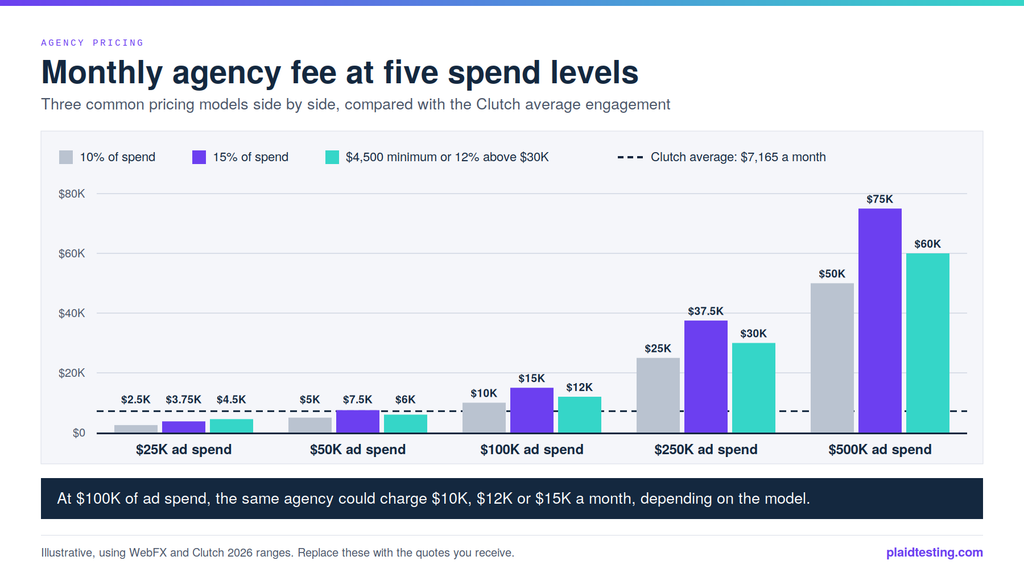
A real account makes the scale concrete. An athletic apparel brand we work with spent $457.4K across paid channels in June 2026, per its Triple Whale account. At that level a 10% fee would have been about $45,740 for the month, a 12% fee about $54,890 and a 15% fee about $68,610. A flat retainer would not have moved at all. None of these is automatically right or wrong. A percentage can be fair if the work genuinely grows with the budget, for example more creative testing, more channels and more analysis. It is worth questioning when the budget doubles and the team, the reporting and the scope stay the same.
Two questions settle most of this in a sales call. Ask how the fee changes if spend doubles, and ask what additional work the extra fee buys. A good partner will answer both in specifics. Our in-house vs agency comparison puts these fees next to the cost of hiring the same skills.
What should the agency fee include?
The fee is only comparable once you know what it covers. Get the scope in writing and check it against this list:
- Channels managed, by name, and whether new channels cost extra
- Creative: strategy and briefs only, or production as well
- Tracking and measurement work, such as Pixel and server-side events
- Landing page and conversion work, or none
- Reporting cadence: daily, weekly and monthly, and in which tool
- Who attends the monthly strategy session, and their seniority
- Notice period, minimum term and what happens to accounts and creative if you leave
Transparency on money is part of the scope. Under Google’s transparency requirements, third parties that manage Google Ads must disclose their fees and report ad costs separately from them (Google Ads policy help), and it tells advertisers they have the right to know the clicks, impressions and total cost of their ads (Google Ads policy help). The same standard is reasonable for every platform and every tool fee. It is not a niche concern: only 28% of advertisers in ANA’s 2025 agency compensation research said they had adequate visibility into how their agencies make money, according to ANA Magazine (ANA Magazine, 6 October 2026).
What hidden costs should you budget for?
The fee on the proposal is rarely the full cost of working with an agency. Four extras come up again and again. Creative production is often the largest: many paid media scopes include strategy and briefs but not the photography, video and editing that the briefs call for. Tools are second: attribution platforms, creative testing software and reporting dashboards are sometimes passed through at cost and sometimes marked up, so ask which. Setup or onboarding fees are third, typically for account restructuring and tracking work in the first month. Minimum terms are fourth: a three, six or twelve month commitment changes the real cost of a poor fit.
Internal time is the extra nobody invoices. Someone on your side still approves creative, answers questions about stock and margins, and reconciles the agency’s numbers with the store. If that person is the founder, it has a real cost.
Finally, measure the fee against what the spend returns, not against other fees. A partner who costs more but finds where the next dollar stops paying can save far more than the difference. Our guide to marginal ROAS shows how to find that point, and the break-even ROAS calculator sets the floor every channel has to clear.
How do you compare agency quotes fairly?
Put every proposal into the same table before you compare. Convert each fee into a monthly cost at your planned spend in six months, add the extras that sit outside the fee, and note the minimum term. Then compare what each one is accountable for. A quote judged on platform ROAS and a quote judged on new customer CPA are not the same product, even at the same price, because one can look good while the business stands still. Our guide to what a good ROAS is explains why.
Ask every finalist to show, not tell. Which person on their side will open your accounts each morning? When did they last advise a client to cut a budget, and why? Which result in a comparable account are they least proud of? Specific answers tell you more than the fee. If you are weighing a fee tied to results, our guide to the performance-based marketing agency model covers how to define the metric so the deal stays fair on both sides, and the ecommerce growth agency guide lists the questions that separate operators from ad buyers.
Want a second opinion before you sign? Book a free 30 minute growth audit. We review your tracking, account structure and budget split, and you leave with three fixes ranked by impact, whichever partner you choose. For a channel-by-channel review, see the paid media audit.
Common questions
How much does a marketing agency cost per month?
For paid media management, WebFX reports typical fees of about $1,000 to $3,000 a month at smaller budgets, or 10% to 20% of ad spend, and Clutch reviews show an average PPC engagement of $7,165 a month. Agencies that also handle creative, email and conversion work charge more, so compare quotes at your planned spend.
Is 10% of ad spend a fair agency fee?
It sits at the low end of the 10% to 20% range WebFX reports for paid media, and a 2021 Lunio survey found most percentage-based agencies charged 6% to 10%. Whether it is fair depends on scope: check what work the fee buys and whether the work grows when the budget does.
What is a typical marketing agency retainer?
Retainers for paid media commonly start around $1,000 to $3,000 a month for small accounts and rise with scope. Many agencies combine a retainer with a percentage of spend, charging a minimum fee or a percentage, whichever is higher. Full-service growth retainers that include creative and email typically cost more.
Do marketing agencies charge setup fees?
Many do, usually for onboarding work in the first month such as account restructuring, tracking setup and reporting dashboards. Ask for setup fees, creative production, tool costs and minimum terms in writing, because they can change the real cost of the first quarter more than the monthly fee does.
Related reading
- Performance-Based Marketing Agency: How Pay-for-Performance Pricing Works for Ecommerce: fees tied to results
- Ecommerce Growth Agency: What It Does, What It Costs and How to Choose One: what a growth partner should own
- In-House vs Agency Marketing for Ecommerce Brands: Costs, Trade-Offs and the Fractional Option: fees against the cost of hiring
- How Much Does a Fractional CMO Cost in 2026?: retainer and hourly structures
- Break-Even ROAS Calculator: Find the ROAS Your Margins Need: the floor every channel has to clear