
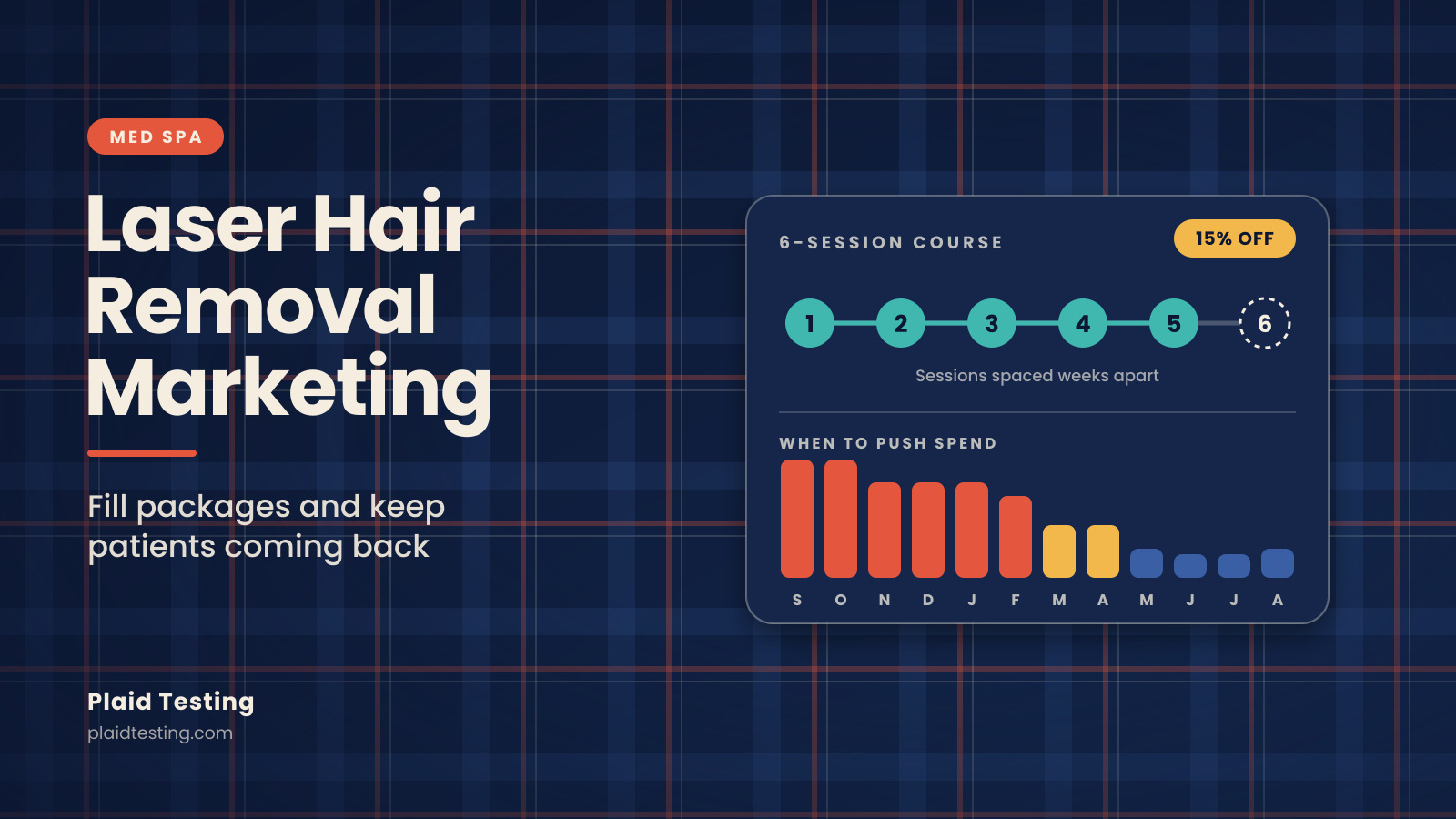
Laser hair removal marketing works when it sells the full course, not a single session. Most patients need four to eight treatments spaced weeks apart, and sun exposure has to be managed around them, so the best campaigns sell packages, start in the cooler months, and judge ads on course completions rather than consultations alone.
That framing changes almost every marketing decision a med spa makes about laser: the offer, the timing of spend, the words in the ad and the numbers on the weekly report. This guide covers each one, with an illustrative pricing table and a month-by-month calendar you can adapt to your own clinic.
Why Laser Hair Removal Is A Package Business
According to the Mayo Clinic, most people need four to eight treatments for best results, scheduled several weeks apart, and results are not guaranteed to be permanent; some patients need occasional follow-up sessions. FDA clearances for hair removal lasers use the phrase “permanent hair reduction”, which a recent 510(k) summary defines as a long-term, stable reduction in the number of hairs regrowing when measured at 6, 9 and 12 months after a treatment regime.
Put those two facts together and the commercial picture is clear. A patient who buys one session and never returns gets a weak result, writes no review and refers nobody. A patient who completes a course gets the outcome they came for, and that patient is the one who books underarms after legs, refers a friend and later tries injectables. The unit you are really marketing is the course, so the offer, the follow-up and the reporting all need to be built around completing it.
What To Say, And What Not To Say, In Laser Ads
Laser is a medical procedure, so claims need the same care you would give any health advertising. Meta also restricts ads that assert or imply personal attributes, so copy such as “Tired of your hairy legs?” is likely to be rejected. Focus on the outcome, the process and the clinic instead of the reader’s body.
| Safer wording | Risky wording |
|---|---|
| Long-term hair reduction with a course of treatments | Permanent hair removal, or never shave again |
| Most clients need several sessions; your provider will advise | Smooth skin after one session |
| Treatment plans for many skin types after a consultation | Safe for everyone |
| Real patient photos, with consent, after a stated number of sessions | Stock or edited before and after images |
| Packages from a stated price, with the full course cost shown | A per-session price that hides the course cost |
| Treatments performed by licensed providers | Pain-free, or no side effects |
Rules on who may perform laser treatments and how procedures can be advertised vary by state, so have your medical director or a healthcare attorney review claims before launch. This guide is marketing advice, not legal advice.
Package Pricing That Sells The Whole Course
A package removes the decision point between sessions, which is where most patients drop off. Price the full course up front, offer a monthly payment option, and make the per-session saving visible. The numbers below are illustrative only; set your own prices from your costs and local market.
| Treatment area (illustrative) | Single session | 6 sessions at full price | 6-session package (15% off) | Monthly over 6 months |
|---|---|---|---|---|
| Small (upper lip, underarms) | $150 | $900 | $765 | $127.50 |
| Medium (bikini, lower legs) | $250 | $1,500 | $1,275 | $212.50 |
| Large (full legs, back) | $400 | $2,400 | $2,040 | $340 |
Two refinements usually lift package uptake. First, add a touch-up session at a reduced price for patients who complete the course, which rewards completion and gives a reason to come back. Second, bundle areas: patients who book legs often add underarms or bikini when the combined price is shown. In ads, lead with the monthly figure only if the full course price and term appear in the ad or on the landing page.
Running laser ads that bring in consults but not packages? Request a growth audit: it is free, takes 30 minutes, and covers the offer, the funnel and the tracking behind your laser campaigns.
A Month-By-Month Laser Hair Removal Calendar
Because patients should avoid sun exposure before treatment and protect treated skin for weeks afterward, the Mayo Clinic guidance quoted above effectively sets the season. Patients who start in the fall can finish most of a course before summer. Plan spend around that rhythm instead of running the same budget all year.
| Months | Message | Spend level |
|---|---|---|
| September to October | Start now, finish before summer. Biggest package push of the year | Highest |
| November to December | Year-end packages and gift cards for courses that start in January | High |
| January to February | New year plans. Last comfortable window to fit a full course before summer | High |
| March to April | Smaller areas and face, plus consults to book a fall start | Medium |
| May to August | Areas you can keep covered, existing patients finishing courses, early fall bookings | Lower, focused on retargeting and email |
The quieter summer months are the right time to refresh creative, collect patient photos with consent and rebuild the email list, so the fall campaign launches with new material.
Which Channels Work For Laser Hair Removal
Search and social do different jobs. Google search captures people already looking, such as “laser hair removal near me” or “laser hair removal cost”, and those searchers are often comparing two or three clinics that week. Meta and Instagram create demand with education, patient stories and package offers, and they are where seasonal pushes reach people who were not yet searching. Our Google Ads management and Meta ads management pages explain how we run each.
Around paid media, three owned channels carry the course to completion: a Google Business Profile with recent reviews, email and SMS reminders that book the next session before the patient leaves, and a referral offer for patients who finish. Our guide to med spa advertising covers channel choice in more depth, and the same package logic applies to injectables, as our guide to Botox marketing explains.
Landing Pages That Turn Laser Clicks Into Consultations
Many clinics send paid traffic to a homepage or a generic services page, then wonder why cost per consult is high. A laser landing page should answer the four questions every prospective patient has, in this order: what does a course cost, how many sessions will I need, is it right for my skin and hair, and when can I start.
Put the package price and monthly option near the top, with a short line explaining that most patients need several sessions. Add a simple area menu so visitors can see the price for legs, underarms or bikini without calling. Show real patient photos with consent and the number of sessions completed, provider credentials, and recent reviews that mention the experience. Keep the booking form short: name, phone, area of interest and preferred times is enough to start. Finally, make sure the form or booking widget fires a conversion event your ad platforms can see, so campaigns learn from booked consultations instead of page views.
Measure Course Completions, Not Just Consults
Most med spa reports stop at cost per lead or cost per booked consultation. That rewards ads that attract browsers and ignores what happens after the first visit. Connect your booking system to your ad reporting and track the full path.
| Metric | Why it matters |
|---|---|
| Cost per booked consultation | Early signal of ad efficiency |
| Consult to package rate | Shows whether the offer and the consult convert |
| Cost per package sold | The real acquisition cost for laser |
| Course completion rate | Drives results, reviews and referrals |
| 12-month revenue per patient | Captures add-on areas and other treatments |
An illustrative example: $3,000 of monthly ad spend produces 40 booked consultations, and 45% buy a $1,275 package. That is 18 packages, $22,950 in package revenue, and about $167 of ad spend per package. If you only looked at the $75 cost per consult, you would not know whether the ads were working. Our customer acquisition cost calculator helps you set a target from your own margins.
For clinics weighing outside help, our roundup of med spa marketing companies lists what to ask, and our med spa marketing page shows how we work with aesthetic clinics.
Planning your fall or January laser push? Talk to Jason Lu in a free growth audit and leave with a package offer, a channel plan and the metrics to judge it.
Laser Hair Removal Marketing FAQs
When is the best time to advertise laser hair removal?
Fall and winter, because patients who start then can complete most of a course before summer sun. Many clinics put their largest push in September and October and a second one in January.
Can I advertise laser hair removal as permanent?
Use “permanent hair reduction”, the term used in FDA device clearances, rather than “permanent hair removal”. Results vary and some patients need occasional follow-up sessions.
Should I advertise a single-session price or a package?
Lead with packages. Most patients need several sessions, and a package price sets honest expectations and keeps patients coming back to finish the course.
Are before and after photos allowed in laser ads?
Real patient photos with written consent are generally the safest approach, labeled with the number of sessions. Platforms review these ads closely, so avoid edited images and copy that comments on the viewer’s body.
What is a good cost per consultation for laser hair removal?
It depends on your market and package value. Judge ads on cost per package sold and course completion, then work back to the cost per consultation your margins can support.