
INDUSTRIES · FASHION AND APPAREL
Fashion marketing agency for apparel and clothing brands
Plaid Testing is a fashion marketing agency for apparel brands spending $50K or more a month on ads. We run paid media, creative testing and tracking under a fractional CMO, and we manage accounts to contribution margin after returns, not to platform ROAS. Apparel is our deepest vertical: three brands, three results, all verified in Triple Whale.
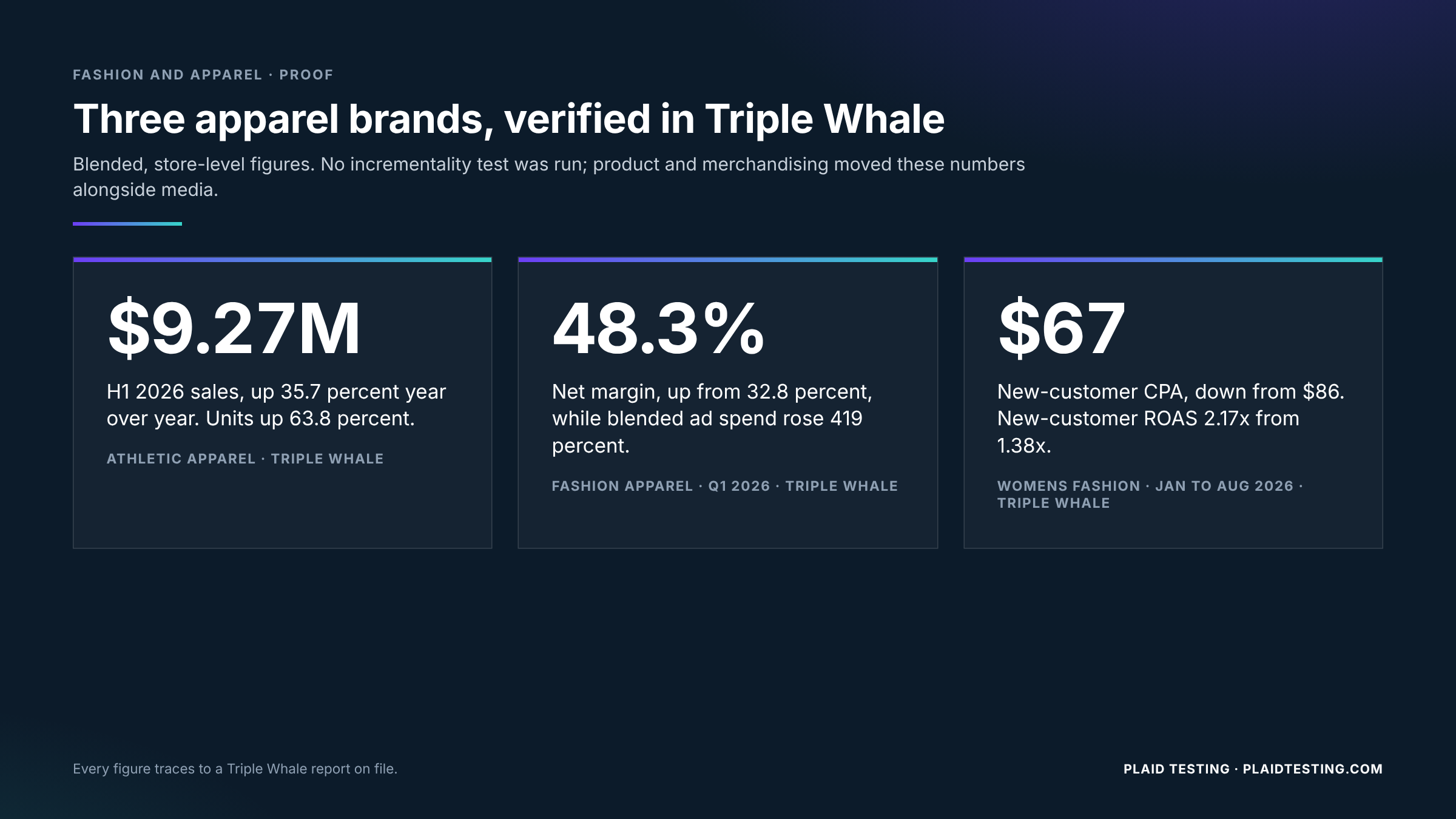
$9.27M
H1 2026 sales, athletic apparel, +35.7% YoY
Triple Whale
48.3%
Net margin, up from 32.8%, while ad spend rose 419%
Fashion apparel, Q1 2026 · Triple Whale
$67
New-customer CPA, down from $86
Womens fashion, Jan to Aug 2026 · Triple Whale
What a fashion marketing agency should actually run
Most agencies that call themselves fashion marketing agencies sell creative, PR or influencer seeding. Those matter, and they are not what moves a Shopify apparel brand from $100K to $500K a month. Paid media does, and apparel paid media has rules that general ecommerce agencies learn the expensive way.
| Channel | What is different in apparel | What we run |
|---|---|---|
| Meta and Instagram | Catalog depth. A 400-SKU store with size and colour variants needs a feed that Meta can learn from, and creative that refreshes every two to three weeks before fatigue sets in. | Advantage+ shopping with a clean catalog, broad prospecting on margin tiers, a weekly creative test slot, and a retention structure that stops bidding against your own returning customers. |
| Google Shopping and Performance Max | Variant feeds break more often than they work. Brand and non-brand must be separated or the account reports a ROAS it never earned. | Feed built by product group and margin, brand carved out, Shopping and PMax budgeted from contribution margin, and search terms reviewed weekly. Google Ads for ecommerce. |
| TikTok | The fastest discovery channel for streetwear, athleisure and womens fashion, and the hardest to attribute. | Spark Ads on creator content, TikTok Shop where the brand sells there, and Triple Whale post-purchase surveys to see what the pixel misses. TikTok Ads. |
| Snapchat | Underpriced reach for 18 to 30 year old buyers in casual and athletic apparel. | Tested in month two for brands with the right customer, scaled only if the blended numbers hold. Snapchat Ads. |
| Creative testing | Apparel ads die fast. The winning ad in January is tired by March. | A weekly testing cadence through our performance creative process: hooks, formats and products tested before budget scales. |
| Tracking and attribution | Returns, exchanges and discount codes distort every platform’s reporting. | Triple Whale pixel and CAPI, blended and new-customer ROAS reported daily, returns modeled into the break-even. Tracking and attribution. |
We do not run email and SMS. We have a partner who does, and we hand off cleanly.
Where apparel paid media breaks
1. Returns turn a good ROAS into a loss
Apparel returns run at roughly 25 percent overall, 27.8 percent in womens fashion and 31 percent in footwear, and the fully loaded cost of processing one apparel return in 2026 is about $30 per item (Eightx, 2026). A campaign that reports a 3.0x ROAS on a $55 item with a 28 percent return rate can be losing money after fulfilment and the return trip. That is why every apparel account we run starts with a returns-adjusted break-even, not a target ROAS copied from a benchmark post. Use our break-even ROAS calculator to see your own number.
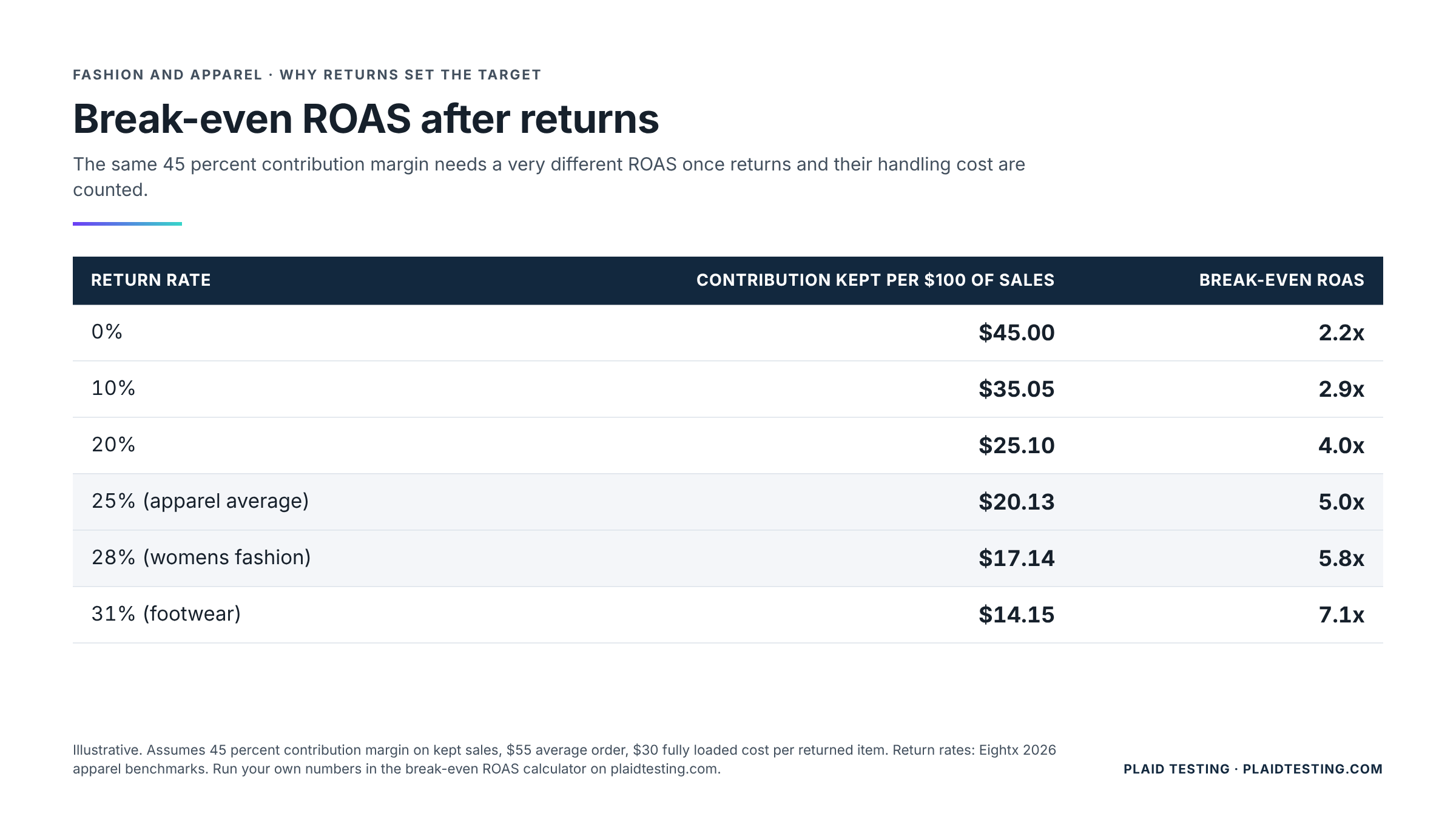
On the athletic apparel account in the stat bar, returns fell 10.2 percent in June 2026 while units sold rose 43.4 percent, because sizing guidance moved into the ads and the landing pages before we scaled spend. Returns are a media problem before they are an operations problem.
2. The feed is the campaign
A fashion catalog with hundreds of variants is only as good as its product feed. Missing GTINs, generic titles, out-of-stock sizes still live in Shopping, and colour variants competing with each other are the four defects we find in almost every apparel audit. Fixing the feed usually does more in the first 30 days than any bid change.
3. Seasonality and drops are planned around, not reacted to
Apparel sells on a calendar: spring and fall drops, back to school, Black Friday and Cyber Monday, January returns season. The ad account should be built for that calendar in advance, with inventory data feeding the media plan so you never scale a size run you cannot ship. Our BFCM paid media calendar is the version of this we publish.
4. Discounting becomes the only lever
When a brand has trained its customers to wait for 30 percent off, paid media gets more expensive every quarter. The fix is in the layer above the ad account: offer structure, bundles, new-customer pricing and a creative pipeline that sells the product rather than the discount. That is the fractional CMO part of the work, and it is why we bring both.
How we run apparel accounts
Every engagement follows the same operating system.
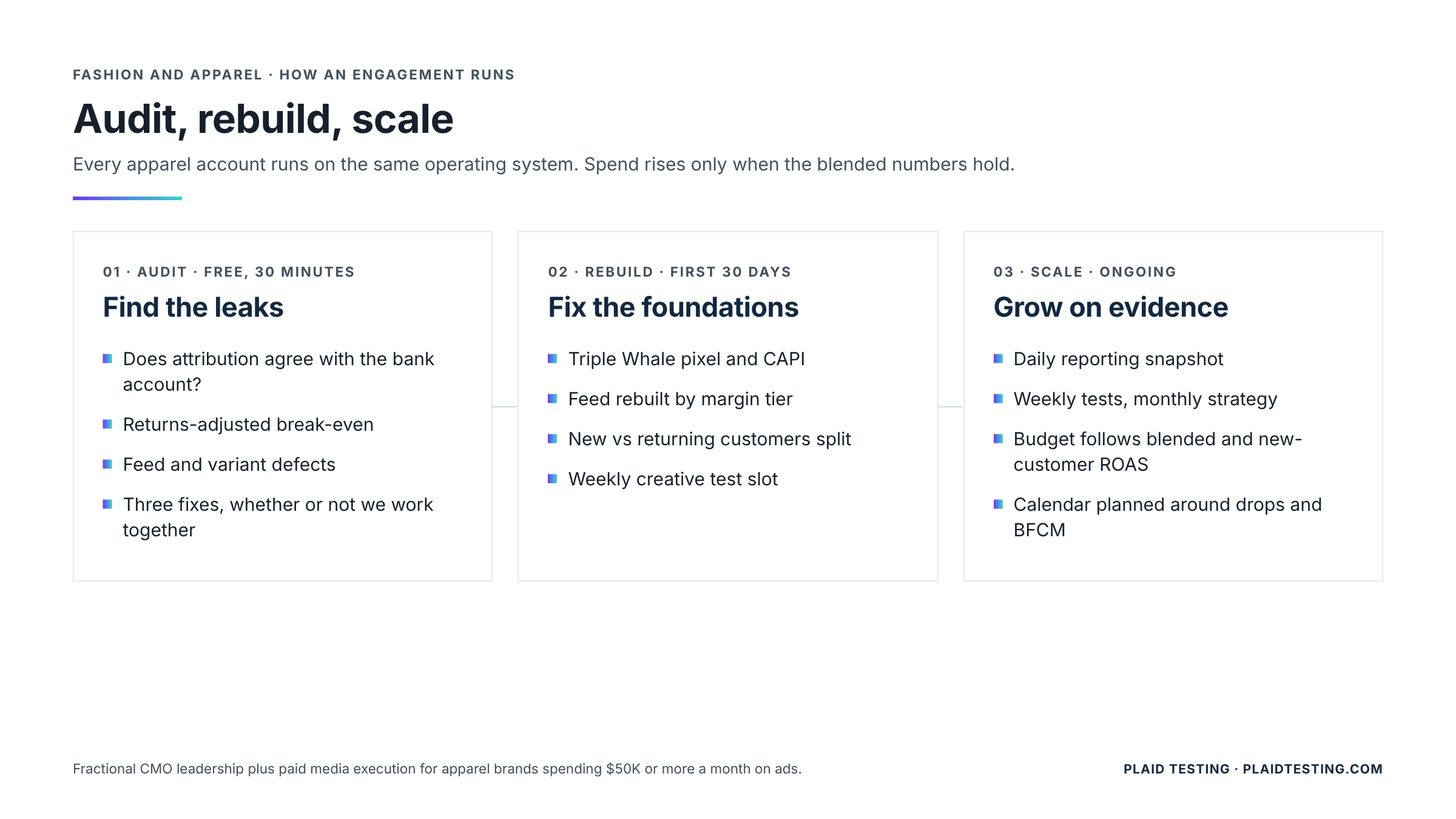
- Audit (free, 30 minutes). Does your attribution roughly agree with your bank account? Where does the current structure leak budget? What is your real break-even after returns? Three fixes, whether or not we work together.
- Rebuild (first 30 days). Triple Whale pixel and CAPI, feed rebuilt by margin tier, campaign structure split by new and returning customers, creative pipeline with a weekly test slot, daily reporting live from day one.
- Scale. Daily snapshot, weekly tests, monthly strategy. Spend rises only when blended and new-customer ROAS hold. In June 2026 on the athletic apparel account, sales grew three times faster than ad spend: sales up 26.9 percent on ad spend up 8.6 percent.
Want this run on your own account? Book a free 30 minute growth audit and we will show you the three highest-leverage changes before you commit to anything.
Proof: three apparel brands, verified in Triple Whale
| Brand | Window | What happened |
|---|---|---|
| Athletic apparel | H1 2026 vs H1 2025 | Sales to $9.27M, up 35.7 percent. Units up 63.8 percent. Returning customer revenue up 52 percent. Shopify blended ROAS 3.77x in June, up from 3.23x. |
| Fashion apparel | Q1 2026 vs Q1 2025 | Sales from $1.05M to $7.20M. Net margin from 32.8 percent to 48.3 percent while blended ad spend rose 419 percent. New-customer CPA down 6.1 percent during a five-fold spend increase. |
| Womens fashion | Jan to Aug 2026 vs same 2025 | Net sales from $1.27M to $2.60M. New-customer orders up 146 percent. New-customer CPA from $86 to $67. New-customer ROAS from 1.38x to 2.17x. |
What this does not claim. No incrementality test was run on these accounts. Blended figures come from Triple Whale, not from platform reporting. Product, merchandising and inventory moved these numbers alongside media. We say that on every case study because the brands we want to work with would ask.
Who this is for
Shopify apparel brands spending $50K or more a month on ads, with a founder or operator who wants to see the numbers daily. That includes:
- Womens clothing brands where returns and sizing decide the margin and creative has to move at the speed of the trend cycle.
- Mens clothing and athletic apparel where replenishment and returning-customer revenue carry the account, and new-customer CPA is the number to protect.
- Streetwear and drop-based brands where the calendar is the strategy and TikTok and Snapchat earn their place.
- Licensed and heritage apparel brands scaling spend quickly and needing margin to hold while they do.
It is not for brands under $25K a month in ad spend, marketplace-only sellers, or brands looking for a creative studio or PR agency. We will tell you that on the audit call.
What it costs
No retainer is required to start. Pricing depends on monthly spend and whether you want the work done for you or done with your team; both models run on the same operating system and the same daily reporting. Our guide to how much marketing agencies charge in 2026 explains the common models and what each one incentivises.
Questions apparel founders ask us
How is a fashion marketing agency different from a general ecommerce agency?
The difference is in what the agency plans around: returns, variant feeds, seasonal drops and creative fatigue. A general ecommerce agency optimises to platform ROAS. A fashion marketing agency that knows the category builds the media plan from contribution margin after returns and runs creative at the speed apparel needs.
Do you work with womens clothing brands?
Yes. Two of our three verified apparel results are womens fashion and fashion apparel brands. Womens clothing carries the highest return rates in the category, so the returns-adjusted break-even matters most there.
Do you produce the ads?
We run the creative testing system and brief the creative. Production is done by your team, our creative partners or a mix, depending on the engagement. What we own is the cadence: which hooks, formats and products get tested each week and what scales.
What is a good ROAS for an apparel brand?
There is no universal number. A good ROAS is one above your break-even after product cost, shipping, payment fees and returns. For many apparel brands that break-even sits between 2.0x and 3.0x blended, which is why a 3.0x platform ROAS can still be a loss. Our guide to what a good ROAS is works through the maths.
Get your free 30 minute growth audit
A senior review of your ad accounts, creative and tracking, with three fixes you can act on whether or not we work together. No retainer required to start.