
The strongest Triple Whale alternatives in 2026 are Northbeam and Rockerbox for modeled attribution and MMM, Polar Analytics and Lifetimely for lower-cost store dashboards, Wicked Reports and Hyros for click-to-order tracking, and TrackBee for server-side events. Many brands should not switch at all: fix the setup first, then judge every tool against store-side new-customer revenue.
The question is louder this year because the inputs changed. Meta stopped returning 7-day view and 28-day view attribution windows through its Ads Insights API on January 12, 2026 (Meta for Developers, October 2025), so every dashboard that pulls Meta data had to adjust. If you have not revisited your own setting since, read our note on which Meta attribution window to use in 2026.
Buyers are also rethinking measurement as a whole. In IAB’s September update to its 2026 Outlook Study, 86% of buyers said they are changing or expect to change how they measure media performance (IAB, September 2026).
Where we stand: we use Triple Whale with client accounts, and Jason has presented on Triple Whale’s Customer Education Series (Meet Moby 2) and spoken at The Whalies, Triple Whale’s conference. Read our view with that in mind. Every price and feature below was checked on the vendor’s own site in November 2026.
This guide covers why brands look elsewhere, seven alternatives plus the free baseline, Triple Whale vs Northbeam, which stack fits your monthly ad spend, and three questions that decide whether you should stay.
Why do brands look for Triple Whale alternatives?
Three reasons come up with almost every founder, and usually only one is about the tool itself.
Price. Triple Whale has a free plan, and its paid plans are priced on a combination of annual revenue and package, based on a 12-month commitment (Triple Whale pricing, November 2026). As revenue grows, so does the bill, even if the team still uses the same three reports.
Data trust. The media buyer sees one ROAS in Meta, another in Triple Whale and a third in GA4. In our audits, the cause is more often the setup than the vendor. A new tool on a broken setup reproduces the same argument with a different logo.
Needs it does not cover well for you. Brands with TV, podcast or retail spend, subscription brands, and businesses that close sales by phone have different measurement problems. Triple Whale now sells Compass, which combines multi-touch attribution, MMM and incrementality testing, so this gap is narrower than it was. Check what your plan actually includes before assuming a feature is missing. Our broader guide to ecommerce attribution models and tools explains how these layers fit together.
Which Triple Whale alternatives are worth a look in 2026?
These are the tools we most often see in client stacks or in other agencies’ pitches.
Northbeam
Northbeam is a multi-touch attribution platform with its own view-through model, Clicks + Deterministic Views, a direct ad platform integration called Apex, and a media mix modeling product, MMM+. It says it is trusted by 1,000+ companies.
- Best for: multi-channel brands that want modeled view-through credit and a path to MMM with one vendor.
- Pricing as published: Starter $1,500 for brands spending under $1.5M a year on ads (month-to-month for Shopify brands), Professional $3,500 a month on annual terms, Enterprise custom. Price is informed by pageviews (Northbeam pricing, November 2026).
- Watch out: MMM+ is listed as an Enterprise add-on, not part of Starter or Professional.
Polar Analytics
Polar Analytics centralizes Shopify, ad, email and marketplace data in the brand’s own Snowflake database, with attribution, a first-party pixel and a separate incrementality testing service. It says it is trusted by 4,000+ ecommerce brands and agencies.
- Best for: brands with an analyst who want one dashboard plus warehouse access.
- Pricing as published: Analyze from $300 a month at $0 to $1.5M GMV; Analyze & Enrich, which adds the first-party pixel, from $350; the top tier reaches $2,900 at $15M to $20M GMV. Monthly, no long-term commitment (Polar Help Center, November 2026).
- Watch out: the pixel sits in Enrich and the CAPI Enhancer in the top tier, so the entry price is not the price of a full attribution setup.
Lifetimely
Lifetimely, by AMP, is profit and lifetime-value analytics for Shopify: daily profit and loss, predictive LTV, CAC payback, and ad spend, ROAS and CPC by channel.
- Best for: brands whose real question is profit and payback, not which ad gets credit.
- Pricing as published: free up to 50 orders a month, then $49 (500 orders), $149 (3,000 orders), up to $999 for 25,000+ orders, with a 14-day trial (Lifetimely pricing, November 2026).
- Watch out: its published plans list no view-through attribution or MMM, so at higher spend it complements an attribution tool.
Rockerbox
Rockerbox sells a marketing data foundation, multi-touch attribution with new vs repeat customer views, MMM with support for offline and custom channels, and managed incrementality testing. DoubleVerify announced a cash deal to acquire it for $85 million (DoubleVerify, February 2025).
- Best for: large brands with TV, podcast, retail or other offline spend that need MTA, MMM and tests to cross-check each other.
- Pricing as published: pricing on request; products are bought as a mix (Rockerbox plans, November 2026).
- Watch out: Rockerbox says MTA or MMM setup takes 6 to 8 weeks, so plan for most of a quarter before it settles decisions.
Hyros
Hyros is ad tracking and attribution that sends sales data back to Meta and Google to improve their optimization. It serves ecommerce, info, call-based, SaaS and agency businesses, and includes call tracking.
- Best for: high-ticket or phone-assisted sales that need cleaner conversion data sent back to ad platforms.
- Pricing as published: pricing on request. Hyros lists one plan, quoted on a setup call and sized to the revenue it tracks, with a “Your ads grow or you do not pay” guarantee (Hyros pricing, November 2026).
- Watch out: cost scales with tracked revenue, so ask for the quote at today’s revenue and at double it.
Wicked Reports
Wicked Reports ties each sale back to the ad click, checked against actual orders. Its “New Customer Truth” view separates new from repeat buyers on every campaign, with lifetime lookback and cohort LTV that updates as rebills arrive.
- Best for: subscription and replenishment brands where the first order undersells the customer.
- Pricing as published: Measure $499 a month (up to $2.5M revenue), Scale $699, Maximize $999, Enterprise from $4,999 for $50M+ brands, based on trailing 12-month revenue (Wicked Reports pricing, November 2026).
- Watch out: the Meta signal feature and its AI tool are $199 add-ons each below Maximize.
TrackBee
TrackBee is server-side tracking: it enriches sessions with first-party data and sends events to Meta, Google Ads, TikTok, Pinterest, Snapchat, GA4, Klaviyo and others, with 19 integrations on every plan. Cometly, often named alongside it, now leads its homepage with B2B SaaS attribution and shows no prices on its pricing page, so we left it out here.
- Best for: brands whose pixel is losing events, underneath whichever dashboard they use.
- Pricing as published: Start €79 a month (€25K tracked revenue), Pro €199 (€100K), Scale €449 (€500K), excluding VAT, with per-€1K overage (TrackBee pricing, November 2026).
- Watch out: it is a tracking layer, not a dashboard replacement.
The free baseline: Shopify analytics, GA4 and platform reporting
Shopify’s channel reports default to last non-direct click, with first click, last click, linear and any click models available (Shopify Help Center, November 2026). GA4 offers data-driven attribution plus two last-click models (Google Analytics Help, November 2026); each ad platform reports its own view.
- Best for: brands under $25K a month, and as a cross-check at every spend level.
- Pricing as published: free. Google’s open-source MMM, Meridian, has been open to all marketers since early 2025 (Google, January 2025), but it needs a data scientist.
- Watch out: three systems give three numbers, and someone has to reconcile them every week.
Triple Whale alternatives compared side by side
| Tool | Type | Best for | Pricing as published (Nov 2026) | Watch out |
|---|---|---|---|---|
| Triple Whale (reference) | Pixel attribution, dashboards, AI, MMM via Compass | Shopify brands wanting one daily view | Free plan; paid by revenue and package, 12-month commitment | Cost rises with revenue |
| Northbeam | MTA with view-through, MMM+ | Multi-channel brands needing view-through | Starter $1,500; Professional $3,500/mo; Enterprise custom | MMM+ is an Enterprise add-on |
| Polar Analytics | BI dashboards, pixel, Snowflake | Brands with an analyst | From $300/mo by GMV | Pixel not in the entry tier |
| Lifetimely | Profit and LTV analytics | Profit and payback questions | Free to 50 orders; $49 to $999/mo | No view-through or MMM |
| Rockerbox | MTA, MMM, incrementality | Offline and TV-heavy mixes | Pricing on request | 6 to 8 week MTA or MMM setup |
| Hyros | Ad tracking, platform feedback | Call-assisted, high-ticket sales | Pricing on request | Price scales with tracked revenue |
| Wicked Reports | Click-to-order attribution, cohort LTV | Subscription brands | $499 to $999/mo; Enterprise from $4,999 | Key features are add-ons below Maximize |
| TrackBee | Server-side tracking | Event loss at scale | €79 to €449/mo by tracked revenue | Not a dashboard |
| Shopify + GA4 + platforms | Free native reporting | Under $25K/mo | Free | Numbers never match |
Triple Whale vs Northbeam: which fits your brand?
Most brands at $100K a month and up end up making this comparison, and we have not seen an independent test that ranks one above the other. Both now describe a clicks-plus-deterministic-views approach to view-through credit, both sell incrementality, and both offer AI or MCP access. The real differences are pricing structure, where MMM sits, and how your team works day to day.
Triple Whale says over 6,000 brands use it (Triple Whale, November 2026) and leans into daily operating use: Moby, its AI operator, and Sonar Optimize for Conversions API and passback. Northbeam positions itself as attribution and MMM for profitable growth, prices on pageviews, and puts MMM+ on its Enterprise tier.
| Question | Triple Whale | Northbeam |
|---|---|---|
| Entry price | Free plan; paid tiers priced by GMV | Starter $1,500 |
| Pricing basis | Annual revenue and package | Pageviews |
| Contract | 12-month commitment | Starter month-to-month for Shopify; Professional annual |
| MMM | Compass (MTA, MMM, incrementality) | MMM+ as Enterprise add-on |
| AI and agents | Moby; credit-based Moby AI Pro | MCP access on all listed tiers |
Our read: under $150K a month with a team that lives in a daily dashboard, Triple Whale’s entry cost is hard to beat. With heavy upper-funnel video spend and a need for modeled credit and MMM, shortlist Northbeam and run both side by side for a month.
Before you sign anything new, our paid media audit compares what each platform claims against your store orders.
Which stack fits your monthly ad spend?
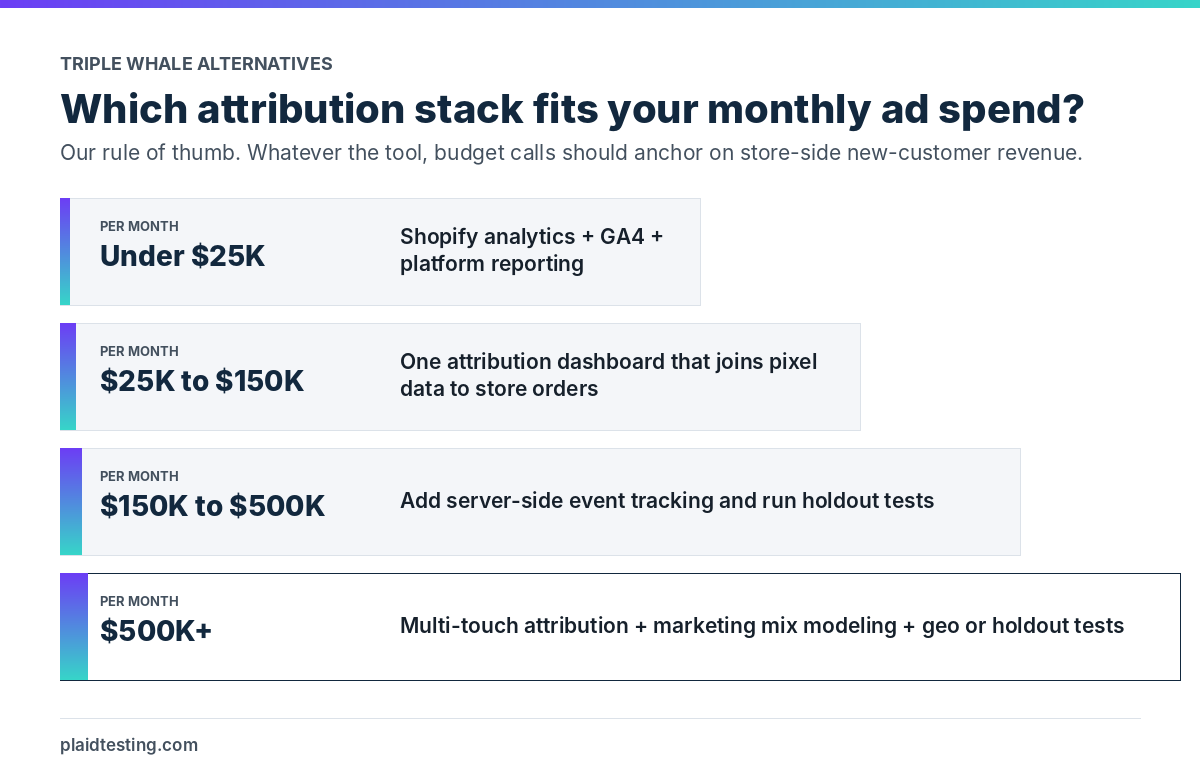
Tool choice should follow spend, because a wrong budget call costs more as the budget grows. This is our rule of thumb, not a law: a brand with heavy TV spend at $200K a month may need MMM earlier.
| Monthly ad spend | Stack | Example tools |
|---|---|---|
| Under $25K | Shopify analytics + GA4 + platform reporting | Free baseline; Lifetimely for profit |
| $25K to $150K | One attribution dashboard combining pixel data with store orders | Triple Whale, Polar, Wicked Reports |
| $150K to $500K | Add server-side event tracking and run holdout tests | TrackBee or native Conversions API; Northbeam, Hyros |
| $500K+ | Multi-touch attribution plus marketing mix modeling plus geo or holdout tests | Northbeam Enterprise, Rockerbox, Triple Whale Compass |
Under $25K, a paid dashboard mostly repeats what Shopify knows. Between $25K and $150K, the win is one place where pixel data meets real orders. From $150K, lost events cost real money and one holdout test can redirect six figures. Past $500K, MTA, MMM and experiments should check each other.
At every level, the number that decides the budget stays the same: store-side new-customer revenue and contribution margin.
Should you stay on Triple Whale or switch?
Switching costs more than the subscription: lost history, retraining and weeks of two tools disagreeing. Ask these three questions in order.
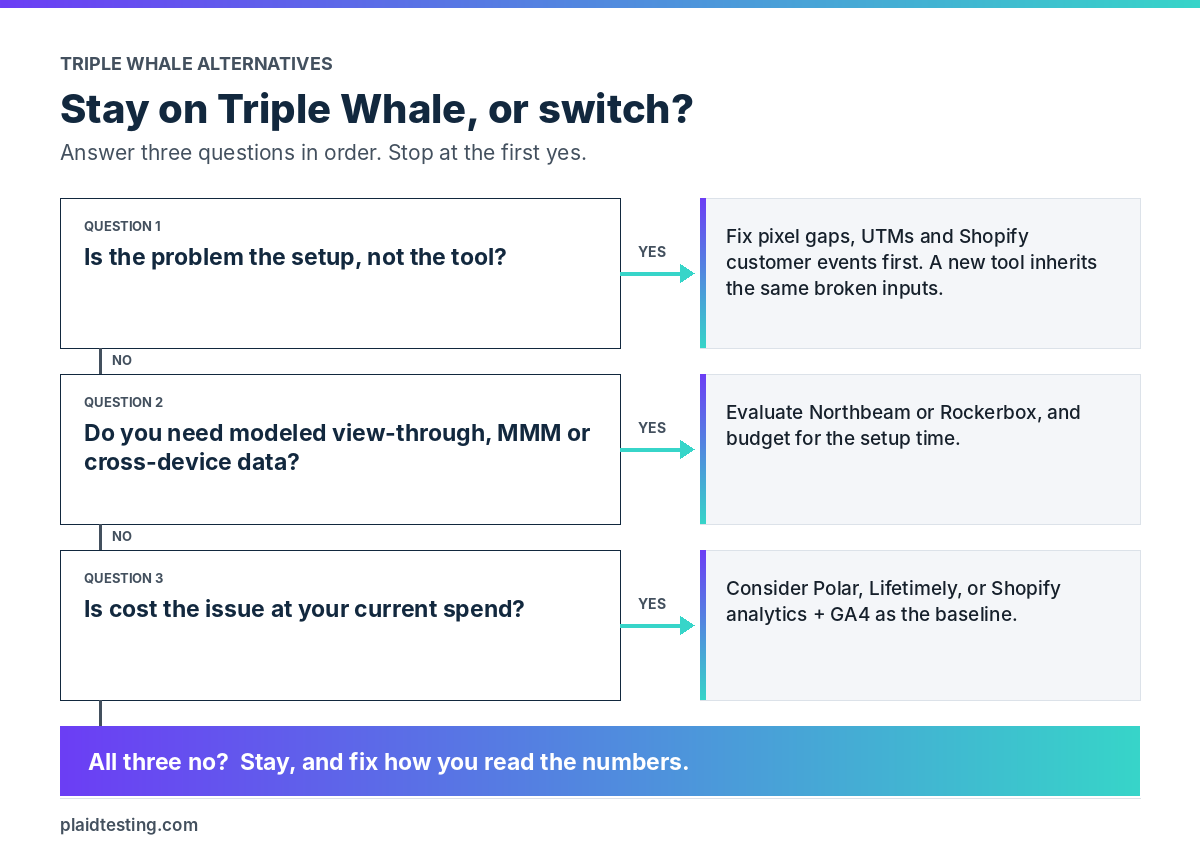
1. Is the problem the tool or the setup?
Check pixel coverage on every checkout and post-purchase page, UTMs on every paid link, Shopify customer events, and Conversions API deduplication. If attributed revenue is far from Shopify orders, the setup is the likely cause, and any new tool will inherit it. Fix it first. This is the core of our tracking and attribution setup work.
2. Do you need modeled view-through, MMM or cross-device data your tool lacks?
If you spend heavily on video, CTV or offline channels and your plan does not model that credit, evaluate Northbeam or Rockerbox. Confirm the feature is in the tier you would buy, not an add-on.
3. Is cost the issue at your spend?
If the tool costs more than the decisions it informs are worth, consider Polar, Lifetimely or the free baseline. If the answer to all three questions is no, stay.
Whatever you choose, anchor budget decisions on store-side new-customer revenue and contribution margin, not attributed ROAS. Our guides to calculating new-customer ROAS and the marketing efficiency ratio show the math. It is also the first thing to ask for when judging what reporting to demand from a DTC agency.
What settled the budget for a heritage fashion brand we work with?
When ad spend multiplies, every tool’s attributed ROAS becomes a debate about credit. A heritage fashion brand we work with shows why the store-side number matters more. Comparing Q1 2026 with Q1 2025, blended ad spend rose from $368,198 to $1,912,212, roughly 5.2 times. New-customer revenue rose from $879,650 to $6,060,308, roughly 6.9 times, and new-customer CPA moved from $33.08 to $31.06. New-customer revenue per ad dollar went from about $2.39 to about $3.17 while each new customer got slightly cheaper. That store-side line, not any dashboard’s attributed ROAS, is what justified the budget.
What this does not prove: these are store-wide Triple Whale numbers that blend every channel, including organic and email. There was no holdout test, so we cannot say how much of the growth the ads caused. Product and merchandising changes also moved results over the same period.
Pick the tool that makes the new-customer and margin view easiest to trust, and let platform data guide decisions inside each channel. That is how we run paid media for fashion and apparel brands.
Common Questions
What is the cheapest alternative to Triple Whale?
The cheapest option is the free baseline: Shopify analytics, GA4 and each ad platform’s reporting. Triple Whale also has its own free plan. Among paid tools, Lifetimely starts free up to 50 orders a month and $49 after that, and Polar starts at $300 a month for brands under $1.5M GMV, as published in November 2026.
Is Northbeam better than Triple Whale?
We have not seen an independent test that proves either is more accurate. Northbeam suits brands that want modeled view-through credit and MMM from one vendor; its Starter plan is listed at $1,500. Triple Whale suits teams that work from a daily dashboard and want a lower entry price. Run both on the same period before deciding.
Does Triple Whale do marketing mix modeling?
Yes. Triple Whale’s Compass combines multi-touch attribution, marketing mix modeling and incrementality testing in one view, and its pricing page lists Compass with MMM and GeoLift incrementality. Check whether your plan includes it before comparing it with Northbeam’s MMM+ or Rockerbox.
Do I need server-side tracking if I use Triple Whale?
Below about $150K a month in ad spend, a correctly installed pixel with Meta’s Conversions API and deduplication is usually enough. Above that, missing events start to cost real money in bidding, so add a dedicated server-side layer, such as TrackBee or the one built into your attribution tool, and audit event match quality every quarter.
How long should we test a new attribution tool before switching?
Run it alongside your current tool for at least one full month, ideally including a promotion, and compare both against Shopify new-customer revenue. Tools with modeled features can take longer; Rockerbox quotes 6 to 8 weeks to implement MTA or MMM. Do not cancel the old tool until the new one has earned trust.
Not sure if your attribution problem is the tool or the setup? Book a free 30 minute growth audit and we will check your tracking against store orders before you pay for anything new.
Related Reading
- Ecommerce Attribution: Models, Tools and What to Trust: the full map of attribution layers and when each one decides.
- NC-ROAS: How to Calculate New Customer ROAS: the store-side metric we anchor budget calls on.
- Marketing Efficiency Ratio (MER): the blended check every attribution tool should agree with.
- Meta Attribution Window: Which Setting to Use in 2026: what changed in Meta reporting this year.
- Break-Even ROAS Calculator: the margin math behind any ROAS target.