
A DTC marketing agency plans and runs paid acquisition, ad creative and often email and SMS for brands that sell direct to consumers. Choose by type first: channel specialist, full-stack DTC agency, or fractional CMO plus execution team. Then check who owns the ad accounts, data and creative files, and budget roughly 10% to 20% of ad spend for management.
US retail ecommerce sales reached $340.2 billion in the second quarter of 2026, 17.1% of all retail sales and up 12.2% on a year earlier (US Census Bureau, August 2026). Marketing budgets are not keeping pace: Gartner’s 2026 CMO Spend Survey of 401 marketing leaders put them at 7.8% of company revenue, up from 7.7%, which Gartner called effectively flat (Gartner, May 2026). Flat budgets against more competition make the agency you pick, and the terms you sign, matter more.
Most lists of the best DTC marketing agencies rank names without a method and say nothing about who owns the accounts when the contract ends. This guide covers the three kinds of DTC agency, who should own what, four pricing models, nine agencies checked on their own sites, and the contract terms that protect the brand.
What Does a DTC Marketing Agency Do?
A DTC marketing agency is responsible for winning new customers profitably and, often, bringing them back. In practice that means running campaigns on Meta, Google and TikTok, briefing creative, setting up tracking, and reporting against store orders. Many add email and SMS, landing pages, Amazon or conversion work.
The type matters more than any ranking.
| Type | What you get | Best for | Common gap |
|---|---|---|---|
| Channel specialist | Deep skill in one or two channels, often with creative | One clear channel bottleneck, strategy set in-house | Nobody owns the budget call between channels |
| Full-stack DTC agency | Media, creative, retention and landing pages under one contract | One vendor for most execution | Senior attention spread across many clients |
| Fractional CMO plus execution team | A senior leader who owns plan, budget and forecast, plus a paid media team | Cross-channel allocation is now the main lever | Narrower bench outside its core channels |
A DTC growth agency is usually the full-stack kind with more weight on forecasting. For what a growth agency does in general, see our ecommerce growth agency guide. If you need help with your store and app stack as much as the ads, Shopify-focused marketing agencies are a separate category.
What to look for in a DTC marketing agency, whichever type: named people on your account, reporting reconciled to store orders rather than platform dashboards, a written creative testing plan, and a clear answer on who owns what.
What Should the Agency Own, and What Stays In-House?
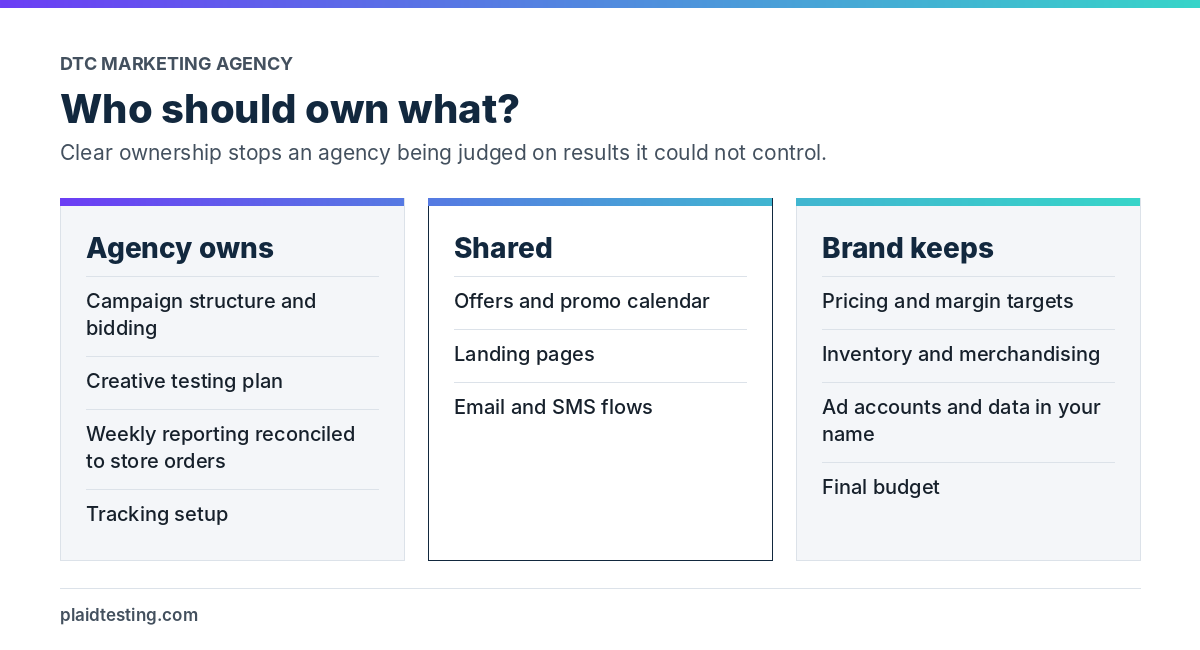
Most agency disputes we see start with a blurry line between the agency’s job and the brand’s. Write the split down before the first invoice. Here is the version we use.
Agency owns:
- Campaign structure and bidding.
- Creative testing plan: what gets tested, in what order, and how a winner is called.
- Weekly reporting and reconciliation to store orders.
- Tracking setup, documented so the next team can follow it.
Shared:
- Offers and promo calendar: the brand decides, the agency needs it early enough to build creative.
- Landing pages: the agency proposes and tests, the brand approves.
- Email and SMS flows: they convert the traffic the ads buy.
Brand keeps:
- Pricing and margin targets.
- Inventory and merchandising.
- Ad accounts and data in the brand’s name.
- Final budget.
The agency should own the work it does daily and can be measured on. Shared items need both sides, because an offer the agency did not know about, or a landing page changed without warning, breaks a test. The brand keeps whatever decides whether the business makes money or survives a change of vendor. An agency that asks to own anything on that last list is asking for a hold over you at renewal.
Why Should One Team Own the Cross-Channel Budget?
The most expensive gap in a split setup is the budget call between channels. If one agency runs Meta and another runs Google, each is judged on its own platform and has little reason to recommend moving money to the other.
A women’s fashion brand we work with shows why. Comparing January to August 2026 with the same months of 2025, Google spend rose 399% to $311K alongside Facebook spend of $829K, up 56%, while new-customer CPA fell from $86 to $67. By our arithmetic from the same report, Google went from about one dollar in ten of those two channels’ combined spend to more than one in four. One team reviews both channels each week against the same new-customer numbers.
What this does not prove: these are store-wide Triple Whale figures that blend every channel, there was no holdout test, and product and merchandising changes also moved results over the same period. We cannot say how much of the CPA drop the budget shift caused. The point is ownership: a shift that size is hard to make when Meta and Google sit with different vendors.
That is why we run paid media management as one cross-channel budget, judged on margin rather than each platform’s ROAS. If you are weighing us, that page sets out how we work. Whoever you hire, ask who makes this call and how often.
How Much Does a DTC Marketing Agency Cost?
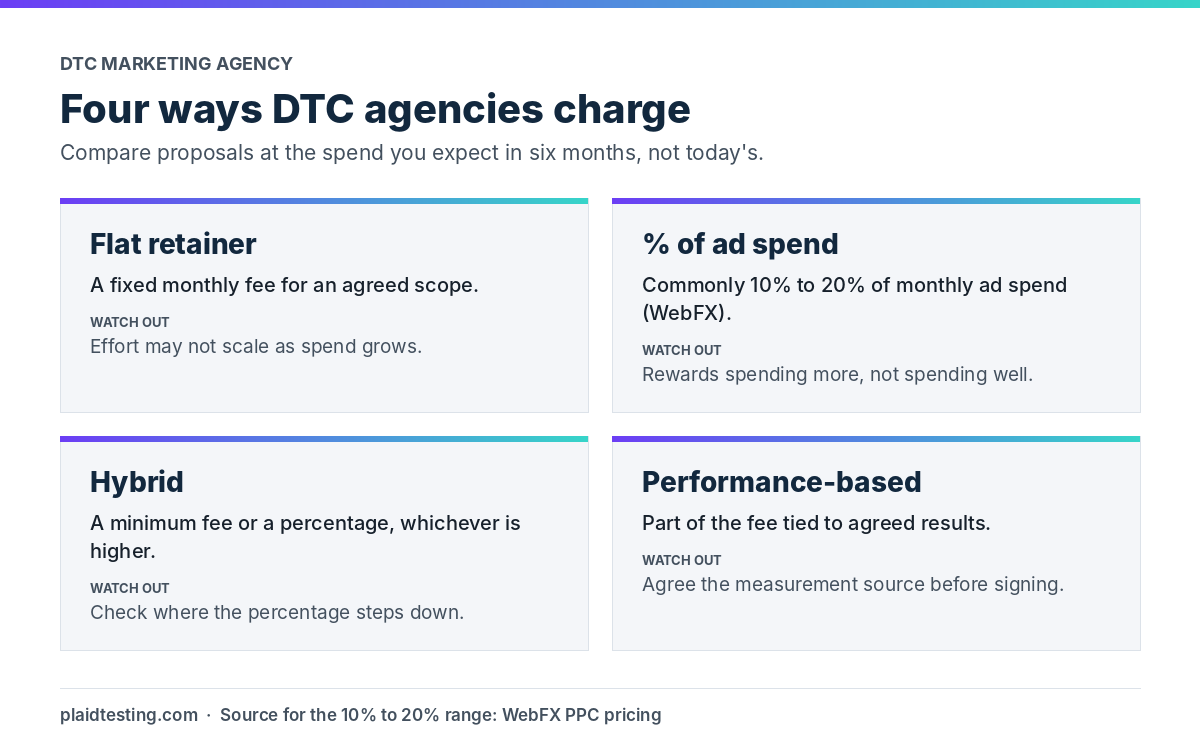
DTC agencies price in four ways. Published rates are scarce: none of the eight outside agencies compared below publishes a fee, so outside benchmarks are the best guide.
WebFX puts typical paid media management at 10% to 20% of ad spend, or around $1,000 to $3,000 a month for smaller accounts, and its own tiers charge the higher of $975 or 15% of spend, or the higher of $4,500 or 12% (WebFX, September 2026). Clutch’s review data puts the average PPC engagement at $7,165 a month (Clutch, September 2026). For the leadership layer, ecommerce fractional CMOs on GoFractional ask an average of $209 an hour (GoFractional, November 2026).
| Model | How it works | Works when | Watch out |
|---|---|---|---|
| Flat retainer | Fixed monthly fee for an agreed scope | Spend and scope are stable | Fee stays flat while the work triples |
| Percentage of ad spend | Fee is a share of media spend, typically 10% to 20% | Spend is growing and workload with it | The agency earns more when you spend more, efficient or not |
| Hybrid | Minimum monthly fee or a percentage of spend, whichever is higher | Spend swings with seasons and launches | Check where the crossover sits at your planned spend |
| Performance-based | Part or all of the fee tied to results such as new-customer CPA | Tracking is clean and both sides trust one report | Disputes over which numbers count; prospecting cut to hit target |
Run every quote at your real spend. At $100K a month in ads, a 12% fee is $12,000 a month before creative production or software. Our breakdown of agency fees by service and spend level lists those extras.
9 DTC Marketing Agencies Compared
How we built this list: we kept agencies that appear for DTC agency searches and whose own sites describe ecommerce or DTC work, then checked each fact on that site in November 2026. Nobody paid to be included, and results are as each firm reports them. Listed by type, not ranked. For leadership without execution, see our roundup of fractional CMO companies.
Darkroom
Darkroom calls itself “the first AI-native advertising agency,” covering paid media, creative, retention, Amazon, AI search and Shopify builds. Best for multi-channel consumer brands, typically $10M to $500M in revenue per its site. Watch out: it says the fit is poor for single-channel brands and companies under roughly $5M.
Common Thread Collective
Common Thread Collective calls itself an “ecommerce profit partner.” Its Prophit Engine pairs software with a dedicated Prophit Engineer, alongside Meta, Google, TikTok Shop and creative work. Best for brands that plan around a profit forecast. Watch out: no pricing or size threshold is published.
Pilothouse
Pilothouse, in Victoria, British Columbia, says it is “built for established, ambitious DTC ecommerce brands,” covering paid media, creative, email and SMS, CRO and Amazon. It mixes monthly retainers, performance incentives and project scopes. Watch out: agree any incentive’s metric and report in writing.
Tinuiti
Tinuiti is a media agency spanning Amazon and retail media, streaming TV, social, search and affiliate, with its own Bliss Point platform for incrementality and media mix modeling. Best for brands with heavy Amazon or TV spend. Watch out: ask which team, core or its midsize Foundation offering, would run your account.
Hawke Media
Hawke Media markets itself as “Your Outsourced CMO,” says it has grown over 6,000 brands, and sells about two dozen services à la carte. Best for brands buying several services from one vendor. Watch out: it serves all sizes and industries, so ask how much senior time your account gets.
Disruptive Advertising
Disruptive Advertising runs paid search and social, SEO, Amazon, CRO and lifecycle work, and lists ecommerce among its segments. It reports $450M+ in annual managed ad spend, no long-term contracts, and a 90-day growth guarantee for “qualifying brands.” Watch out: get that qualification in writing.
Linear
Linear, with offices in Miami, London and Dubai, says it has worked with 200+ eight and nine figure DTC brands, focusing on performance creative and paid social and search. It charges a creative retainer plus a percentage of ad spend. Watch out: model both fee lines at your planned spend.
Homestead Studio
Homestead Studio focuses on DTC acquisition and retention: paid social, paid search, email and SMS, and landing pages. Best for brands wanting acquisition and repeat purchase under one team. Watch out: it is now part of Verndale, so confirm who staffs your account.
Plaid Testing
Disclosure: this is us. Plaid Testing, in West Hollywood, pairs fractional CMO leadership with a team running paid media on Meta, Google, TikTok and Snapchat, plus tracking, for US ecommerce brands spending $50K+ a month on ads. Watch out: below about $50K a month we are not the right fit, and Amazon and PR sit outside our services.
| Agency | Type | Best for | Services | Published pricing? |
|---|---|---|---|---|
| Darkroom | Full-stack | $10M to $500M multi-channel brands | Media, creative, retention, Amazon, Shopify | No |
| Common Thread Collective | Full-stack, forecast-led | Profit-forecast planning | Meta, Google, TikTok Shop, creative | No |
| Pilothouse | Full-stack | Established DTC brands | Media, creative, email and SMS, CRO | Model only |
| Tinuiti | Full-stack media | Heavy Amazon or TV spend | Retail media, TV, social, search | No |
| Hawke Media | Full-service | À la carte services | Media, SEO, PR, Amazon, lifecycle | No |
| Disruptive Advertising | Full-service | No long-term contract | Search, social, SEO, Amazon, CRO | No; 90-day guarantee |
| Linear | Channel specialist | Creative volume | Creative, paid social and search | Model only |
| Homestead Studio | Acquisition and retention | Acquisition plus repeat purchase | Social, search, email and SMS | No |
| Plaid Testing (us) | Fractional CMO plus execution | $50K+ monthly ad spend | Leadership, paid media, tracking | No |
DTC Marketing Agency vs In-House Team: Which Fits?
The in-house question is less about cost than about which decisions you want inside the building. An in-house buyer hears about the stockout before the ads keep spending on it. An agency brings pattern recognition from many accounts and a bench when someone leaves.
Large advertisers keep building internal teams, and the role is moving upstream: in the ANA’s 2026 State of In-Housing report, 53% agreed the primary role of an in-house agency is to act as a strategic partner (ANA, June 2026). DTC brands rarely have that headcount, so the split usually lands in one of three places.
- Mostly in-house: a strong head of growth and one or two buyers, with creative or specialist help bought by project.
- Agency-led: no senior marketer in-house, spend in one or two channels, and a founder who reviews weekly reports.
- Fractional leader plus execution: spend large enough that allocation, forecasting and hiring need a senior owner, but not yet a full-time CMO.
Whichever you pick, the ownership split above still applies. For salaries and overhead, see the full in-house vs agency cost comparison.
What Should You Ask a DTC Agency Before You Sign?
Sales calls are rehearsed. These questions get past the deck to how the account will actually run.
- Who works on our account each week, by name and seniority, and how many other accounts do they carry?
- Which report do you reconcile platform numbers to, and how often?
- Which attribution tool will you report from, and who pays for it? If it is new to you, read up on choosing the attribution tool your agency reports from first.
- What is your creative testing cadence, and who produces the assets?
- How do you decide when to move budget between channels?
- What do you need from us each week: margins, inventory, promo dates?
- What happens to our accounts, data and creative files if we leave?
- Can we speak to a current client at a similar spend level?
Vague answers to questions two, three and seven are the clearest warning signs: they decide whether you can judge the work and leave cleanly. Ask for the answers in the written proposal, so the contract can point back to them.
Which Contract Terms Protect a DTC Brand?
Four clauses do most of the work. Ask for them in the first draft, not at renewal.
- Accounts in your name. Ad accounts, pixels, analytics, store and email platform should sit in the brand’s own business accounts, with the agency added as a partner or user. On Google, linking your account to an agency’s manager account leaves your account and its history unchanged, and the manager does not get administrative ownership by default (Google Ads Help, November 2026).
- Creative file ownership. You should receive source files, not just exported ads: raw footage, project files and usage rights for creator content, with how long those rights last.
- Notice period. Know how many days’ notice ends the contract and what is billed during it. Disruptive Advertising advertises no long-term contracts and we require no lock-in, so a long minimum term is worth negotiating.
- Which report settles disputes. Name the source of truth, such as store orders or a specific attribution tool, and the metric. Any performance fee should be calculated from that report alone.
None of these terms is hostile. A good agency will agree to all four quickly.
Common Questions
What does a DTC marketing agency do?
A DTC marketing agency plans and runs paid acquisition for brands that sell direct to consumers, usually on Meta, Google and TikTok. Most also produce or brief ad creative, set up tracking and report results against store orders. Full-stack agencies add email and SMS, landing pages, conversion work and sometimes Amazon, while channel specialists focus on one or two platforms.
How much does a DTC marketing agency charge?
Most charge a flat retainer, a percentage of ad spend, a hybrid of the two, or a fee tied to results. WebFX puts typical paid media management at 10% to 20% of ad spend, and Clutch’s review data shows an average PPC engagement of about $7,165 a month. Creative production and attribution software are often billed on top.
Is it better to hire a DTC agency or build an in-house team?
It depends on who owns strategy. With a strong head of growth in-house, specialists or project help may be enough. Without senior marketing leadership, an agency or a fractional CMO plus execution team usually costs less than hiring several people. In every setup, the brand should keep the ad accounts, data, margins and final budget.
Who should own the ad accounts when you work with an agency?
The brand should. Ad accounts, pixels, analytics and email platforms should sit in the brand’s own business accounts, with the agency given partner or user access. That way your account history, audiences and data stay with you if the relationship ends, and a new agency can start without rebuilding from scratch.
What is the difference between a DTC agency and a fractional CMO?
A DTC agency executes: it runs campaigns, creative and reporting. A fractional CMO is a part-time senior leader who owns the plan, budget, channel mix and hiring decisions. Some firms combine both, pairing fractional leadership with a team that runs paid media, so the person deciding the budget also sees the account-level results every week.
Book a free 30 minute growth audit and we will review your tracking, account structure and the three fixes we would make first, whether you hire us, another DTC agency or neither.
Related Reading
- Performance-Based Marketing Agency: how results-based fees work and where they go wrong.
- Digital Media Buying Agency vs Freelance Media Buyer: the next choice if you only need execution.
- How to Hire a Fractional CMO: Questions and Terms: the leadership side of the same decision.
- Ecommerce Attribution: Models, Tools and What to Trust: what to settle before you agree on a source of truth.
- NC-ROAS: How to Calculate New Customer ROAS: a fair metric to hold any agency to.