

Snapchat ads for business are full screen vertical ads that run in Stories and Spotlight, land in the Chat inbox as Sponsored Snaps, or are built from a product catalog. For an ecommerce brand spending $50K+ a month, Snapchat is a prospecting test: worth running once tracking and catalog are clean, and judged on blended new customers.
Who can a business reach on Snapchat in 2026?
Snapchat had 493 million daily active users in the second quarter of 2026, up 5% year over year, and 971 million monthly active users (Snap, 3 August 2026). For a US brand the regional split matters more than the total. North America held 92 million of those daily users, down 7%, while Europe had 98 million and the rest of the world 303 million, according to the same Snap results of 3 August 2026, so the worldwide growth came from outside the market a US apparel or lifestyle brand sells into.
The money moves the other way. North American revenue per user reached $10.26 for the quarter, up 23%, against $3.25 worldwide (Snap, 3 August 2026). Snap’s 10-Q attributes its second quarter advertising revenue growth to a rise of approximately 10% in the average cost per advertising impression, with first half impressions up about 8% on Sponsored Snaps delivery (Snap Form 10-Q, filed 4 August 2026). Fewer North American users, each worth more to Snap, means more advertiser money chasing the same attention, although Meta’s 12% rise in average price per ad over the same quarter (Meta, 29 July 2026) suggests the increase belongs to a wider rise in social ad prices.
The audience is also older than its reputation: Snap’s prepared remarks for the quarter say its US audience growth is led by people aged 35 and older (Snap, 3 August 2026). It is also a supplement, not a substitute: Meta averaged 3.60 billion daily active people across its apps in June 2026 (Meta, 29 July 2026), so Snapchat’s job in a plan is to reach people the other channels miss. What higher North American prices do to a test budget is worked through in our Snapchat ads cost benchmarks and test sizing math.
What types of Snapchat ads are there?
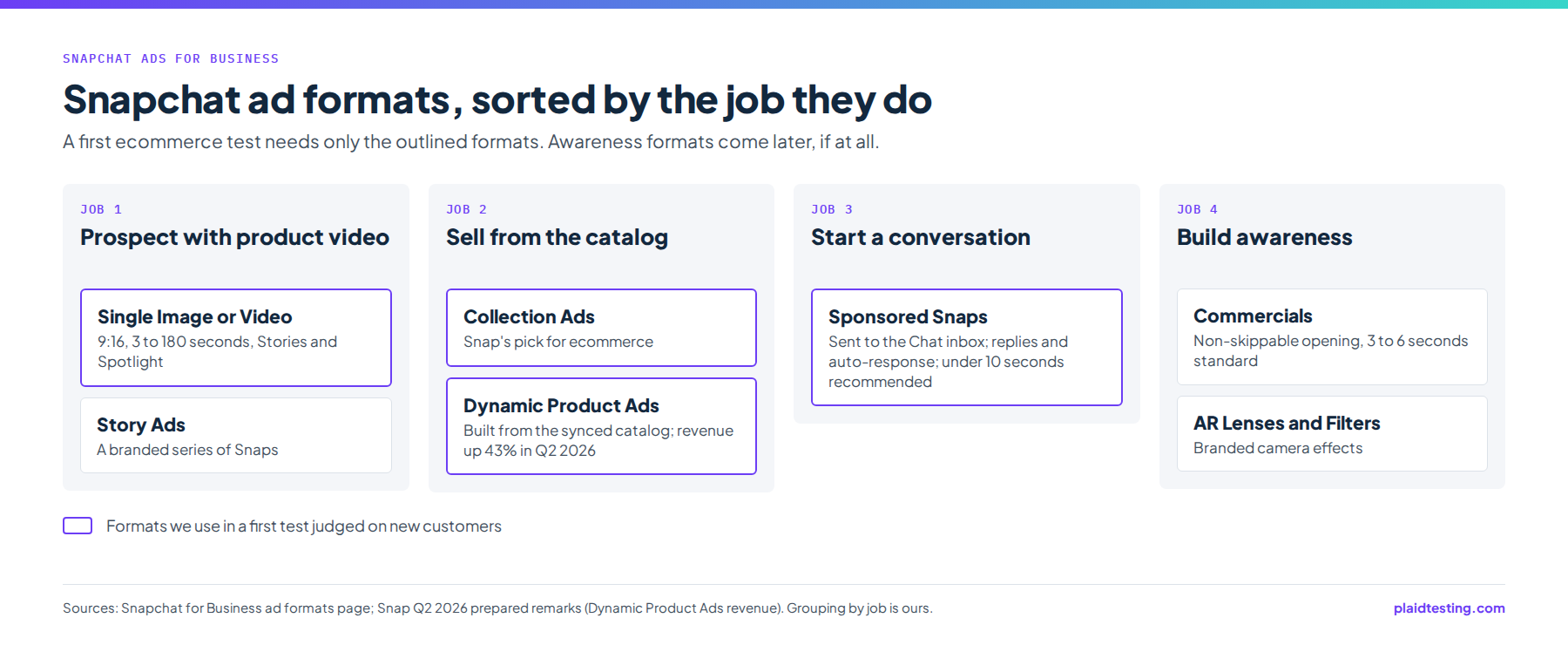
Snapchat for Business lists Sponsored Snaps, Single Image or Video Ads, Story Ads, Collection Ads, Commercials, and AR Lenses and Filters on its ad formats page, and Snap’s Shopify app adds catalog-driven dynamic ads. Sorting Snapchat ad formats by the job they do is more useful than learning the list, because a first test needs only a few of them.
Prospecting with product video is the first job. Single Image or Video Ads are full screen 9:16 units of 3 to 180 seconds that show in Stories and Spotlight, and Snap’s advice is direct: “If you’re just starting out, we recommend a single image or video ad” (Snapchat for Business). Catalog selling is the second job. Snap labels Collection Ads as best for ecommerce advertising, and Dynamic Product Ads build each ad from the synced catalog. Snap credited wider retailer adoption for 43% growth in Dynamic Product Ads revenue in the second quarter (Snap, 3 August 2026), a sign of where retail budgets are going rather than of the returns they earn.
Chat is the third job. Sponsored Snaps send a Snap directly to the audience, who can reply, and brands can turn on an auto-response; they run up to 180 seconds, with under 10 recommended (Snapchat for Business). Snap says roughly one third of the Snapchatters reached this way were incremental to its other surfaces (Snap, 3 August 2026), a reach figure inside Snapchat, not a sales result. Awareness is the fourth job: non-skippable Commercials and AR Lenses and Filters suit a launch with a reach goal and rarely belong in a test judged on purchases.
| Format | What it is | Length and spec | Best job | Ecommerce fit |
|---|---|---|---|---|
| Single Image or Video | One full screen image or video in Stories and Spotlight | 9:16, 720×1280; .mp4, .mov, .jpg or .png; 3 to 180 seconds; brand name up to 25 characters, headline up to 34 | Prospecting with product video | High: Snap’s suggested first format |
| Story Ads | A branded series of Snaps under one entry | Not detailed on the formats summary; confirm in Ads Manager before building | Showing a range or a drop across several Snaps | Medium: suits collections and launches |
| Collection Ads | A lead image or video with products to browse | Not detailed on the formats summary | Product discovery | High: Snap’s own pick for ecommerce |
| Dynamic Product Ads | Ads assembled from the synced product catalog | Catalog synced through the Snapchat Ads app for Shopify | Retargeting product viewers and catalog prospecting | High: revenue up 43% in Q2 2026 on retailer adoption |
| Sponsored Snaps | A Snap sent to the Chat inbox, with replies and an optional auto-response | Up to 180 seconds; under 10 recommended | Launches, offers and conversation | Medium to high: test beside single video |
| Commercials | Video with a non-skippable opening | Standard 3 to 6 seconds; Extended Play 7 to 180 seconds, first 6 non-skippable | Reach and awareness | Low for a test judged on purchases |
| AR Lenses and Filters | Branded camera effects that users apply | Not detailed on the formats summary | Awareness and product play | Low to medium: launch support |
Specs in the table come from Snapchat for Business’s formats page, the catalog route from the Shopify App Store listing for the Snapchat Ads app, and the 43% figure from Snap’s Q2 2026 prepared remarks.
How does Snapchat ads targeting work?
Snapchat ads targeting works in three layers, set out on Snapchat for Business’s targeting page. Standard targeting covers location and demographics such as age, gender and language. Custom Audiences come from an uploaded list of existing customers’ emails or phone numbers, or from a Pixel Custom Audience once the Snap Pixel is installed. Lookalikes start from either source and find more people similar to the customers in it.
In the accounts we run, prospecting starts broad: the country and language the brand ships to, a lookalike seeded from the best customers, and little else. Snap’s delivery system needs room during its Exploration Phase, which typically lasts four days or more depending on the objective (Snapchat for Business), and stacked demographic filters take that room away before it has learned anything.
Exclusions matter more than any targeting choice. Exclude the uploaded customer list from prospecting, or Snapchat can find existing customers cheaply, count their repeat orders as conversions and make prospecting look stronger than it is. Retargeting through Pixel Custom Audiences belongs mostly to Dynamic Product Ads, in a campaign of its own, so people already in the checkout do not pad the prospecting numbers.
A lookalike copies whoever is in the seed, so a list of repeat or high order value buyers beats every email the store has ever collected. Since people 35 and older are leading Snap’s US audience growth (Snap, 3 August 2026), an age cap built on Snapchat’s teenage reputation can shut out real buyers; let purchase data show which ages convert. Location targeting also makes a regional holdout possible, which the test design below depends on.
If you want Snapchat built this way, with existing customers kept out of prospecting and every format read on the same blended numbers as Meta and Google, see how we set up and test Snapchat ads for ecommerce brands.
How should an ecommerce business set up Snapchat ads?
Set up Snapchat in the order delivery depends on it: signal, catalog, audiences, then budget. For a Shopify store the starting point is Snap’s Snapchat Ads app, which its Shopify App Store listing says can “Install the Snap Pixel in one click” and “Sync your product catalog to create dynamic ads”. The same Shopify App Store page shows it free to install, launched on 20 November 2018 and rated 4.6 from 699 reviews. It handles the browser pixel and the catalog. It does not prove that purchases reach Snap accurately.
Server events close that gap. Snap’s developer docs describe the Conversions API as a server-to-server integration for web, app and offline events and recommend that web advertisers run it alongside a Pixel integration. With both running, one purchase can reach Snap twice, and deduplication matches unique events so it counts once. Before budget goes live we check that purchases arrive from both sources, that duplicates are removed, and that Snap’s purchase count and order values agree with Shopify’s orders for the same days. That check sits at the center of our tracking and attribution service, and skipping it trains Snap’s delivery on a distorted record of who buys.
Then the catalog: confirm that titles, images, prices and stock status arrive as the store shows them, because Dynamic Product Ads and Collection Ads can only show what the feed holds. Budget comes last. Snapchat for Business sets a $5 daily minimum and recommends at least $20 to $50 a day so delivery can complete the Exploration Phase; for a brand spending $50K+ a month those are floors, not a test budget.
| Setup item | What to set | Owner | Why it matters |
|---|---|---|---|
| Snap Pixel | Install through the Snapchat Ads app for Shopify; confirm purchase events fire with order values | Ecommerce or web lead | Feeds delivery and builds Pixel Custom Audiences |
| Conversions API | Send purchase events server to server alongside the Pixel | Tracking lead or developer | Snap’s recommended pairing for web advertisers |
| Deduplication check | Confirm each order counts once and matches Shopify’s order count and value | Tracking lead | Stops double counting from inflating reported results |
| Catalog sync | Sync products through the Shopify app; audit titles, images, prices and stock | Ecommerce manager | Dynamic Product Ads and Collection Ads show only what the feed holds |
| Customer list | Upload emails or phone numbers as a Custom Audience; exclude it from prospecting | Retention or CRM owner | Keeps prospecting spend on people who have not bought |
| Lookalikes | Seed from best customers or a Pixel Custom Audience of buyers | Paid media lead | Gives broad prospecting a stronger starting point |
| Budget | At least $20 to $50 a day; $5 a day is the floor | Paid media lead with finance | Below the recommendation, delivery may not finish the Exploration Phase |
| Baseline | Record blended new customers and acquisition cost for the weeks before launch | Head of growth | Without it, the test has no fair point of comparison |
The pixel and catalog rows follow the Shopify App Store listing, the Conversions API rows follow Snap’s developer docs, and the budget row uses Snapchat for Business’s pricing page.
Are Snapchat ads worth it for an ecommerce business?
The strongest evidence for Snapchat comes from Snap, so every figure needs its label. Snap’s own claim is that Sponsored Snaps “already drive 22% more conversions with nearly 20% lower cost per action” than other inventories (Snap Newsroom, 28 April 2026). Snap’s business blog summarized Triple Whale research from February to May 2025, built on about 20,000 advertisers and about $3 billion of ad spend, and reported that Snapchat’s ROAS improved 7.5% while most platforms declined and that apparel advertisers held the highest ROAS across platforms (Snapchat for Business blog, 17 July 2025): Triple Whale data, selected and published by Snap.
Snap’s Q2 2026 prepared remarks also cite a Measured study, which Snap chose to publish, finding approximately 19.3% higher incremental return on ad spend than blended social advertising (Snap, 3 August 2026). A Kantar study run with Snap found that chat-tab ads capture 1.6x more passive attention, and that Sponsored Snaps, once opened, produced 2.3x more lift in unaided brand awareness and 1.8x more lift in purchase intent than other social platforms (Kantar, 6 October 2025); those are brand lift results, not sales. The table shows what each piece of evidence can and cannot settle.
| Evidence | Who measured and published it | What it measures | What it cannot tell you |
|---|---|---|---|
| Sponsored Snaps conversions and cost per action | Snap, about its own inventory | Conversions Snap attributes to the format, compared with other inventories | Whether those buyers were new to your brand |
| ROAS trend and apparel ROAS across platforms | Triple Whale data, summarized and published by Snap | Reported ROAS across many advertisers in early 2025 | How Snapchat will perform against your margin in your category |
| Incremental return on ad spend | Measured, published by Snap | Incrementality compared with blended social advertising | Whether the result holds for an account of your size and mix |
| Attention and brand lift | Kantar, in a study run with Snap | Attention, unaided awareness and purchase intent | Any effect on orders or revenue |
| Incremental reach of Sponsored Snaps | Snap | People reached who were not reached by other Snapchat surfaces | Whether they sat outside your Meta, Google and TikTok reach |
The stronger case for a test often comes from the customer mix. At one athletic apparel brand we work with, returning customers’ share of June revenue rose from about 39% in June 2025 to about 44% in June 2026, per its Triple Whale account. Read it with care: the figure is blended across all channels rather than tied to Snapchat, it has not been through an incrementality test, and product and merchandising choices shaped it alongside media. It is good news for retention and also a warning, since a brand whose revenue leans more on people who already know it needs channels that find new buyers. Finding them is what a Snapchat test is for.
Snapchat fits brands whose products read well in short vertical video, such as apparel, accessories and lifestyle goods, with stable Meta and Google programs, clean tracking and a steady supply of 9:16 creative. Brands already making creator video for TikTok can recut it, and how TikTok’s creator-led Spark Ads work is the closest comparison. Snapchat is a poor fit while core channels or measurement are unsettled, because a new channel fixes neither.
How should you test Snapchat before scaling it?
A fair test answers one question: did the business gain new customers it would not otherwise have won, at a cost its margin can carry? Snapchat’s dashboard cannot settle that alone, because like every platform it credits itself with the conversions it sees. When Haus asked 500 senior US decision makers which measurement they trust most, 60% chose independent incrementality testing and 37% chose in-platform reporting (EMARKETER, 19 May 2026). A regional holdout is the practical version of that test for a channel this size.
The design we use for a new channel runs in a fixed order:
- Record blended new customers, new customer acquisition cost and revenue divided by total ad spend for the weeks before launch.
- Confirm the Pixel and Conversions API are deduplicated and match Shopify orders.
- Brief a first batch of 9:16 creative: proven concepts recut for Snapchat plus a few made for it, with the product on screen from the first frame.
- Run prospecting (single video and Sponsored Snaps, broad targeting, customers excluded) apart from Dynamic Product Ads retargeting.
- Hold out a set of regions with location targeting, so regions with Snapchat can be compared against regions without it.
- Fix the spend, the end date and the success threshold on paper before launch.
- Read blended new customers after the Exploration Phase and several full weeks, never on the first days of delivery.
Timing matters for a brand planning in late September 2026. A test launched in October can run into Black Friday and Cyber Monday, when promotions and heavier spend everywhere move blended numbers at once and bury any Snapchat effect. Finish the read before peak promotions or start after them, using the BFCM 2026 paid media calendar to find the quieter windows. A passing test earns budget in steps while blended new customer acquisition holds, and from then on it competes for every dollar inside paid media managed as one plan across every channel. A failing test stops on the agreed date.
Every platform that grades its own results deserves the same treatment, as our review of GMV Max on TikTok Shop shows, and reconciling platform claims with store data is a standing job. It is also the rule behind our Snapchat ads management for ecommerce brands: Snapchat keeps budget only by adding customers the rest of the plan was not reaching.
Before Snapchat takes budget from channels that already work, a free 30 minute growth audit checks your Pixel and Conversions API, your catalog and your new customer trend, then tells you whether a Snapchat test belongs before peak season or after it. Book your free 30 minute growth audit
Common questions
What types of Snapchat ads can a business run?
Snap’s format list covers Story Ads, Collection Ads, full screen Single Image or Video Ads, Sponsored Snaps delivered to Chat, non-skippable Commercials, and AR Lenses and Filters, and Shopify retailers can add Dynamic Product Ads from a synced catalog. A first ecommerce test rarely needs more than single video, Dynamic Product Ads and Sponsored Snaps; Commercials and AR suit awareness goals.
Can you run Snapchat ads from a Shopify store?
Yes. Snap publishes a Snapchat Ads app on the Shopify App Store that installs the Snap Pixel in one click, syncs the product catalog for dynamic ads and costs nothing to install. The app covers the pixel and the catalog. It does not confirm that every purchase reaches Snap once and with the right value, so compare Snap’s purchase count with Shopify’s orders before spending at scale.
Do business Snapchat ads need the Conversions API if the Snap Pixel is installed?
Yes. Snap recommends that web advertisers run the Conversions API alongside the Pixel rather than choosing one. The Pixel reports from the shopper’s browser, the Conversions API sends events from server to server, and deduplication stops an order that arrives through both routes from being counted twice. Without the server route, Snap learns from an incomplete record of who bought.
Can Snapchat ads targeting reach buyers over 35?
Yes. Snap’s Q2 2026 prepared remarks credit people aged 35 and older with leading the growth of its US audience. That does not make Snapchat right for every older customer base, but it does mean age caps based on the app’s teenage reputation can exclude real buyers. Start broad with lookalikes, then check which age groups bought once the test has run.
Related reading
- Snapchat Ads Cost in 2026: Benchmarks, Minimums and How to Size a Test: budget floors, benchmarks and the math for sizing a test
- TikTok Spark Ads: How They Work, Codes and Costs: the creator-led vertical format to weigh against Snapchat
- Ecommerce Attribution: Models, Tools and What to Trust: reading a channel test against the store’s own numbers
- BFCM 2026 Paid Media Calendar for Ecommerce Brands: timing a Snapchat test around peak season
- Instagram Reels Ads: Specs, Safe Zones and What Works for Ecommerce Brands: the Meta placement built on the same vertical video