
The best Meta ads agency for an ecommerce brand is the one that keeps the ad account in your name, commits to a monthly creative volume in writing, and reports new-customer CPA from your store, not Ads Manager ROAS. Below are eight agencies compared on Meta focus, ecommerce fit and published pricing, with Plaid Testing included and labeled.
Meta is getting more expensive to buy. In the third quarter of 2026, Meta’s average price per ad rose 14% year over year while ad impressions grew 10% (Meta Q3 2026 earnings release, October 2026). The agency fee sits on top of that media cost: on a $150K monthly Meta budget, the gap between a 10% and a 15% fee is $90,000 a year.
This guide covers how we chose, what a Facebook ads agency should do for a store, eight agencies with published pricing, fee arithmetic, six checks before signing, the weekly report to demand, and the in-house alternative.
How We Chose These Meta Ads Agencies
We built this list from what each agency publishes on its own website, checked in November 2026. We have not worked with any of them, and none paid to appear. Four filters applied.
- Published services: The agency describes a Meta or Facebook ads service on its own site, not just “social media.”
- Ecommerce focus: It names ecommerce, DTC or retail as a client focus, or shows catalog and shopping work.
- Meta specialism: Meta is the core of the offer or a clearly scoped service line, not one logo among twenty.
- Pricing transparency: We record exactly what each agency publishes about fees, including when it publishes nothing.
We dropped agencies whose Meta service we could not confirm on their own pages, and left out the large full-service ecommerce agencies, where Meta is one channel among many. If you want a full-service partner, our guide to choosing a DTC marketing agency is the better starting point.
Client results on agency sites are self-reported, so we leave them out, and partner status is reported as each agency’s claim. Plaid Testing appears once, marked as us. For the multi-platform view, read our piece on hiring a paid social agency for ecommerce.
What Should a Meta Ads Agency Do for an Ecommerce Brand in 2026?
A Meta ads agency for a store has four jobs. A proposal that skips one is a media buying proposal, not a Meta program.
Account structure. Fewer, larger campaigns give Meta enough purchase data to learn from. The agency should make deliberate Advantage+ choices and set exclusions or caps so prospecting budget is not spent on existing customers. Ask to see the structure before launch.
Creative volume and testing. Creative now does most of the targeting work on Meta, so good agencies commit to a number of new ads per month. Volume alone is not enough; you also need a creative testing system with written kill and scale rules, so each test answers one question.
Conversions API and data setup. Meta describes its Conversions API as a connection from an advertiser’s server, website platform, app or CRM to the systems that optimize targeting, decrease cost per result and measure outcomes (Meta for Developers, November 2026). The agency should confirm events are deduplicated against the pixel and that purchase values match the store.
Reconciliation to store orders. Meta counts purchases inside its attribution window; your store counts orders. Each week the agency should line up Meta-reported purchases against Shopify orders and new-customer orders. The attribution window you report on changes that count, so agree on one setting at the start and keep it.
Best Meta Ads Agencies for Ecommerce: 8 Compared
Grouped from Meta-led specialists to broader agencies, not ranked. Facts come from each agency’s own site.
Flighted
Flighted is a Meta-led performance agency for DTC and B2B SaaS brands that says it is a Meta Business Partner. Best for ecommerce brands spending $25K+ a month that want a fixed fee: a flat retainer from $5,000 a month, no percentage of spend, 50+ new ads a month included. Watch-out: UGC creator fees are billed on top.
Pilothouse
Pilothouse is a full-funnel performance agency “built for established, ambitious DTC ecommerce brands,” buying on Meta, Google, TikTok and Amazon, offering creative production and showing a Meta Business Partner badge. Best for established DTC brands wanting media and production together. Pricing is not published; it mixes retainers with performance incentives. Watch-out: ask whether incentives key off store revenue or platform numbers.
inBeat
inBeat is a creative growth agency whose Meta service covers structure, creative production, testing, catalog ads and Pixel and Conversions API setup. It shows a Meta Business Partner badge and does not publish pricing. Best for brands whose bottleneck is creator and UGC volume. Watch-out: it serves many verticals, so ask for ecommerce references at your spend.
The Social Shepherd
The Social Shepherd is a social-first agency with UK and US offices whose Facebook ads service is “focused on eCommerce, direct to consumer & B2C brands.” Best for brands selling in both markets that want paid, organic and influencer work from one team. Pricing and partner status are not published there. Watch-out: confirm which office and senior buyer will run a US account.
AdvertiseMint
AdvertiseMint says it specializes in Facebook and Instagram advertising and is listed in the Meta partner directory. It is the most open on price here: 25% of spend from $10,000 a month, stepping down to 20%, 15%, 10% and 5% above $1M, with no setup fee. Best for brands that want a public rate card. Watch-out: its pricing page says month-to-month, its Facebook ads page mentions a 3 month initial commitment, so get the term in writing.
Plaid Testing (Disclosure: this is us)
Plaid Testing is Jason Lu’s firm: fractional CMO leadership plus hands-on Meta, Google and TikTok execution for ecommerce brands spending $50K or more a month, and a Meta Business Partner. Best for brands where Meta is the largest line and one senior operator should own plan and account. Here is how we run Meta ads for ecommerce brands, judged on blended new-customer CPA and MER. Watch-out: pricing is not published, we do not produce creative (your creators work from our briefs), and we are not a fit under about $50K a month.
KlientBoost
KlientBoost is a performance agency covering PPC, Facebook, LinkedIn, SEO and CRO, with Facebook ads for “eCommerce, SaaS, or lead-gen” campaigns. Best for smaller stores wanting Meta plus landing page work; it takes budgets from $5,000 a month and charges a percentage of spend or a flat fee, case by case. Watch-out: it is not ecommerce-specific and that page states no Meta partner status.
Homestead Studio
Homestead Studio is a DTC growth agency whose paid social team builds direct response ads aimed at first-purchase profitability, alongside paid search, email and SMS. Best for DTC brands that want paid social and retention planned together. Pricing and partner status are not published. Watch-out: it is now part of Verndale, so ask who your day-to-day team will be.
| Agency | Best for | Meta focus | Pricing as published |
|---|---|---|---|
| Flighted | Ecommerce brands at $25K+/mo wanting a fixed fee | Core service; 50+ new ads a month included | Flat retainer from $5,000/mo; no % of spend; $25K/mo spend minimum |
| Pilothouse | Established DTC brands wanting media plus production | One of four buying channels | Not published; retainers plus performance incentives |
| inBeat | Creator and UGC-led brands | Full Meta service incl. CAPI and catalog ads | Not published |
| The Social Shepherd | UK and US brands wanting paid plus organic | Dedicated Facebook ads service | Not published |
| AdvertiseMint | Brands wanting a public rate card | Says Facebook and Instagram is its specialism | 25% down to 5% of spend by tier; $10K/mo minimum |
| Plaid Testing (us) | $50K+/mo brands where Meta is the largest line | Meta, Google and TikTok under one fractional CMO plan | Not published |
| KlientBoost | Smaller stores wanting Meta plus CRO | One of several paid channels | % of spend or flat fee, case by case |
| Homestead Studio | DTC brands pairing acquisition and retention | Paid social within an omnichannel offer | Not published |
How Much Does a Meta Ads Agency Cost?
Meta ads agencies charge a percentage of ad spend, a flat monthly retainer, or a hybrid of base fee plus percentage or bonus. WebFX puts management fees at 10% to 20% of ad spend, usually falling as spend rises (WebFX, September 2026). Flat fees are more common than founders expect: in Credo’s agency survey, 51.8% of social ads agencies offered flat-fee billing and only 11.8% billed purely on a percentage (Credo, June 2022). That survey is older background, not a 2026 benchmark.
The table below is an illustration of the arithmetic, not a quote from any agency. It shows a 10% and a 15% fee at three spend levels, next to AdvertiseMint’s published tier, the one public rate card in this list.
| Monthly Meta spend | 10% fee per month | 15% fee per month | Extra cost of 15% per year | AdvertiseMint published tier |
|---|---|---|---|---|
| $50,000 | $5,000 | $7,500 | $30,000 | 20% = $10,000/mo |
| $150,000 | $15,000 | $22,500 | $90,000 | 15% = $22,500/mo |
| $500,000 | $50,000 | $75,000 | $300,000 | 10% = $50,000/mo |
A percentage fee grows with your budget even when the work does not; going from $150K to $500K a month rarely takes three times the hours, so brands at higher spend negotiate a flat fee or a declining rate. Compare total cost at the budget you plan to run in six months, not today.
Ask what the fee covers: some agencies bundle creative, others bill creator fees, shoots or extras separately, such as AdvertiseMint’s $150 an hour for custom projects. For other agency types, see what marketing agencies charge ecommerce brands in 2026.
How to Vet a Facebook Ads Agency: Six Checks Before You Sign
Agency pitches look alike. These six checks separate the agencies that will run your account for you from those that will run it for themselves. Ask each on the first call, then put the answers in the contract.
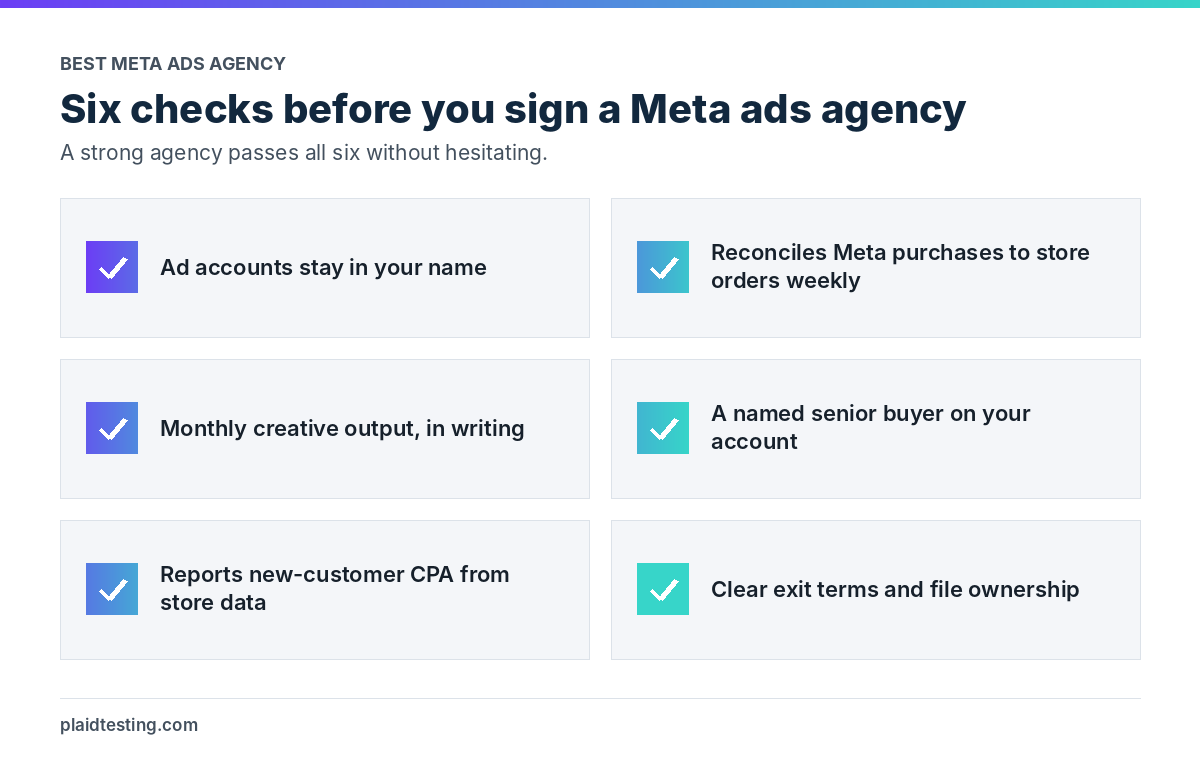
- Ad accounts stay in your name. Ad account, Business Manager, pixel and catalog belong to your business, with the agency added as a partner, so history stays when you leave.
- Monthly creative output in writing. New concepts and total ads per month, formats, and who produces them. “Ongoing creative” is not a commitment.
- Reports new-customer CPA from store data. New-customer orders come from Shopify or your attribution tool, not only from Ads Manager.
- Reconciles Meta purchases to store orders weekly. Ask for a sample. A large, unexplained gap means the account is being judged on the wrong number.
- A named senior buyer on your account. Who touches the account daily, and how many other accounts they run.
- Clear exit terms and file ownership. Notice period, minimum term, and written confirmation that you keep all creative, raw files and dashboards.
On partner status: Meta runs a Business Partners program, and its own page says partners are “vetted for excellence” (Meta, November 2026). Treat the badge as a minimum bar, not proof of fit, and ask the agency to show you its partner confirmation rather than a logo.
If you would rather run these checks against your current account first, our free Meta ads audit reviews signal, structure, creative and measurement in 30 minutes and ends with three fixes ranked by impact.
What a Weekly Meta Ads Report Should Show
The weekly report is where an agency proves it is working on your business, not just your ad account. These six items should appear every week, in the same order.
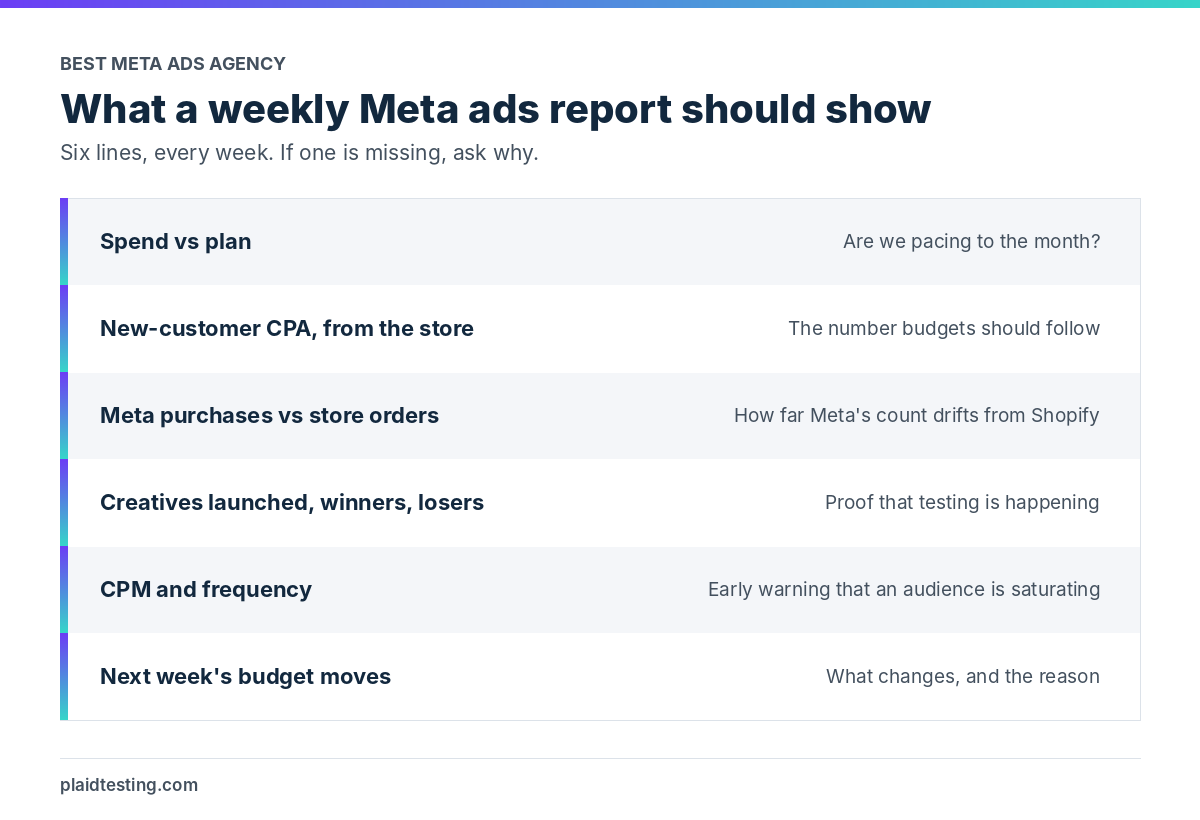
- Spend vs plan: actual against budget, with reasons for variance.
- New-customer CPA from the store: Meta spend divided by new-customer orders recorded in Shopify or your attribution tool.
- Meta-reported purchases vs store orders: both counts side by side, with the gap explained.
- Creatives launched, winners and losers: new ads live, which beat the control, which were cut.
- CPM and frequency: cost per thousand impressions and how often the same people see your ads, the early signs of fatigue.
- Next week’s budget moves: what will be scaled, cut or tested, and why.
CPM needs context: with Meta’s average price per ad up 14% in Q3, part of a rising CPM is the market, not the agency. When Meta-reported purchases look healthy but store orders fall, work through our five-step diagnosis for Facebook ads that are not converting before moving budget.
Judge the account on store-side numbers. For an athletic apparel brand we work with, June 2026 sales reached $1.73M, up from $1.36M in June 2025 (+26.9%), while blended ad spend rose only 8.6%, from $421.1K to $457.4K. Shopify blended ROAS went from 3.23x to 3.77x. Those are blended store numbers, not Ads Manager ROAS.
What they do not prove: these are store-wide Triple Whale figures that blend every channel, not Meta alone. There was no holdout test, so we cannot isolate what paid media caused, and product and merchandising changes also moved results. If you are choosing the tool that produces numbers like these, see our roundup of Triple Whale alternatives for ecommerce attribution.
Meta Ads Agency vs In-House Meta Buyer
An in-house buyer looks cheaper on paper. Payscale puts the average US media buyer base salary at $60,062 (Payscale, July 2026) and a senior media buyer at $84,896 (Payscale, May 2026). A 10% agency fee costs $60,000 a year at $50K monthly spend. Salary is not the full cost, though.
| Factor | Meta ads agency | In-house Meta buyer |
|---|---|---|
| Annual cost | 10% to 20% of spend, or a flat retainer | Senior base averages $84,896, before benefits, tools and creative |
| Creative output | Often bundled or managed by the agency | Needs separate designers, editors or creators |
| Coverage | A team covers vacations and turnover | One person; the account stalls if they leave |
| Pattern recognition | Sees many accounts and auctions | Knows your product and margins deeply |
| Control | Shared, set by the contract | Full |
In our experience, below about $50K a month an agency or seasoned freelancer usually costs less than a full-time hire once creative is counted. At high spend, an in-house buyer with outside strategic oversight often wins. Either way, a weak agency and a weak hire fail the same way: nobody reconciles Meta to the store.
Common Questions
How much does a Meta ads agency charge?
Most charge 10% to 20% of monthly ad spend, a flat retainer, or a base fee plus a percentage. WebFX puts typical management at 10% to 20% of spend. Among agencies in this guide, Flighted publishes a flat retainer from $5,000 a month and AdvertiseMint publishes tiers from 25% down to 5% of spend. Always ask whether creative production is included.
Is a Meta Business Partner agency better than one without the badge?
Not automatically. Meta says its partners are vetted, but the badge says nothing about your category, your spend level or who will actually run your account. Ask for proof of status, then judge the agency on the six vetting checks: account ownership, creative output, store-based CPA, weekly reconciliation, a named senior buyer and clear exit terms.
Should I hire a Meta ads agency or an in-house media buyer?
It depends on spend and creative capacity. Payscale puts the average senior media buyer base salary at $84,896, before benefits, tools and creative production. Below roughly $50K a month in spend, an agency or experienced freelancer is usually cheaper. At higher spend, an in-house buyer with outside strategic oversight often makes sense, provided someone reconciles Meta to store orders weekly.
How soon should a Meta ads agency show results?
Expect the first two to four weeks to go on tracking, Conversions API checks and account structure. Creative testing needs enough launches to find winners, so judge direction after 60 to 90 days, using new-customer CPA from your store rather than Ads Manager ROAS. An agency that promises a fixed ROAS in month one is guessing.
Is a Facebook ads agency the same as a Meta ads agency?
Yes. Facebook’s parent company is now called Meta, and Facebook and Instagram ads are bought through the same Meta Ads Manager, so agencies use both names for the same service. What matters is whether the agency runs both placements with the Conversions API in place and reports results against your store orders, not the label.
Book a free 30 minute growth audit and we will check your Meta account against these six tests and your store data, then tell you whether an agency, an in-house buyer or a fix to your current setup is the right next move.
Related Reading
- Digital Media Buying Agency vs Freelance Media Buyer: the cost and control trade-offs if you are weighing a freelancer instead of an agency.
- In-House vs Agency Marketing for Ecommerce Brands: a wider look at building a team versus hiring out.
- NC-ROAS: How to Calculate New Customer ROAS: the new-customer metric your weekly agency report should be built around.
- Meta Attribution Window: Which Setting to Use in 2026: why Meta’s purchase count differs from your store and which window to report on.
- Facebook Ads Not Converting? A 5-Step Diagnosis for Ecommerce Brands: what to check before blaming the agency or the creative.
- Best Med Spa Marketing Companies: 10 Agencies Compared: ten med spa marketing companies compared on services, pricing and fit.